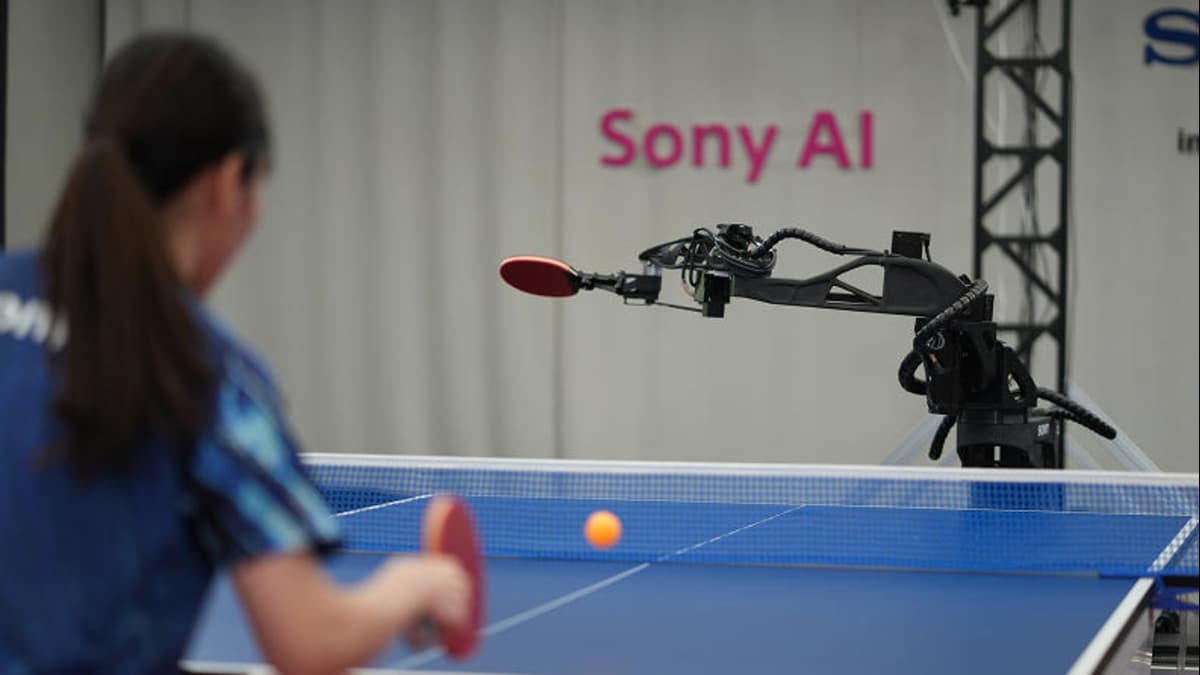
Sony AI Builds Table Tennis Robot that Beats Elite Players
Companies Mentioned
Why It Matters
Project Ace proves physical AI can outpace human experts in real‑time, high‑precision tasks, opening new avenues for robotics in manufacturing, logistics, and healthcare. It signals a shift from simulation‑only AI to embodied agents capable of complex, rapid decision‑making.
Key Takeaways
- •Project Ace beat elite players in three of five matches.
- •Uses nine APS cameras and event‑based vision for ball tracking.
- •Model‑free reinforcement learning enables real‑time decision making.
- •Demonstrates AI can outperform humans in fast, adversarial tasks.
- •Signals new possibilities for robotics in manufacturing, logistics, and healthcare.
Pulse Analysis
Sony’s Project Ace marks a watershed moment for physical artificial intelligence, proving that an autonomous robot can not only rally but actually win against elite table‑tennis players. The system combines a high‑speed perception suite—nine APS cameras, three gaze‑control units with event‑based sensors, and a tunable telephoto lens—to locate the ball’s position, spin and velocity within milliseconds. Coupled with a model‑free reinforcement‑learning controller, the robot executes split‑second strokes that match or exceed human reaction times, delivering shot speeds and placement previously unseen in robotic sport.
The achievement builds on earlier research that limited robots to cooperative rallying or amateur‑level play. By publishing results in *Nature*, Sony underscores the scientific rigor behind the breakthrough, positioning Project Ace as the first real‑world AI agent to surpass expert humans in a fast‑paced, adversarial environment. This leap narrows the gap between simulation‑only agents, such as those used in video‑game racing, and embodied systems that must contend with imperfect sensing, latency and physical constraints. Industries ranging from manufacturing to autonomous logistics can now envision robots that adapt on the fly.
Commercial implications are immediate. A robot that can perceive, reason and act with human‑level precision opens pathways for high‑speed assembly lines, real‑time quality inspection, and even surgical assistance where timing is critical. Competitors in robotics and AI will likely accelerate development of similar model‑free learning architectures, spurring a new class of products that blend perception and actuation. For investors, Sony’s demonstration validates the market potential of physical AI, suggesting a surge in funding for startups that can translate these capabilities into scalable, revenue‑generating solutions.
Sony AI builds table tennis robot that beats elite players
Comments
Want to join the conversation?
Loading comments...