Sound Waves Give Neuromorphic Chips a Brain-Simulating Edge

Why It Matters
The breakthrough could shrink neuromorphic hardware while slashing energy use, accelerating AI workloads that require massive parallelism such as pattern recognition and sensory processing. It also opens a route to embed neuromodulatory flexibility without the complexity of large neural networks.
Key Takeaways
- •Acoustic synapse uses phi‑bits for parallel, low‑power computation.
- •Device achieved 96.7% accuracy on iris classification with 39 parameters.
- •Power consumption is about one‑tenth of state‑of‑the‑art neuromorphic chips.
- •Adding rods enables neuromodulator‑like adaptability in a single hardware unit.
- •Topological acoustic design reduces wiring complexity versus traditional electronic neurons.
Pulse Analysis
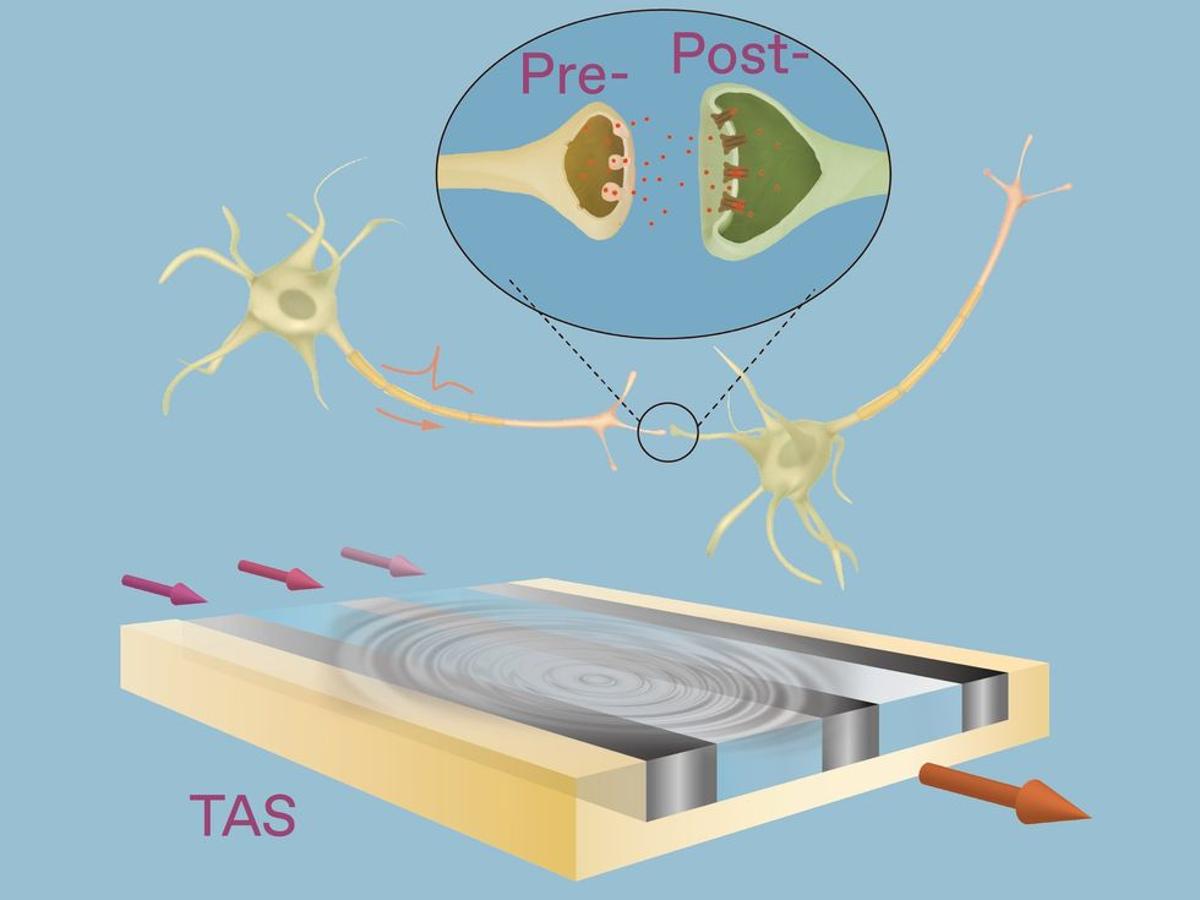
Neuromorphic computing promises brain‑like efficiency by merging memory and processing, yet today’s silicon‑based chips still fall short of the dense connectivity found in biological neurons. A human Purkinje cell can host up to 100,000 synapses, while most artificial neurons are limited to a single static junction, inflating wiring overhead and power draw. Researchers have turned to acoustic physics as a shortcut, exploiting the fact that sound waves can carry phase information in a continuous medium. By treating the phase of an ultrasonic wave as a multi‑valued ‘phi‑bit,’ they create a compact substrate that mimics the parallelism of a neural mesh without the transistor count.
The prototype described by Xiaodong Yan’s team consists of three epoxy‑bonded aluminum rods, each about 60 cm long, with honey‑filled interfaces that guide ultrasonic transducers. When a data stream—such as images of iris flowers—is encoded into the phase of the transmitted sound, the interacting waves produce a topological acoustic synapse capable of synaptic plasticity. In benchmark tests the device reached 96.7 % classification accuracy using only 39 adjustable parameters and did so 20 % faster than a comparable multilayer perceptron. Energy measurements indicate the acoustic system consumes roughly one‑tenth the power of state‑of‑the‑art electronic neuromorphic processors.
Beyond raw efficiency, the acoustic approach introduces a new form of hardware‑level neuromodulation. Adding an extra rod allows the system to emulate the influence of multiple neurotransmitters, letting a single compact network reconfigure its learning dynamics on the fly. For industry, this translates into smaller, adaptable AI accelerators that could be embedded in edge devices, autonomous sensors, or data‑center racks where power budgets are tight. As the field matures, hybrid architectures that combine wave‑based preprocessing with conventional digital cores may become a cornerstone of next‑generation low‑energy AI.
Sound Waves Give Neuromorphic Chips a Brain-Simulating Edge
Comments
Want to join the conversation?
Loading comments...