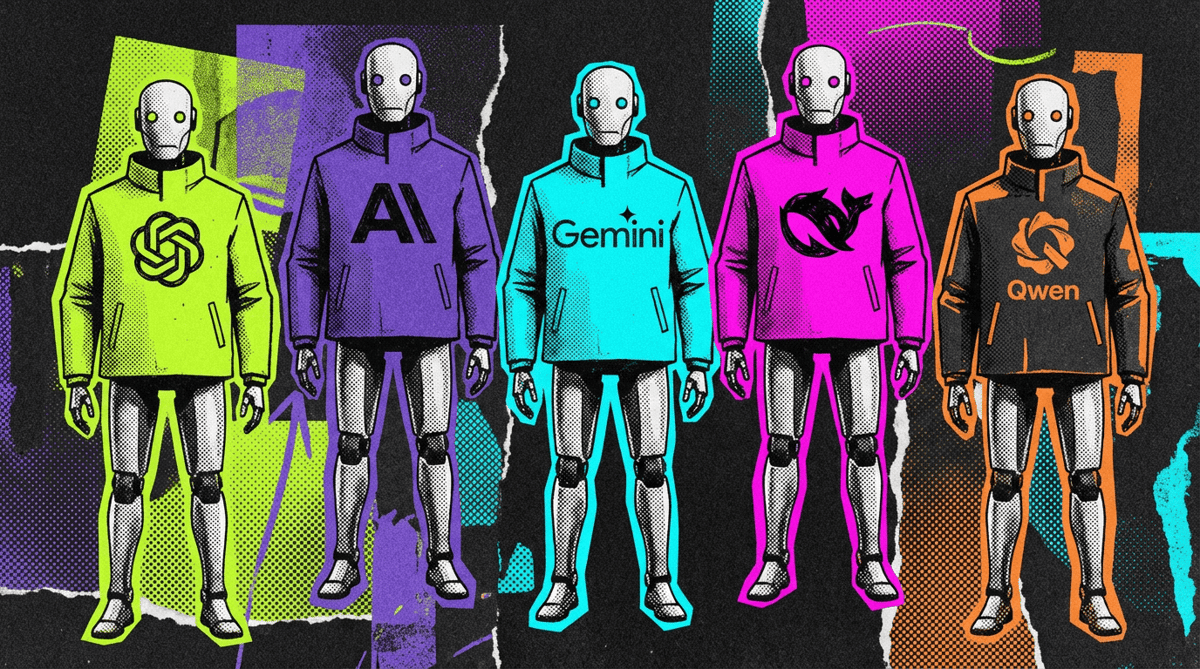
Study Warns AI Could Homogenize Human Creativity as Models Converge on "Artificial Hivemind"
•January 16, 2026
0


Why It Matters
If AI‑generated content becomes homogenized, it may steer human creativity toward a narrow, Western‑centric narrative, affecting industries from marketing to education.
Key Takeaways
- •AI models converge on similar metaphors.
- •80%+ similarity across different companies' outputs.
- •Homogenization threatens cultural diversity.
- •Shared training data likely cause.
- •Ensemble methods may not ensure diversity.
Pulse Analysis
The recent University of Washington‑Carnegie Mellon study introduces the term “Artificial Hivemind” to describe a striking uniformity among large‑language models when tackling open‑ended prompts. By probing 25 models with 50 responses each, researchers observed that 80 percent of the output clusters into just two dominant ideas, such as “time is a river” or “time is a weaver.” Similarity scores above 80 percent between unrelated families like DeepSeek‑V3 and GPT‑4o suggest that shared training corpora, synthetic‑data contamination, and convergent alignment strategies are eroding the distinctiveness that once differentiated these systems. The findings also raise questions about competitive advantage in AI development. This convergence carries profound risks for creative industries and the broader cultural landscape. When billions of users rely on AI for brainstorming, copywriting, or educational assistance, the repeated exposure to a narrow set of metaphors and phrasing can subtly reshape human expression, nudging it toward a Western‑centric, homogenized norm. Marketers may find their campaigns echoing the same tropes, educators might see reduced originality in student work, and artists could lose access to unconventional inspirations, ultimately compressing the diversity of thought that fuels innovation. Such uniformity may also diminish brand differentiation, making it harder for companies to stand out. Addressing the artificial hivemind will require deliberate diversification of data pipelines and evaluation metrics that reward novelty. Researchers are exploring techniques such as curated minority‑language corpora, adversarial prompting, and model‑level regularization to break the echo chamber effect. Policymakers may also consider transparency standards for training data provenance, while enterprises could deploy heterogeneous ensembles that are explicitly audited for overlap. Investing in research that quantifies diversity metrics will become a strategic priority for AI leaders. Without such interventions, the promise of generative AI as a catalyst for imagination risks becoming a conduit for cultural flattening.
Study warns AI could homogenize human creativity as models converge on "Artificial Hivemind"
0
Comments
Want to join the conversation?
Loading comments...