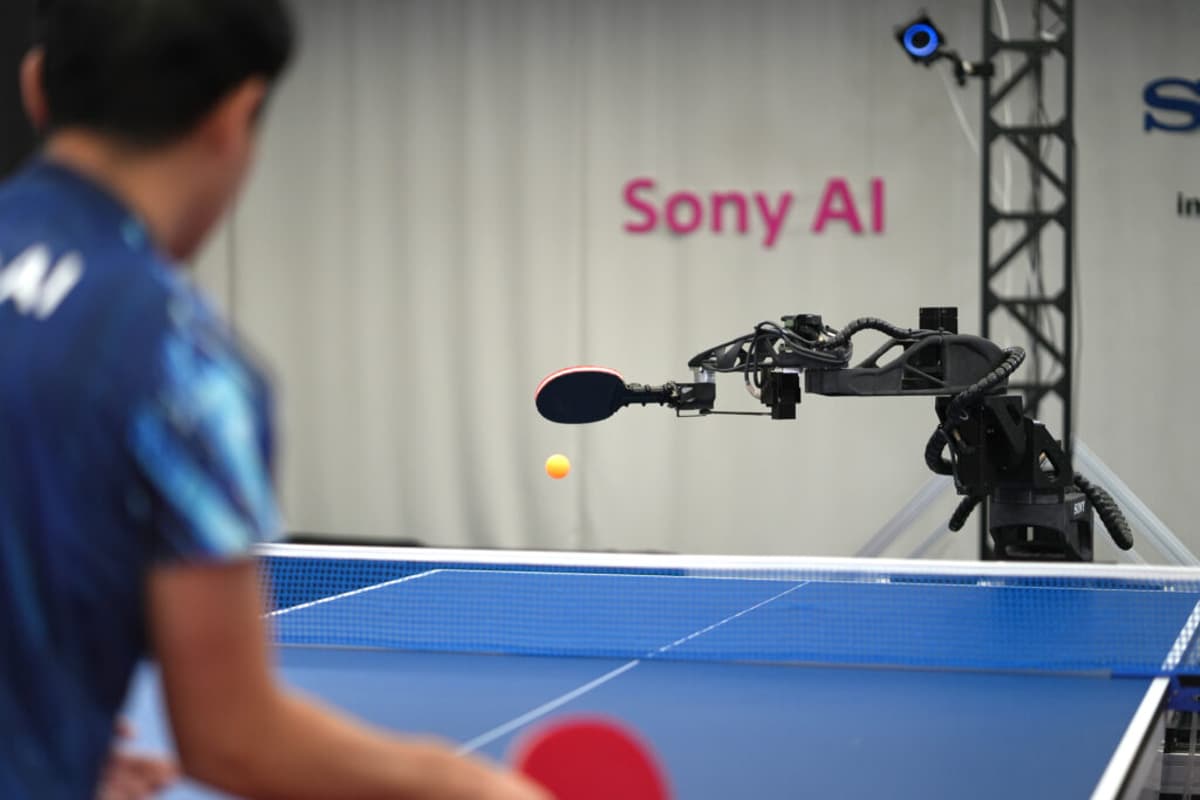
Table Tennis Robot Defeats some of World’s Best Players – Why This Has Major Implications for Robotics
Why It Matters
Ace shows that AI can reliably operate in unstructured, high‑speed environments, a breakthrough for industrial automation and collaborative robotics. Its success signals a shift toward physically embodied intelligence that can adapt to real‑world uncertainty.
Key Takeaways
- •Sony AI's Ace won 3 of 5 matches vs elite players
- •Event‑based vision sensors and high‑speed cameras give Ace sub‑0.5‑second reaction
- •Deep reinforcement learning in simulation enables Ace's real‑time trajectory planning
- •Six‑degree‑of‑freedom arm delivers shots up to 20 m/s, handling 9,000 rpm spin
- •Shows sim‑to‑real transfer, paving way for robots in unstructured environments
Pulse Analysis
The headline‑grabbing victories of Sony AI’s Ace robot mark a turning point for artificial intelligence in the physical world. While AI has long dominated board games and video‑game arenas, table tennis introduces a blend of speed, spin, and human intuition that tests perception and motor control in real time. By beating seasoned professionals on a regulation table, Ace demonstrates that machine learning can move beyond deterministic simulations into environments where milliseconds and millimetres matter.
Ace’s performance rests on three technical pillars. First, event‑based vision sensors capture light changes instead of full frames, allowing the robot to follow a 20 m/s ball without blur, complemented by nine high‑speed cameras that map opponent movements. Second, a deep reinforcement‑learning framework, honed through millions of simulated rallies, generates motion commands every few tens of milliseconds, continuously updating trajectories to avoid collisions. Finally, a six‑joint, high‑speed arm translates these commands into precise strikes, handling spin rates approaching 9,000 rpm. This seamless integration narrows the notorious sim‑to‑real gap, proving that policies learned in virtual environments can survive the noise and variability of the real world.
Beyond sport, Ace’s capabilities herald a new era for robotics in manufacturing, healthcare, and construction. The ability to predict, adapt, and react within half a second opens doors for collaborative robots that can safely share workspaces with humans, handling irregular objects and unexpected motions. As industries push for flexible automation, the technologies showcased by Ace—event‑based sensing, rapid reinforcement‑learning inference, and high‑bandwidth actuation—provide a blueprint for building machines that are not just intelligent, but physically adept in unstructured settings. This shift could accelerate the deployment of autonomous systems across sectors that previously relied on rigid, pre‑programmed robots.
Table tennis robot defeats some of world’s best players – why this has major implications for robotics
Comments
Want to join the conversation?
Loading comments...