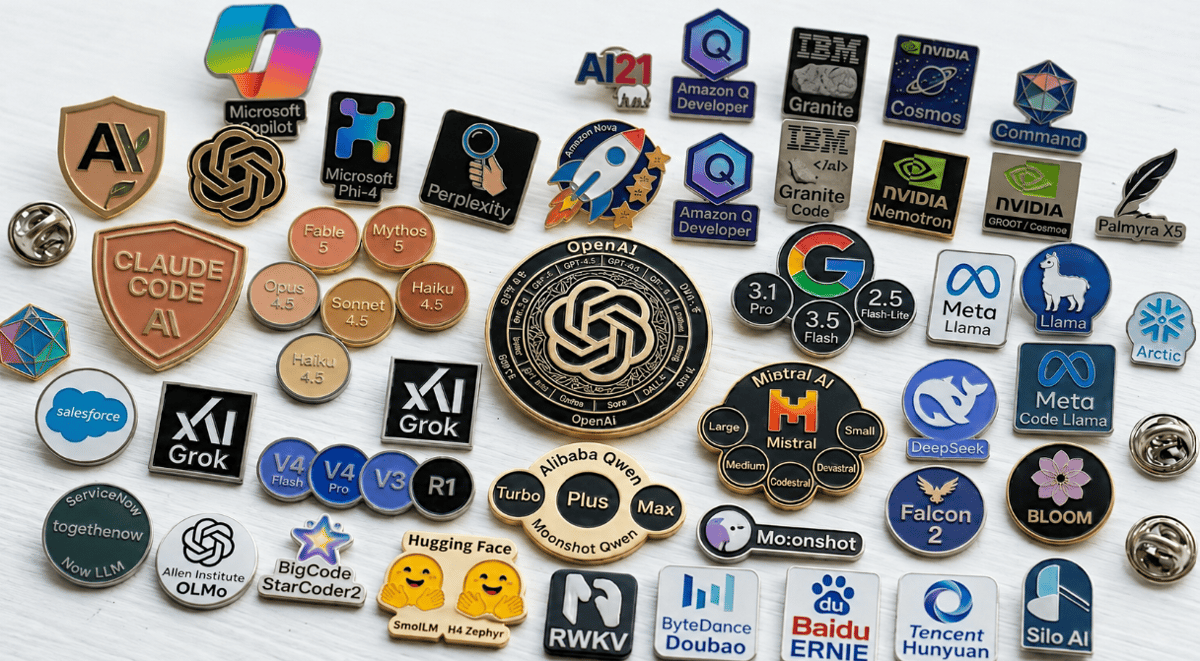
The Complete AI Model Guide 2026: LLMs, Real Pricing, and the Five Competing Arenas Reshaping the Market
Why It Matters
Understanding the five arenas and real‑world pricing is critical for enterprises to avoid costly mis‑steps, ensure regulatory compliance, and align AI spend with strategic workflow ownership.
Key Takeaways
- •Five AI arenas dictate buying decisions beyond benchmark scores
- •OpenAI GPT‑5.5 costs $5 input and $30 output per million tokens
- •Anthropic’s Claude Fable 5 suspended globally after U.S. export‑control order
- •Google Gemini’s Flash‑Lite tier priced at $0.10/$0.40 per million tokens
- •Meta Llama can be self‑hosted free but requires $8‑16 per GPU‑hour
Pulse Analysis
The AI landscape’s shift from a single benchmark‑driven hierarchy to five distinct arenas reshapes how enterprises source intelligence. Frontier intelligence focuses on raw capability, but most businesses now care about workflow ownership—whether an AI lives inside Word, Excel, or Salesforce—because that determines user adoption without additional training. Simultaneously, search and discovery platforms compete for the web traffic that fuels SEO‑driven revenue, while deployment‑control solutions appeal to firms with strict data‑sovereignty mandates. Finally, regional sovereignty arenas force vendors to navigate local regulations, making jurisdiction as important as model performance.
Pricing disparities further complicate selection. OpenAI’s flagship GPT‑5.5 commands $5 per million input tokens and $30 per million output tokens, positioning it as a premium but costly option for enterprises demanding multimodal features. Anthropic’s Claude Fable 5, despite leading software‑engineering benchmarks, is temporarily unavailable after a U.S. export‑control order, highlighting regulatory risk. Google Gemini undercuts competitors with a Flash‑Lite tier at $0.10 input and $0.40 output per million tokens, offering a budget‑friendly path for high‑volume applications. Meta’s Llama series can be self‑hosted at no API fee, yet the required H100‑class GPU infrastructure runs $8‑16 per hour, turning cost savings into capital‑intensive investments for data‑sensitive organizations.
Regulatory and sovereignty considerations now sit at the forefront of AI procurement. The regional arena groups models by jurisdiction—Mistral in Europe, Qwen in China, Falcon in the Middle East—reflecting data‑residency laws and government procurement rules that can override pure performance metrics. Companies must therefore map their operational geography to the appropriate arena, ensuring compliance while leveraging the most suitable model. Aligning AI strategy with these five arenas enables firms to balance cost, capability, and compliance, turning the fragmented market into a structured decision framework that safeguards both budget and brand reputation.
The Complete AI Model Guide 2026: LLMs, Real Pricing, and the Five Competing Arenas Reshaping the Market
Comments
Want to join the conversation?
Loading comments...