"The Entire Stack Is Being Changed" - Nvidia CEO Jensen Huang Looks Ahead to the Next Generation of AI
•January 5, 2026
0
Companies Mentioned

Why It Matters
Nvidia’s hardware roadmap accelerates the migration to GPU‑driven AI, reshaping enterprise compute economics and setting new performance benchmarks for the industry.
Key Takeaways
- •Nvidia unveils Vera Rubin chips with CPU and dual GPUs
- •AI workloads moving from CPUs to GPU‑accelerated stacks
- •Physical AI aims to model real‑world common sense
- •DGX platform fuels breakthroughs in healthcare, weather, autonomous vehicles
- •Nvidia targets single unified AI platform for developers
Pulse Analysis
The computing landscape is entering its next evolutionary cycle, echoing the industry resets of the past decade. While earlier shifts moved from mainframes to personal computers and then to cloud services, today’s transformation is driven by AI workloads that demand massive parallelism. Nvidia, already the de‑facto leader in GPU acceleration, is positioning itself at the epicenter of this change by championing a stack where GPUs, not CPUs, become the default execution engine for both training and inference. This realignment promises lower latency, higher throughput, and new business models for cloud providers and enterprises alike.
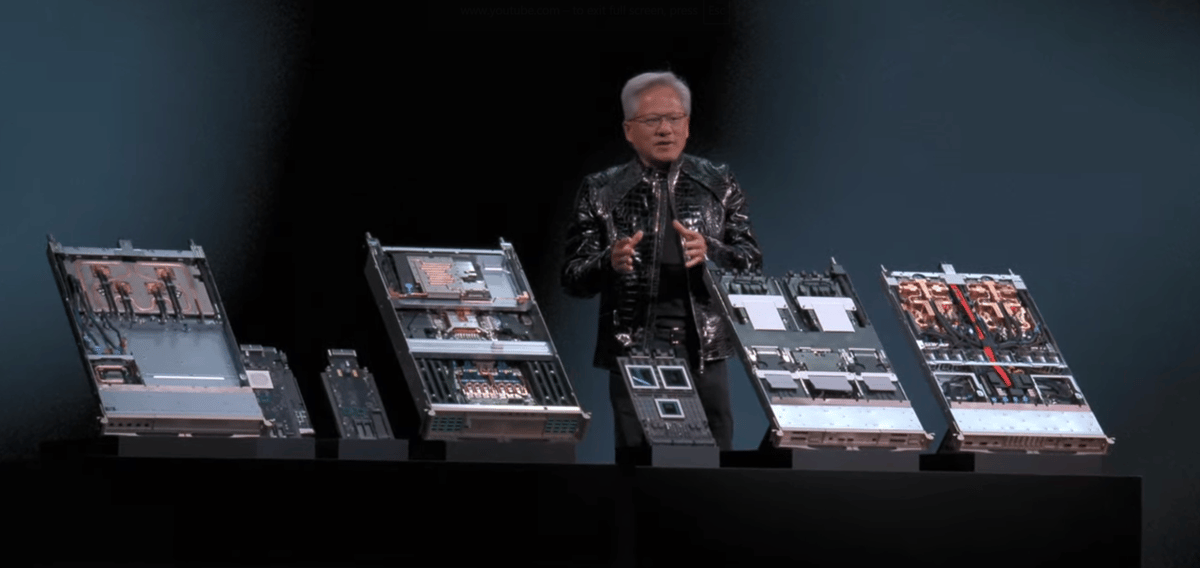
Central to Nvidia’s strategy is the Vera Rubin chip family, a hybrid silicon solution that marries a custom Vera CPU with two high‑performance Rubin GPUs on a single package containing over 17,000 components. By co‑locating compute and memory resources, the design reduces data movement overhead and enables hyper‑scaled AI racks—dubbed "AI Factories"—that can sustain petaflop‑scale workloads. Competitors such as AMD and Intel are racing to close the gap, but Nvidia’s integrated approach, combined with its mature software ecosystem, gives it a distinct advantage in delivering end‑to‑end performance for demanding applications like autonomous driving and large‑scale scientific simulations.
Beyond raw horsepower, Huang’s focus on "physical AI" signals a strategic pivot toward models that understand the physical world through synthetic data. Initiatives like Cosmos, Gr00T and Alpamayo aim to imbue AI with common‑sense reasoning, a capability critical for robotics, augmented reality and next‑generation digital twins. By coupling these models with the DGX platform and the forthcoming Vera Rubin hardware, Nvidia is building a cohesive stack that lowers the barrier for developers to create sophisticated, real‑world AI solutions. This holistic vision not only reinforces Nvidia’s market dominance but also accelerates the broader adoption of AI across industries, reshaping how businesses innovate and compete.
"The entire stack is being changed" - Nvidia CEO Jensen Huang looks ahead to the next generation of AI
0
Comments
Want to join the conversation?
Loading comments...