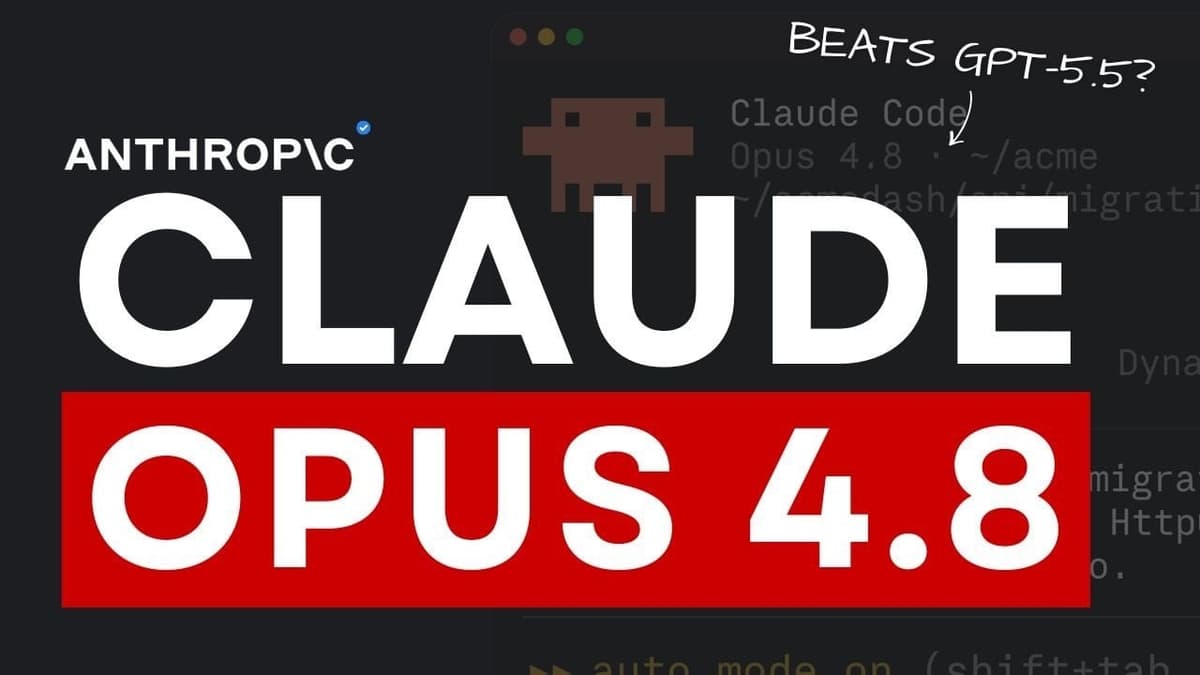
The Hidden Strategy Behind Anthropic’s New Claude Opus 4.8 Release
Key Takeaways
- •Opus 4.8 boosts code error detection fourfold
- •Dynamic workflows automate complex tasks via verifiable subtasks
- •Fast mode costs $10‑$50 per million tokens, speeds responses
- •Effort control lets users balance depth versus speed
- •Mythos delay highlights Anthropic’s cautious roadmap against OpenAI
Pulse Analysis
Anthropic’s Opus 4.8 arrives as a modest evolution rather than a disruptive leap. The model claims a four‑fold improvement in self‑diagnosing code errors, sharper logical reasoning, and more reliable multi‑step task handling. Pricing stays at $5 per million input tokens and $25 per million output tokens, preserving cost parity for existing customers. By positioning the upgrade as an “evolutionary” release, Anthropic signals a focus on steady performance gains while buying time for its long‑awaited Mythos system, which remains in cybersecurity testing.
Two new knobs—effort control and Fast Mode—give users granular trade‑offs between response depth and latency. Effort control is free across all plans, letting developers request concise summaries or exhaustive analyses on demand. Fast Mode, priced at $10 per million input and $50 per million output tokens, promises near‑real‑time replies for time‑critical workloads such as security alerts or rapid code migrations. The standout addition, dynamic workflows, breaks sprawling operations into verifiable subtasks and routes them through multiple agents, a capability that could streamline large‑scale audits, bug fixes, and cross‑platform code refactors once it moves out of research preview.
Anthropic’s incremental push must be measured against OpenAI’s rapid rollout of GPT‑5.5 and the looming GPT‑5.6, which continue to dominate enterprise budgets. By holding back Mythos, the company bets on a differentiated, security‑hardened offering rather than a pure performance race. If dynamic workflows and the premium fast tier gain traction, Anthropic could carve a niche in regulated sectors that value auditability and speed. However, without a clear breakthrough, the firm risks ceding market share to rivals that combine raw capability with aggressive pricing. The next quarter will reveal whether Opus 4.8’s refinements translate into tangible revenue growth.
The Hidden Strategy Behind Anthropic’s New Claude Opus 4.8 Release
Comments
Want to join the conversation?