The Invisible System: How AI Is Redefining Game Testing and Balancing
Why It Matters
AI‑driven testing and balancing directly boost player engagement and revenue while reducing costly post‑launch fixes, making it essential for competitive live‑service games.
Key Takeaways
- •AI agents run thousands of simulations simultaneously for stress testing.
- •Real‑time analytics detect resource hoarding, meta dominance, and progression issues.
- •Continuous balancing ties gameplay tweaks directly to retention and revenue.
- •Predictive models let developers pre‑test content before live release.
- •Over‑optimisation risks making gameplay feel engineered, reducing authenticity.
Pulse Analysis
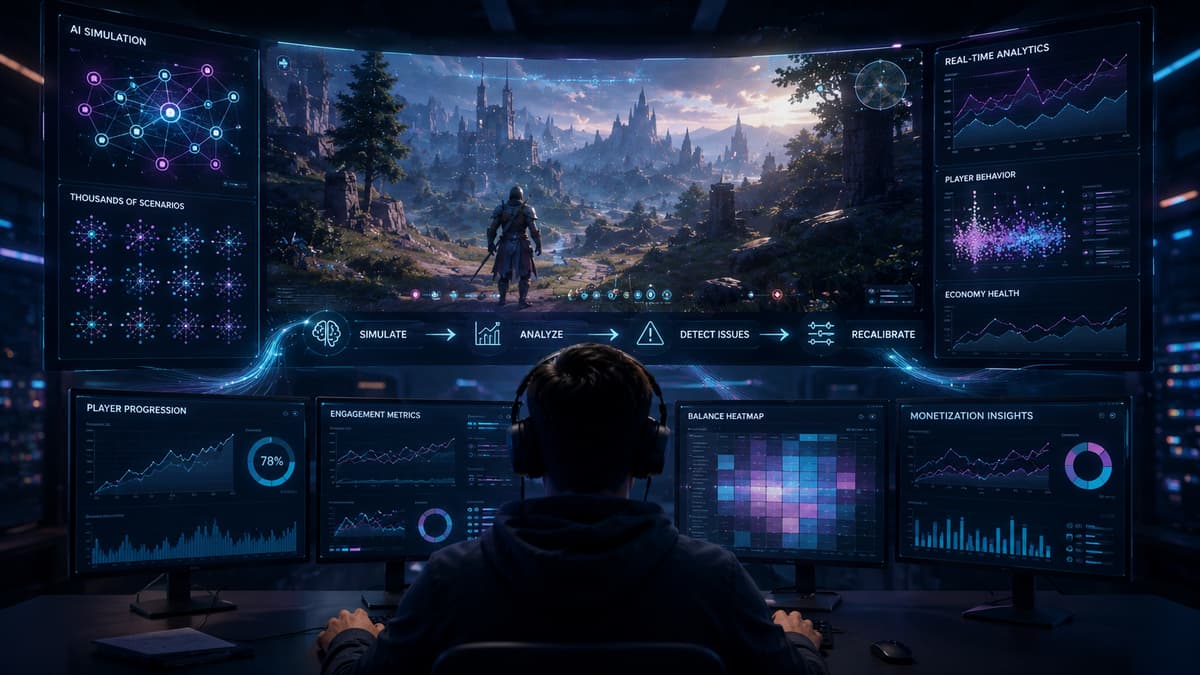
The gaming industry has moved beyond traditional quality‑assurance pipelines, replacing small QA crews with autonomous AI agents that can execute thousands of gameplay loops in parallel. These simulations stress‑test mechanics, hunt for exploits, and map edge‑case scenarios that human testers would never encounter. By modelling diverse player archetypes—from casual spenders to hardcore optimisers—developers gain a holistic view of how systems interact under extreme conditions. This scalability is especially vital for live‑service titles, where a single imbalance can cascade through economies, narratives, and monetisation layers, jeopardising launch stability.
Once a game ships, balancing is no longer a periodic patch but a continuous, data‑driven process. AI ingests live telemetry—session length, win rates, resource flows—and automatically nudges difficulty curves, reward frequencies, and progression pacing to keep churn in check. The feedback loop shortens the time between player behaviour and design response, turning balancing into a revenue lever that aligns engagement spikes with in‑game offers. Predictive modelling further allows studios to simulate new characters, events, or pricing structures before they go live, reducing the risk of costly post‑launch rollbacks.
Despite measurable gains, the rise of algorithmic tuning raises a subtle design dilemma: how to preserve the sense of discovery that makes games compelling. Over‑engineered experiences can feel scripted, eroding player agency and long‑term loyalty. Successful studios therefore blend AI recommendations with human intuition, using automated alerts as a guide rather than a dictate. As AI continues to mature, its role will expand from testing to co‑creation, enabling adaptive worlds that evolve with each player while safeguarding the authenticity that defines memorable gameplay.
The invisible system: How AI is redefining game testing and balancing
Comments
Want to join the conversation?
Loading comments...