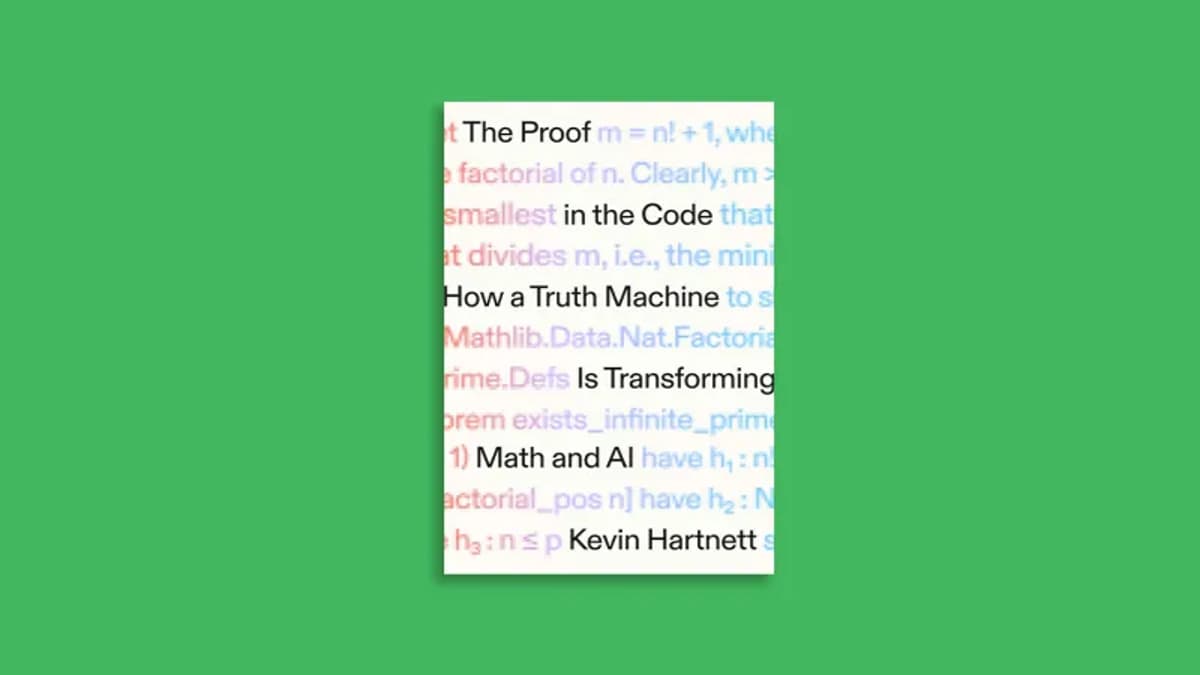
The Proof in the Code Traces Efforts to Digitally Verify Mathematical Truths

Why It Matters
Lean’s maturation bridges formal verification and AI‑driven theorem proving, promising more reliable software and faster mathematical discovery. Its adoption signals a shift toward provable AI outputs, reducing hallucinations and accelerating research.
Key Takeaways
- •AlphaProof scored 28 points, reaching silver‑medal cutoff at IMO 2024
- •Lean, launched 2013, now powers AI math solvers and theorem verification
- •Mathematicians built extensive Lean libraries, enabling complex concepts like perfectoid spaces
- •Proof assistants require explicit proofs of trivial statements, exposing hidden logical gaps
- •By 2025, tens of thousands use Lean across academia and tech
Pulse Analysis
The Lean proof‑assistant, created by Leo de Moura in 2013, began as a software‑verification tool but quickly attracted mathematicians seeking a formal language for proofs. Its core idea—treating mathematical arguments like executable code—allowed users to catch logical errors that would otherwise go unnoticed. Over the past decade, a community of researchers and educators expanded Lean’s libraries, translating sophisticated theories such as perfectoid spaces into machine‑readable form. This collaborative effort turned Lean into a shared infrastructure for both pure mathematics and computer science.
AI researchers seized on Lean’s growing corpus to train models capable of tackling advanced mathematical problems. DeepMind’s AlphaProof, which entered the 2024 International Mathematical Olympiad as an unofficial participant, leveraged Lean’s libraries to achieve a silver‑medal level score of 28 out of 42. By grounding its reasoning in formally verified steps, AlphaProof demonstrated how proof assistants can mitigate the hallucinations that plague large language models, offering a path toward AI systems that produce provably correct results rather than plausible‑but‑unverified answers.
The convergence of formal verification and AI has broader implications beyond academia. Industries that rely on critical software—finance, aerospace, healthcare—stand to benefit from a “truth machine” that guarantees logical consistency, reducing costly bugs and security vulnerabilities. As Lean’s user base swells to tens of thousands across academia and technology, its role as a universal language for rigorous reasoning is poised to reshape how we develop software, validate scientific claims, and accelerate innovation in a world increasingly dependent on trustworthy AI.
The Proof in the Code traces efforts to digitally verify mathematical truths
Comments
Want to join the conversation?
Loading comments...