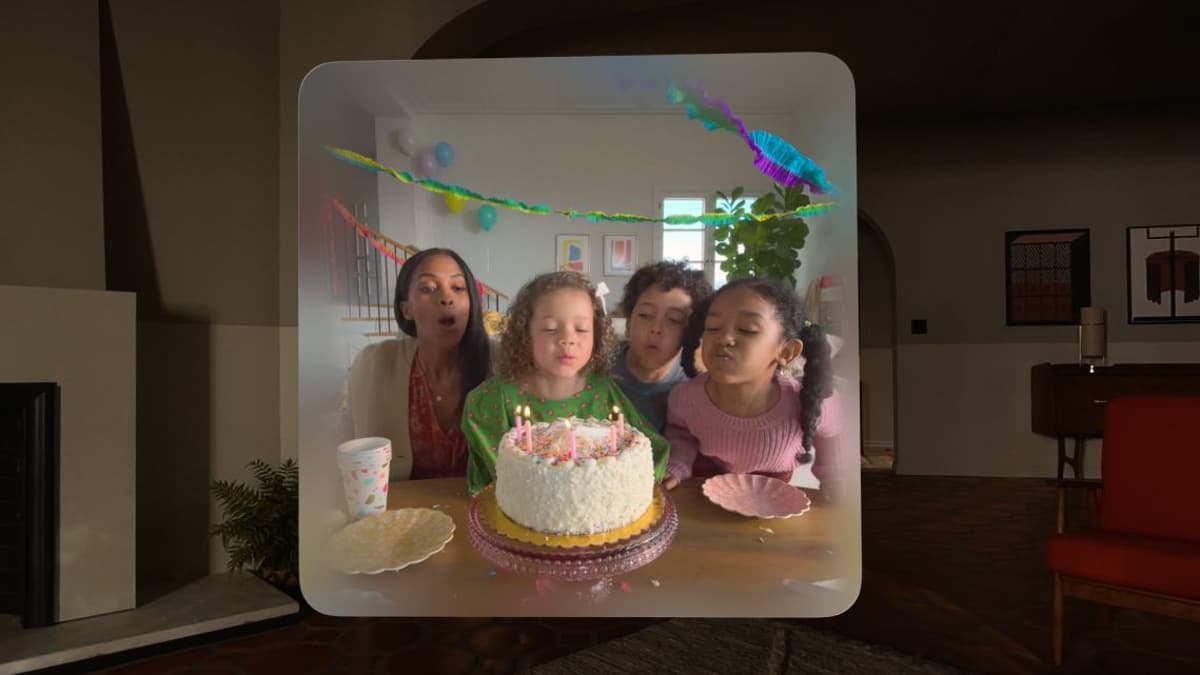
The Star Trek Holodeck Just Got Closer – Apple’s New AI Tool Generates 3D Scenes From Your Photos in Under a Second for VR Memories
•December 18, 2025
0
Companies Mentioned


Why It Matters
SHARP’s rapid 2D‑to‑3D conversion could redefine personal media consumption and strengthen Apple’s position in the emerging AR/VR market.
Key Takeaways
- •SHARP converts 2D photos to 3D in <1 second
- •Trained on 8M synthetic and 2.65M real images
- •Open‑source code released on GitHub for developers
- •Potential integration with Vision Pro for immersive memories
- •Depth accuracy limited for distant viewpoints
Pulse Analysis
Apple’s recent research paper introduces SHARP, a neural‑network‑driven system that transforms a single flat photograph into a navigable three‑dimensional scene in under a second. The capability builds on the company’s earlier spatial Lock Screen experiments and aligns with the broader push toward immersive media across consumer electronics. By generating depth maps and volumetric representations on‑device, SHARP promises to blur the line between traditional photo galleries and virtual reality experiences, offering users a new way to relive memories without dedicated 3D capture hardware.
The model was trained on roughly eight million synthetic images and 2.65 million licensed photographs, allowing it to infer realistic scale and occlusion cues from a single viewpoint. SHARP encodes the scene as a set of 3‑D Gaussian primitives, which can be rasterized in real time on standard GPUs, delivering photorealistic results with minimal warping—a common flaw in legacy depth‑from‑single‑image methods. Because the inference pass completes in less than one second, the pipeline is suitable for interactive applications, from mobile photo viewers to head‑mounted displays.
While SHARP remains a research prototype, its open‑source release signals Apple’s intent to embed advanced 3‑D synthesis into future software stacks, potentially enhancing the Vision Pro ecosystem and third‑party AR/VR apps. Competitors such as Meta and Google have pursued similar depth‑generation pipelines, but Apple’s tight integration with its hardware and developer tools could give it a speed and quality edge. If the technology matures into a consumer feature, it may redefine how users store, share, and experience visual content, driving new revenue streams for content‑creation platforms and hardware sales.
The Star Trek Holodeck just got closer – Apple’s new AI tool generates 3D scenes from your photos in under a second for VR memories
0
Comments
Want to join the conversation?
Loading comments...