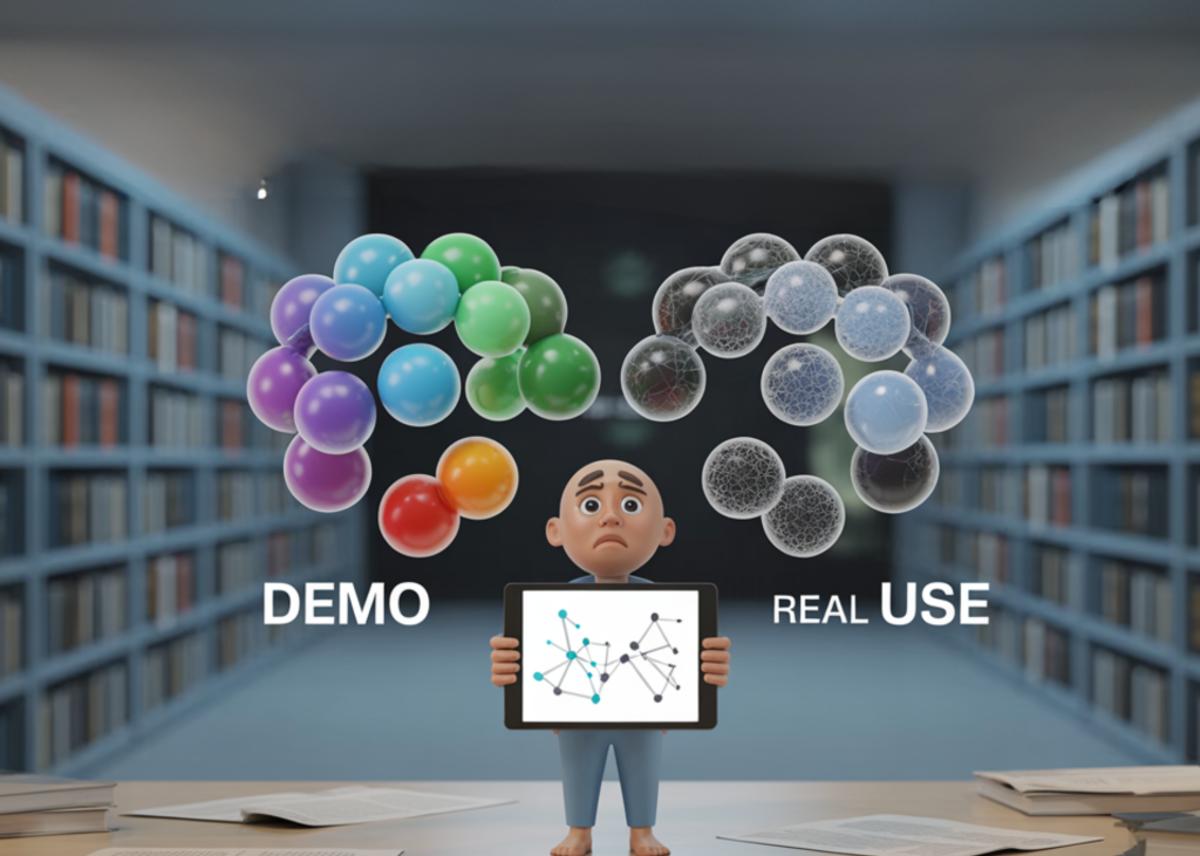
This AI Paper From Stanford and Harvard Explains Why Most ‘Agentic AI’ Systems Feel Impressive in Demos and Then Completely Fall Apart in Real Use
•December 24, 2025
0
Why It Matters
Understanding these adaptation pathways lets companies engineer more reliable, scalable AI assistants, reducing costly failures when moving from demos to production environments.
Key Takeaways
- •Four adaptation paradigms combine agent/tool target with supervision signal
- •A1 learns from verifiable tool outcomes using PPO
- •A2 relies on final output signals, needs tool supervision
- •T1 trains reusable tools while keeping agent frozen
- •T2 optimizes tools under a fixed, powerful agent
Pulse Analysis
Agentic AI—large‑language‑model cores linked to tools, memory, and external environments—has moved from laboratory demos to real‑world tasks such as scientific discovery and software engineering. Yet practitioners repeatedly encounter brittle tool usage, short‑term planning failures, and poor generalization when scaling beyond controlled benchmarks. The recent “Adaptation of Agentic AI” paper, authored by researchers from Stanford, Harvard, UC Berkeley and Caltech, offers a unified mathematical lens that categorizes how these systems can be tuned. By formalizing the interaction between planning, tool‑use, and memory modules, the framework clarifies why many prototypes collapse under production workloads.
Central to the framework are four adaptation paradigms, derived from two binary choices: whether to adapt the agent itself or the attached tools, and whether the learning signal comes from verifiable tool execution or from the final agent output. A1 approaches, exemplified by Toolformer and DeepRetrieval, train agents directly on tool‑level feedback using supervised imitation or KL‑regularized PPO. A2 methods must supplement sparse final‑answer rewards with explicit tool‑call supervision to prevent agents from ignoring external resources. Conversely, T1 isolates tool training—creating reusable retrievers—while T2 refines tools against a frozen, high‑capacity generator, as seen in s3 and AgentFlow.
For enterprises, the taxonomy provides a roadmap to balance performance and engineering cost. Deployments that demand rapid iteration on search or simulation components can adopt T1/T2 pipelines, reusing trained tools across multiple agents without retraining the core model. High‑stakes applications, such as clinical decision support, may benefit from periodic A1 updates that guarantee tool‑level correctness, while still leveraging stable frozen agents for inference speed. As the field matures, hybrid systems that blend A‑type and T‑type adaptations are likely to dominate, offering both robustness and scalability for next‑generation AI assistants.
This AI Paper from Stanford and Harvard Explains Why Most ‘Agentic AI’ Systems Feel Impressive in Demos and then Completely Fall Apart in Real Use
0
Comments
Want to join the conversation?
Loading comments...