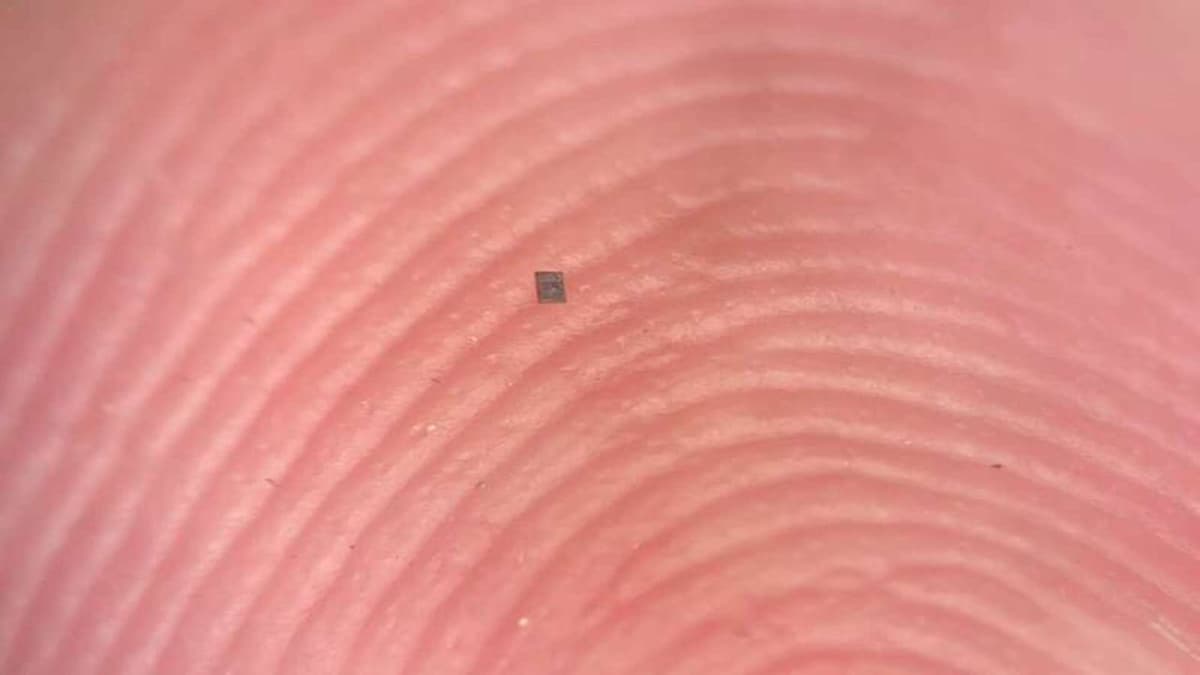
This Autonomous Solar-Powered Robot Costs 1p, Is Smaller than a Grain of Salt, and Communicates Through 'Wiggles of a Little Dance'
•January 4, 2026
0
Why It Matters
The breakthrough demonstrates that computation, power, and communication can coexist at microscopic scales, unlocking new possibilities for medical diagnostics and ultra‑miniature manufacturing.
Key Takeaways
- •Robots measure 200 µm × 300 µm × 50 µm.
- •Powered by 75 nanowatt solar panels.
- •Propulsion via ion-driven electrical fields.
- •Communicate using microscopic dance wiggles.
- •Operate autonomously for months, sensing temperature.
Pulse Analysis
Microrobotics has long been constrained by the physics of the micro‑world, where viscous drag overwhelms inertia and traditional actuators fail. By abandoning moving parts and instead exploiting ion‑induced electro‑osmotic flow, the Penn‑Michigan team sidestepped these limits, creating a propulsion method that works reliably in fluidic environments. This approach not only delivers consistent locomotion but also simplifies manufacturing, as the electrodes are etched directly onto the robot’s silicon substrate. The result is a durable, reusable device that can navigate complex micro‑fluidic landscapes without external magnetic or acoustic fields.
Energy scarcity at the sub‑millimeter scale is another hurdle the researchers overcame with a miniature solar panel that harvests ambient light to generate 75 nanowatts—enough to run a highly optimized instruction set and a suite of sensors. By condensing program logic into ultra‑efficient circuits, power consumption dropped by three orders of magnitude, enabling the robot to function for months on a single charge. Temperature sensing, encoded in precise thermal gradients, is transmitted via subtle oscillations of the robot’s swimming pattern, a communication scheme reminiscent of honeybee waggle dances but observable only through high‑resolution microscopy.
The implications extend far beyond academic curiosity. In medicine, fleets of such bots could infiltrate bodily fluids, monitor cellular environments, and relay real‑time data without invasive procedures. In manufacturing, they could assemble or inspect components inside sealed micro‑chambers where conventional tools cannot reach. As the platform scales to incorporate additional sensors, faster locomotion, and more sophisticated algorithms, it may become the foundational technology for a new generation of autonomous, intelligent microsystems that operate at the edge of what is physically possible.
This autonomous solar-powered robot costs 1p, is smaller than a grain of salt, and communicates through 'wiggles of a little dance'
0
Comments
Want to join the conversation?
Loading comments...