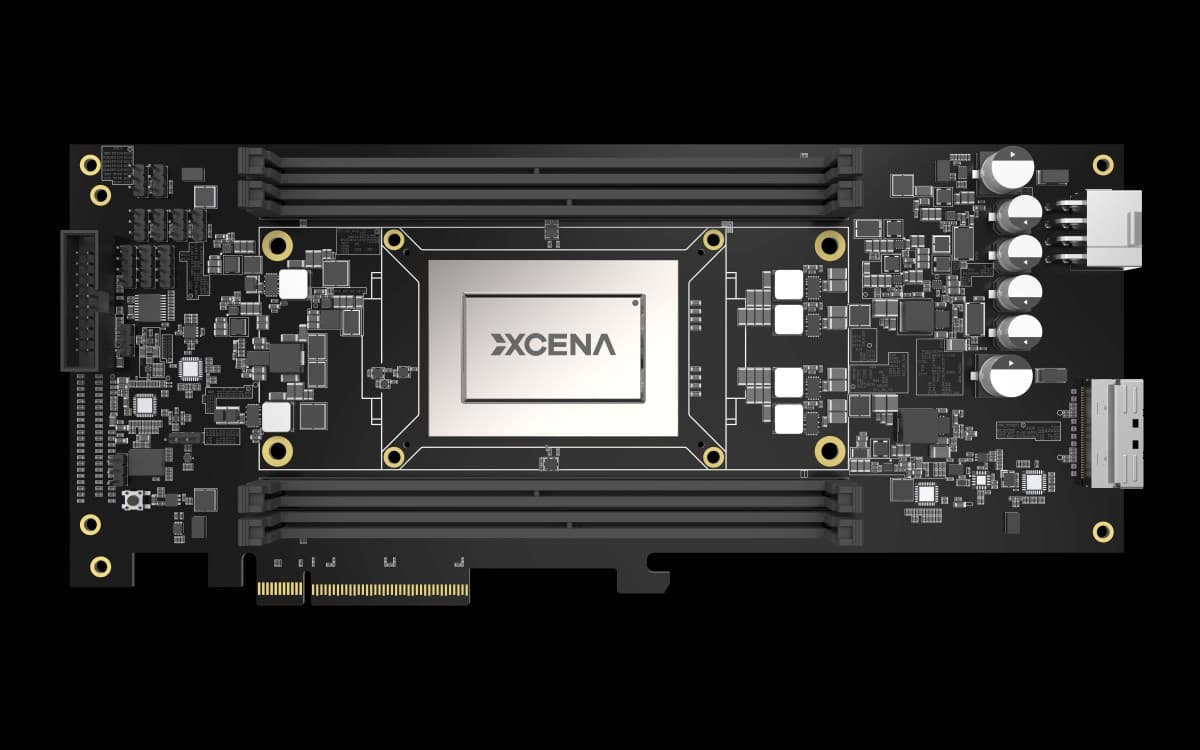
This Chip Startup Just Raised $135M on a Bet that AI’s Biggest Bottleneck Isn’t Compute — It’s Memory
Companies Mentioned
Why It Matters
Memory‑centric AI chips could slash hyperscaler infrastructure costs, reshaping the economics of large‑scale inference workloads. The funding validates investor belief that memory bottlenecks are the next frontier beyond raw compute power.
Key Takeaways
- •XCENA raised $135M Series B, valuing it at $570M.
- •MX1 chip processes data directly in DRAM via CXL link.
- •Claims one server can replace ten for AI inference workloads.
- •Targets hyperscalers; revenue expected from 2027 after Samsung production.
Pulse Analysis
The rapid expansion of generative AI has exposed a structural inefficiency: inference workloads still rely on a costly round‑trip between CPUs, GPUs and memory. While GPUs excel at matrix multiplication, the surrounding data orchestration—pre‑processing, caching, and context management—remains memory‑bound. Industry analysts now view memory bandwidth and latency as the next performance ceiling, prompting a wave of research into compute‑near‑memory architectures that can keep data where it lives rather than shuttling it across the system bus.
XCENA’s MX1 chip tackles this challenge by integrating thousands of RISC‑V cores directly onto a DRAM module and linking it to the host processor via Compute Express Link (CXL). This design enables the chip to perform routine inference tasks—such as KV‑cache handling and data staging—without leaving the memory stack, potentially collapsing the server count needed for a given workload by up to tenfold. Compared with rivals like Astera Labs and Marvell, XCENA’s vertical integration of cores, interconnect, and memory controller gives it a differentiated IP portfolio that could translate into lower power draw and higher throughput for hyperscale data centers.
The $135 million Series B, led by Atinum and IMM Investment, signals strong market confidence that memory‑centric solutions will become a cornerstone of AI infrastructure. With a $570 million valuation and a production timeline targeting Samsung’s 2026 fab line, XCENA is positioned to capture a share of the multi‑billion‑dollar spend by cloud giants on inference hardware. If the MX1 lives up to its promises, the resulting cost savings could reshape vendor negotiations, accelerate the adoption of CXL‑based memory fabrics, and spur further investment in specialized memory compute across the semiconductor ecosystem.
This chip startup just raised $135M on a bet that AI’s biggest bottleneck isn’t compute — it’s memory
Comments
Want to join the conversation?
Loading comments...