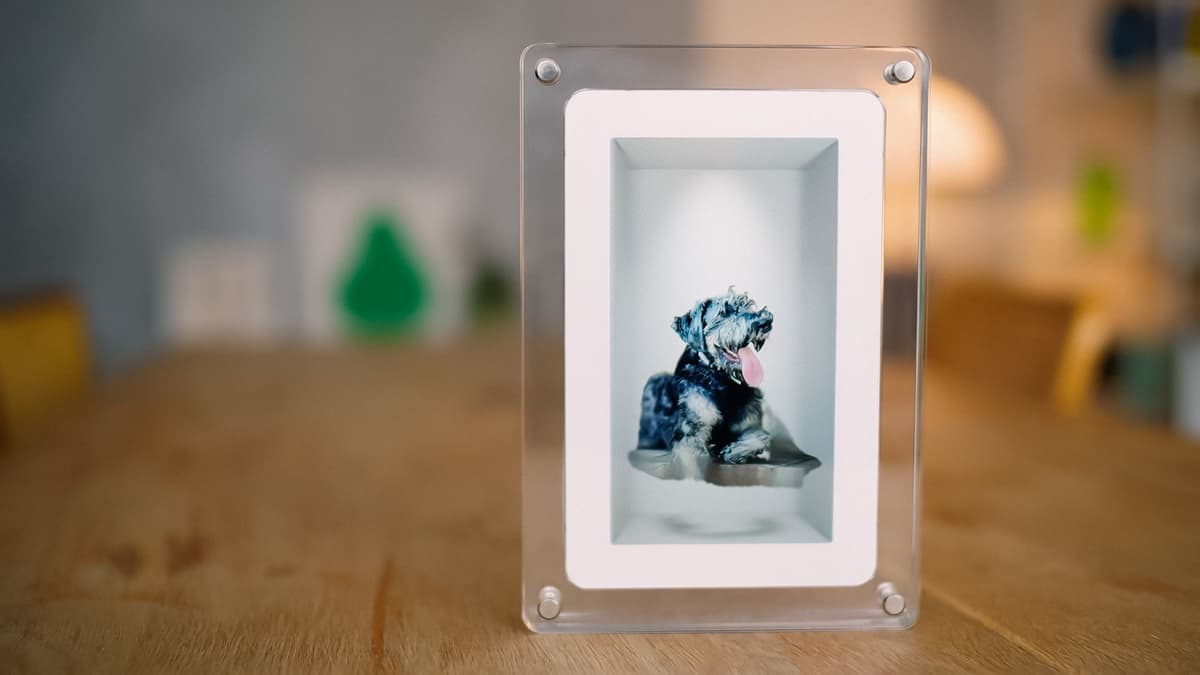
This Digital Picture Frame Wants to Bring People Closer to a Holographic Future
•March 11, 2026
0
Companies Mentioned

Why It Matters
Musubi lowers the barrier to consumer holography, potentially expanding a niche technology into everyday homes and prompting broader adoption of AI‑enhanced visual experiences.
Key Takeaways
- •Musubi uses AI to convert images into 3D holograms.
- •No Wi‑Fi, app, or subscription required.
- •Stores up to 1,000 images; videos limited to 30 seconds.
- •Kickstarter price $99, later $149; ships June 2026.
- •Expands consumer market for holographic displays.
Pulse Analysis
The holographic display market has long been dominated by high‑cost, enterprise‑grade panels used in museums, medical imaging, and advertising. Looking Glass entered that arena in 2019 with its Hololuminescence technology, which creates depth perception by projecting light through ultra‑thin glass. While the technology has proven compelling for large installations, its price points—ranging from $2,000 to $20,000—kept it out of reach for most consumers. Musubi represents a strategic pivot, leveraging the same optical principles in a compact, 7‑inch frame designed for the home.
Musubi’s differentiators lie in its simplicity and local processing model. Users edit photos and videos on a PC or Mac using free software, then transfer the holographic assets via USB‑C, eliminating the need for cloud services or ongoing fees. The frame can hold up to 1,000 static images and 30‑second video loops, offering a tactile, privacy‑first alternative to subscription‑based digital frames. Its 170‑degree viewing angle ensures multiple viewers can experience the 3D effect simultaneously, a feature rarely found in consumer‑grade devices. By pricing the Kickstarter launch at $99, Looking Glass signals confidence that mass adoption is feasible without sacrificing the depth and realism that set its technology apart.
The introduction of Musubi could accelerate competition in the consumer holography space, prompting rivals like Razer and Fraimic to refine their own AI‑enhanced displays. As AI models become more efficient, the cost of local processing will drop, making devices that once required cloud inference increasingly viable offline. If Musubi meets its shipping timeline and garners strong consumer interest, it may catalyze a new product category—holographic picture frames—that blends nostalgia with futuristic visual storytelling, reshaping how families preserve and share memories.
This Digital Picture Frame Wants to Bring People Closer to a Holographic Future
0
Comments
Want to join the conversation?
Loading comments...