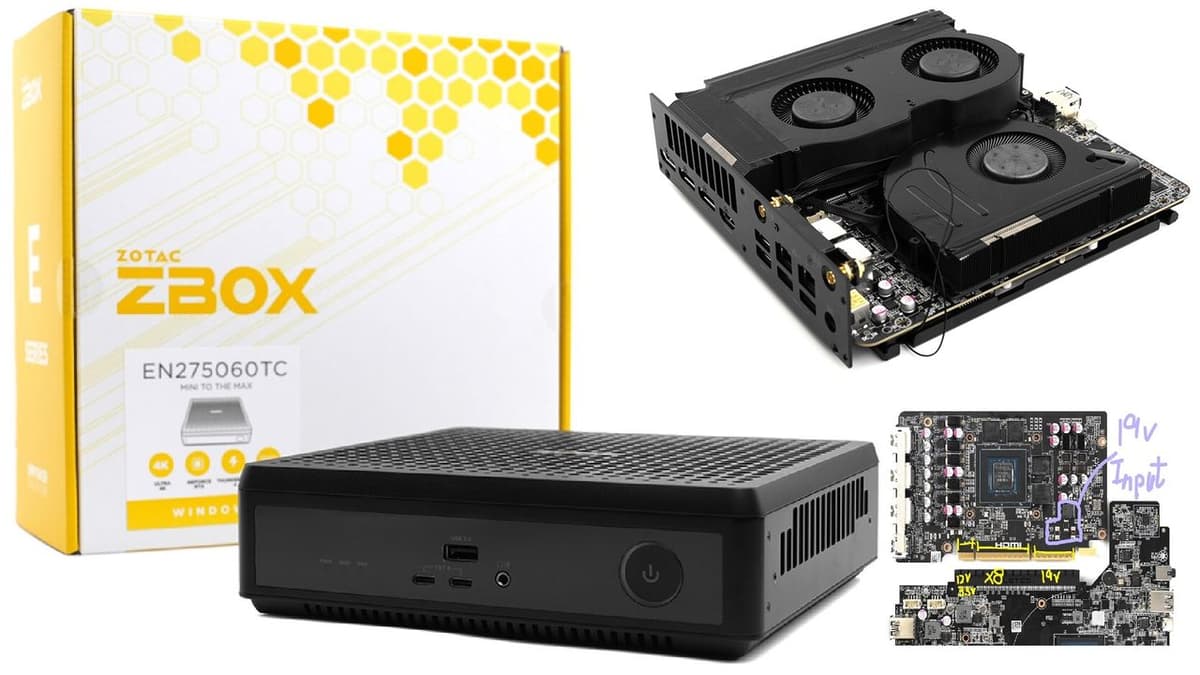
This Zotac Mini PC Has the Most Powerful GPU Ever Bundled in a PC of This Size — 16GB GeForce RTX 5060 Ti Is Competitive with 5070 Ti Laptop Edition
•December 12, 2025
0
Companies Mentioned

Why It Matters
Bringing desktop‑grade graphics into a mini PC reshapes the value proposition for creators and gamers seeking power without bulk, and pressures competitors to innovate in power delivery and thermal design.
Key Takeaways
- •RTX 5060 Ti fits in 2.65‑liter chassis
- •Hybrid PCIe design eliminates external power connector
- •Performance rivals RTX 5070 Ti laptop GPU
- •Cost‑to‑performance 45.57 G3D marks per dollar
- •Thermal management remains key in compact design
Pulse Analysis
The rise of compact workstations reflects a broader industry shift toward space‑efficient high‑performance computing. Zotac’s EN275060TC tackles the traditional power‑delivery bottleneck by routing 19‑volt input through a secondary PCIe lane, allowing a full‑desktop RTX 5060 Ti to operate without the bulky adapters typical of small‑form‑factor builds. This hybrid PCIe approach not only simplifies cable management but also sets a precedent for future mini PCs that aim to balance power density with sleek design.
Performance‑wise, the RTX 5060 Ti 16 GB in the Zotac chassis posts a G3D Mark score of 22,785, just shy of the RTX 5070 Ti laptop’s 23,082. The marginal gap across DirectX 9‑12 workloads translates into a cost‑to‑performance metric of roughly 45.57 G3D marks per dollar, positioning the mini PC as a compelling alternative to higher‑priced laptop solutions. At a $500 price point, it offers desktop‑class clock speeds and memory capacity, making it attractive for content creators, engineers, and gamers who need desktop‑level graphics in a portable footprint.
The EN275060TC’s success could accelerate adoption of hybrid power architectures across the mini PC market, prompting OEMs to explore similar designs for next‑gen GPUs. However, the compact chassis intensifies thermal challenges; sustained workloads may push temperatures higher than in larger desktops, necessitating advanced cooling strategies. As manufacturers refine airflow and heat‑pipe solutions, the convergence of desktop performance and miniaturization is likely to broaden, expanding the use cases for powerful yet space‑saving PCs in both professional and consumer segments.
This Zotac mini PC has the most powerful GPU ever bundled in a PC of this size — 16GB GeForce RTX 5060 Ti is competitive with 5070 Ti laptop edition
0
Comments
Want to join the conversation?
Loading comments...