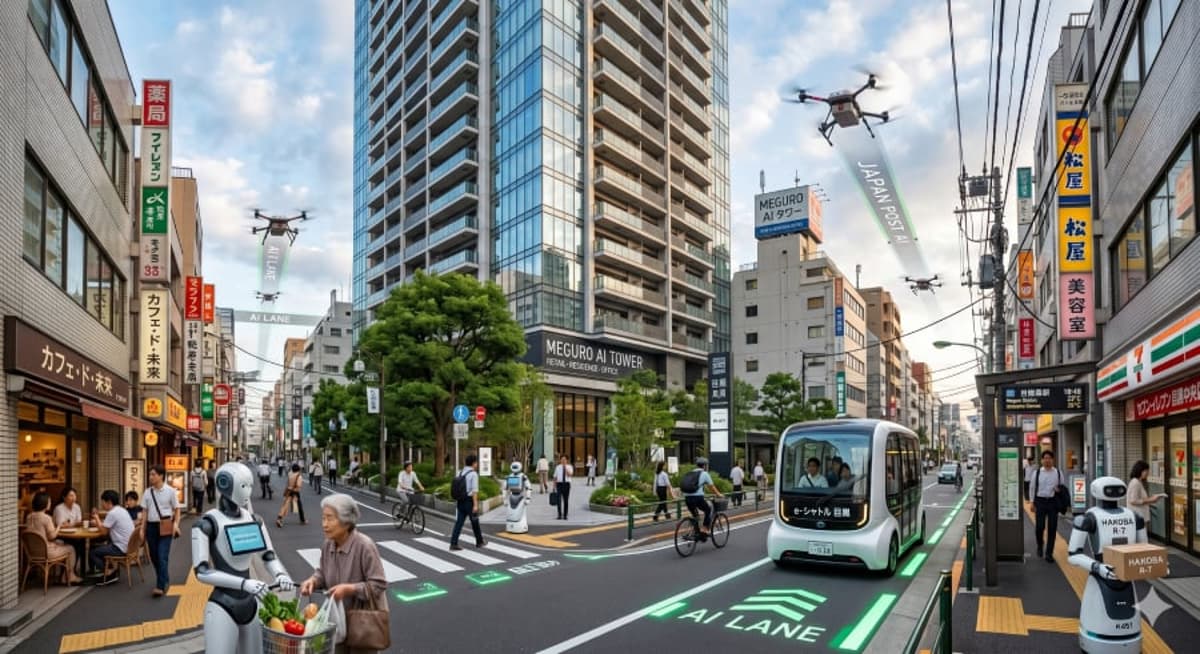
Tokyo Wants to Build a Real-World Robot City by 2031

Why It Matters
The project provides a real‑world proving ground for next‑generation robotics and AI, accelerating deployment in dense urban environments and addressing Japan’s labor shortfall. Success could reshape how cities worldwide integrate autonomous systems into daily life.
Key Takeaways
- •39‑story complex in Meguro to open by fiscal 2031
- •70 firms, including NTT, Hitachi, Denso, joining the testbed
- •Project targets “physical AI” with humanoid robots and autonomous transport
- •Initiative mirrors Toyota’s Woven City, addressing labor shortages
- •Residents will experience robot‑grown food and AI health services
Pulse Analysis
Tokyo’s Meguro district is poised to become a living laboratory where "physical AI" moves beyond the lab and into the streets. By 2031, a 39‑story tower will host a dense ecosystem of humanoid robots, driverless shuttles, drone couriers and AI‑enhanced health services. The collaboration of roughly 70 technology firms—ranging from telecom giant NTT to automotive supplier Denso—creates a unique consortium that can iterate on hardware, software and regulatory frameworks in real time. This scale of integration is unprecedented in a major metropolis, offering valuable data on robot navigation, human‑robot interaction and service reliability under everyday conditions.
The Meguro experiment builds directly on lessons from Toyota’s Woven City, another purpose‑built community designed for autonomous mobility and robotics trials. While Woven City operates as a controlled enclave, Meguro will embed similar technologies within a functioning urban neighborhood, exposing them to the unpredictability of crowds, mixed‑use traffic and diverse resident behaviors. This shift from sandbox to real‑world testing is critical for validating "physical AI"—systems that must perceive, decide and act amid noisy sensor inputs and spontaneous human actions. Success could demonstrate that robots can reliably handle tasks such as last‑mile deliveries, food preparation and health monitoring, mitigating Japan’s chronic labor shortages and aging demographic pressures.
Globally, the project signals a competitive push among cities to attract high‑tech investment and become testbeds for autonomous infrastructure. If Meguro’s robots prove viable, municipalities worldwide may accelerate similar deployments, reshaping urban planning standards, zoning laws and public safety protocols. Moreover, the data harvested could feed AI models that improve efficiency across sectors, from logistics to healthcare, potentially unlocking new revenue streams for participating firms. In a market where automation promises both cost savings and enhanced quality of life, Tokyo’s robot city could set a benchmark for the next generation of smart, resilient urban environments.
Tokyo Wants to Build a Real-World Robot City by 2031
Comments
Want to join the conversation?
Loading comments...