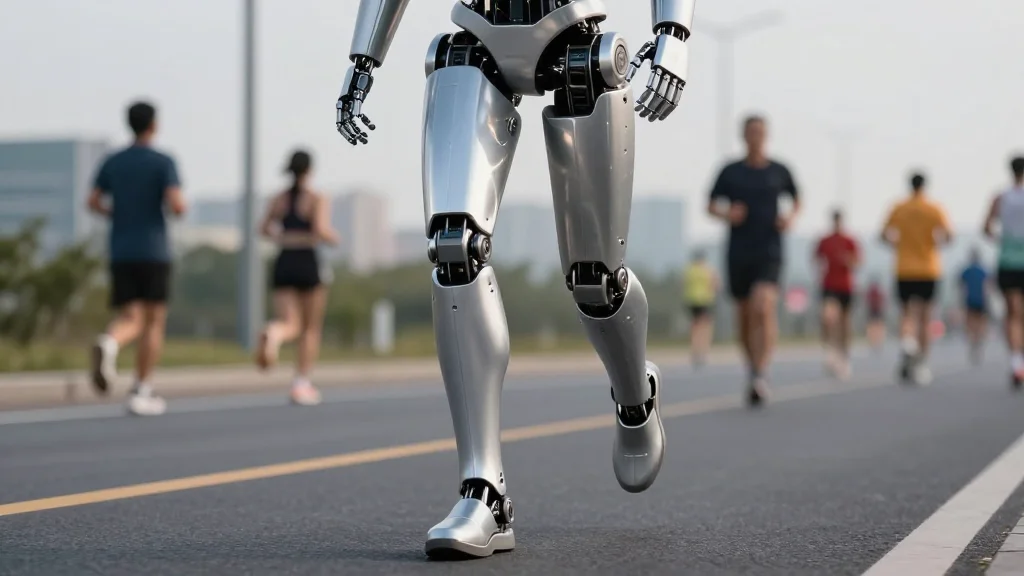
Training for Beijing’s Humanoid Half-Marathon Is Gruelling
Why It Matters
The showdown provides a high‑visibility testbed for next‑generation robotics, accelerating technology validation and public acceptance. Success could cement China’s leadership in commercial humanoid applications and spur global investment.
Key Takeaways
- •Over 300 humanoid robots slated for Beijing half‑marathon on April 19
- •Participation up from 21 robots last year, showing rapid industry growth
- •Only six robots finished last race; many suffered overheating and mechanical failures
- •Event highlights China's push for advanced robotics in public spaces
- •Companies use race to test endurance, AI navigation, and battery efficiency
Pulse Analysis
The Beijing E‑Town Humanoid Robot Half‑Marathon is more than a novelty; it is a strategic platform for developers to stress‑test autonomous locomotion at scale. By placing hundreds of machines on a public course, engineers can gather data on gait stability, obstacle avoidance, and real‑time decision‑making that laboratory settings cannot replicate. The race also forces manufacturers to confront practical constraints such as battery life, heat dissipation, and sensor reliability, driving rapid iteration toward commercially viable humanoids.
Technical hurdles remain steep. Last year’s inaugural event highlighted common failure modes: overheating motors, insufficient power reserves, and software glitches that caused robots to stall or fall. This year’s participants are equipped with upgraded actuators, more efficient lithium‑polymer cells, and advanced reinforcement‑learning algorithms that adapt to crowd dynamics. The dense urban environment of Yizhuang, with its mixed pedestrian traffic and variable terrain, serves as a realistic proving ground for AI that must balance speed with safety, a prerequisite for future service‑robot deployments in malls, airports, and hospitals.
From a market perspective, the half‑marathon signals China’s ambition to dominate the global humanoid market, a sector projected to exceed $15 billion by 2030. Success stories from the race can attract venture capital, accelerate supply‑chain development, and encourage standards‑setting bodies to formalize safety protocols. As Chinese firms showcase robust, field‑tested robots, international competitors may feel pressure to accelerate their own roadmaps, potentially reshaping the competitive landscape of service and companion robotics worldwide.
Training for Beijing’s humanoid half-marathon is gruelling
Comments
Want to join the conversation?
Loading comments...