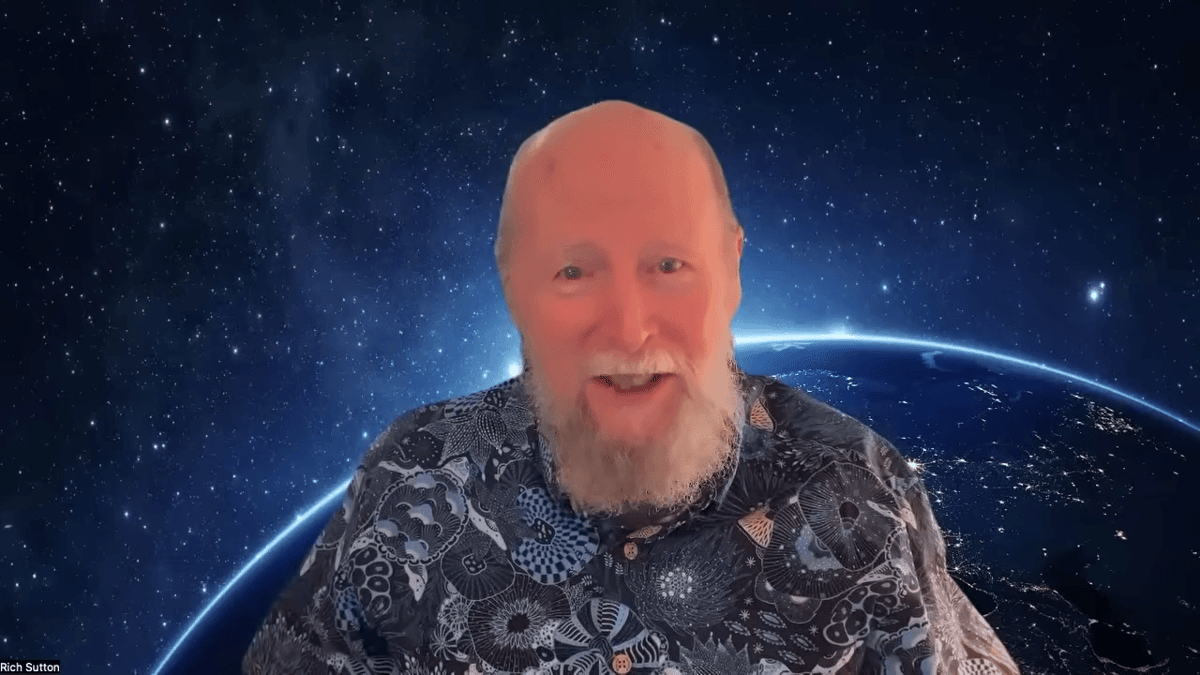
Turing Award Winner Richard Sutton Says Pure Generative AI Can't Do Real Science

Why It Matters
Without self‑evaluation, AI cannot autonomously drive discovery, limiting its impact on research, engineering and competitive advantage. Sutton’s framework pushes the industry toward agents that learn and adapt like scientific method practitioners.
Key Takeaways
- •Pure generative AI cannot self‑evaluate its novel outputs.
- •Scientific discovery requires variation, evaluation, and selective retention loops.
- •AlphaGo, AlphaFold and Claude Code succeed via built‑in feedback mechanisms.
- •Sutton advocates continual‑learning agents that adapt without overwriting prior knowledge.
- •Current AI focus on larger models overlooks the need for autonomous evaluation.
Pulse Analysis
Richard Sutton’s critique cuts to the heart of a fundamental gap in today’s generative AI: the absence of an internal evaluation mechanism. Large language and image models excel at pattern replication and can produce seemingly novel artifacts, but they lack the capacity to judge whether those artifacts advance knowledge or merely hallucinate. This shortfall means they are powerful assistants for summarization or content creation, yet they fall short of the iterative hypothesis‑testing cycle that defines scientific progress.
The distinction becomes clear when examining systems that integrate generation with feedback. AlphaGo’s historic move 37, AlphaFold’s accurate protein‑structure predictions, and Claude Code’s ability to pass software tests all rely on a loop where generated outputs are immediately scored against a concrete objective—win probability, physical plausibility, or test suite success. These evaluation steps enable the AI to prune low‑value variations and reinforce successful strategies, effectively turning random exploration into directed discovery. Sutton argues that this three‑step process—variation, evaluation, selective retention—is the engine of true creativity, whether in games, mathematics or engineering.
For the broader AI industry, Sutton’s message signals a strategic pivot. The prevailing race toward ever‑larger language models prioritizes breadth of knowledge over depth of learning. By championing continual‑learning agents that rebuild internal models, receive real‑time feedback, and retain useful concepts, Sutton envisions a future where AI can autonomously conduct experiments, validate hypotheses, and iterate without human intervention. His Oak architecture exemplifies this shift, proposing agents that start tabula rasa, interact with environments, and evolve abstract concepts over time. Embracing such self‑evaluating, adaptive systems could unlock AI‑driven breakthroughs across pharmaceuticals, climate modeling and beyond, redefining the role of artificial intelligence from a static tool to an active scientific partner.
Turing Award winner Richard Sutton says pure generative AI can't do real science
Comments
Want to join the conversation?
Loading comments...