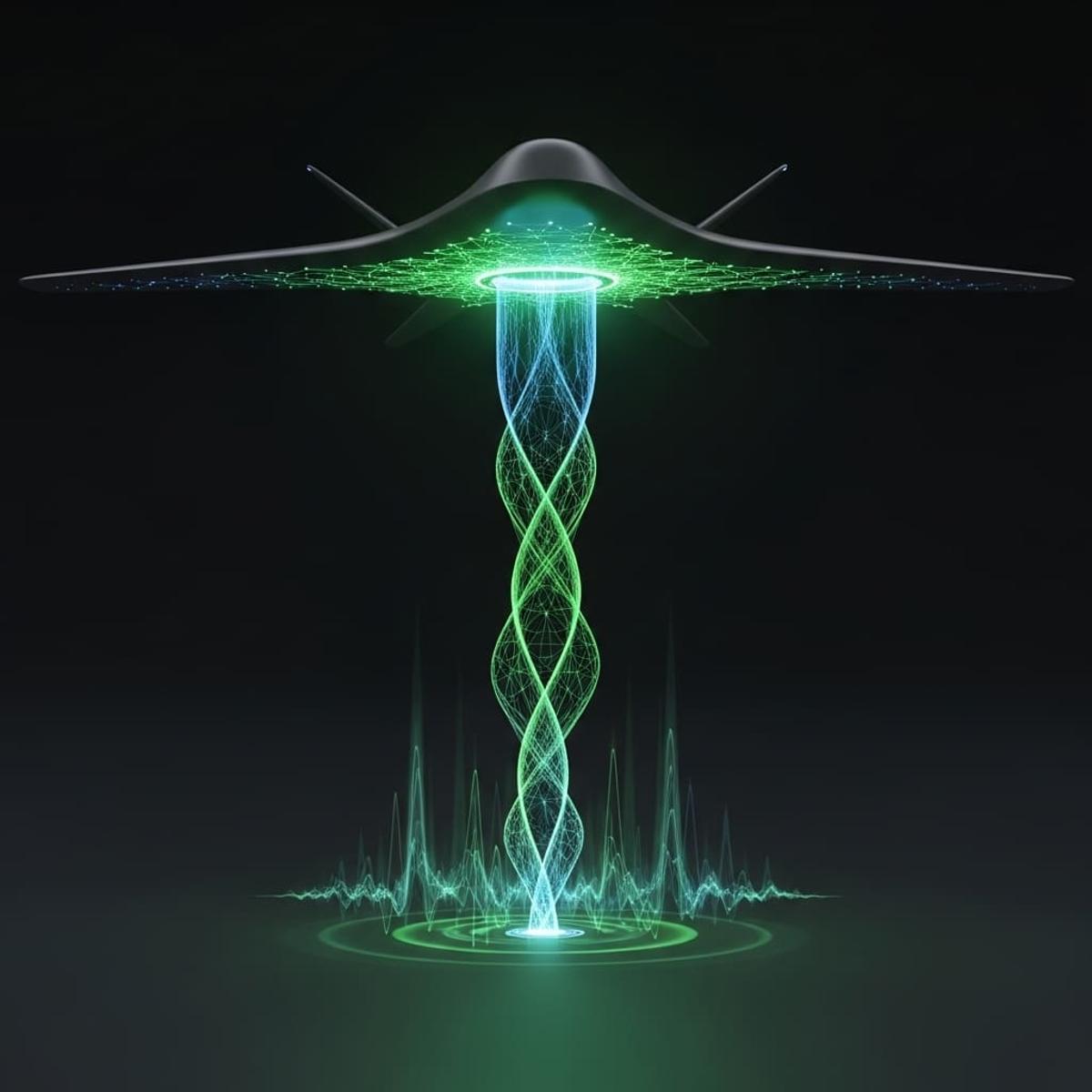
Uav-Deployed QKD Achieves Finite-Key Security with AI-Assisted Calibration

Key Takeaways
- •Unified channel model includes turbulence, misalignment, aperture clipping
- •AI‑assisted calibration boosts secret key rate 10‑30%
- •Finite‑key analysis requires over 10^9 pulses for security
- •OAM‑encoded BB84 viable for UAV links under moderate turbulence
- •Decoy‑state optimization lowers QBER below BB84 security threshold
Pulse Analysis
Quantum key distribution has long promised information‑theoretic security, yet its practical reach has been limited to fiber‑optic links or stationary free‑space terminals. Deploying QKD on unmanned aerial vehicles introduces a host of dynamic impairments: atmospheric turbulence distorts the spatial mode structure, while platform jitter causes misalignment and finite‑aperture clipping that elevate the quantum bit error rate. Orbital angular momentum encoding offers a high‑dimensional carrier that can tolerate some mode mixing, but without accurate channel modeling the potential gains remain untapped. The new framework quantifies these effects, turning a chaotic propagation environment into a predictable communication channel.
The authors combine a weak‑plus‑vacuum decoy‑state protocol with a physics‑informed gradient‑boosting decision tree that evaluates each received pulse in real time. This AI‑assisted calibration discerns corrupted photons caused by turbulence spikes or pointing errors and adapts decoding parameters on the fly, preserving composable security while extracting more usable bits. Finite‑key analysis incorporates statistical fluctuations, detector dark counts, and error‑correction leakage, revealing that a block size exceeding 10⁹ pulses is sufficient to meet standard security parameters. Simulated and experimental results show a 10‑30 % boost in secret key rate under moderate turbulence and sub‑milliradian jitter.
By demonstrating a viable, turbulence‑resilient QKD link on a UAV, the study opens a pathway to mobile quantum networks that can be deployed for battlefield communications, emergency response, or secure data relays between moving assets. The modular architecture—spanning channel modelling, decoy optimization, and AI‑driven calibration—facilitates rapid integration with existing drone platforms and adaptive optics hardware. Future work will likely focus on extending range, refining the learning model for harsher atmospheric conditions, and conducting field trials that validate the composable security claims in real‑world operations. The technology promises to shift quantum security from static labs to the sky.
Uav-Deployed QKD Achieves Finite-Key Security with AI-Assisted Calibration
Comments
Want to join the conversation?