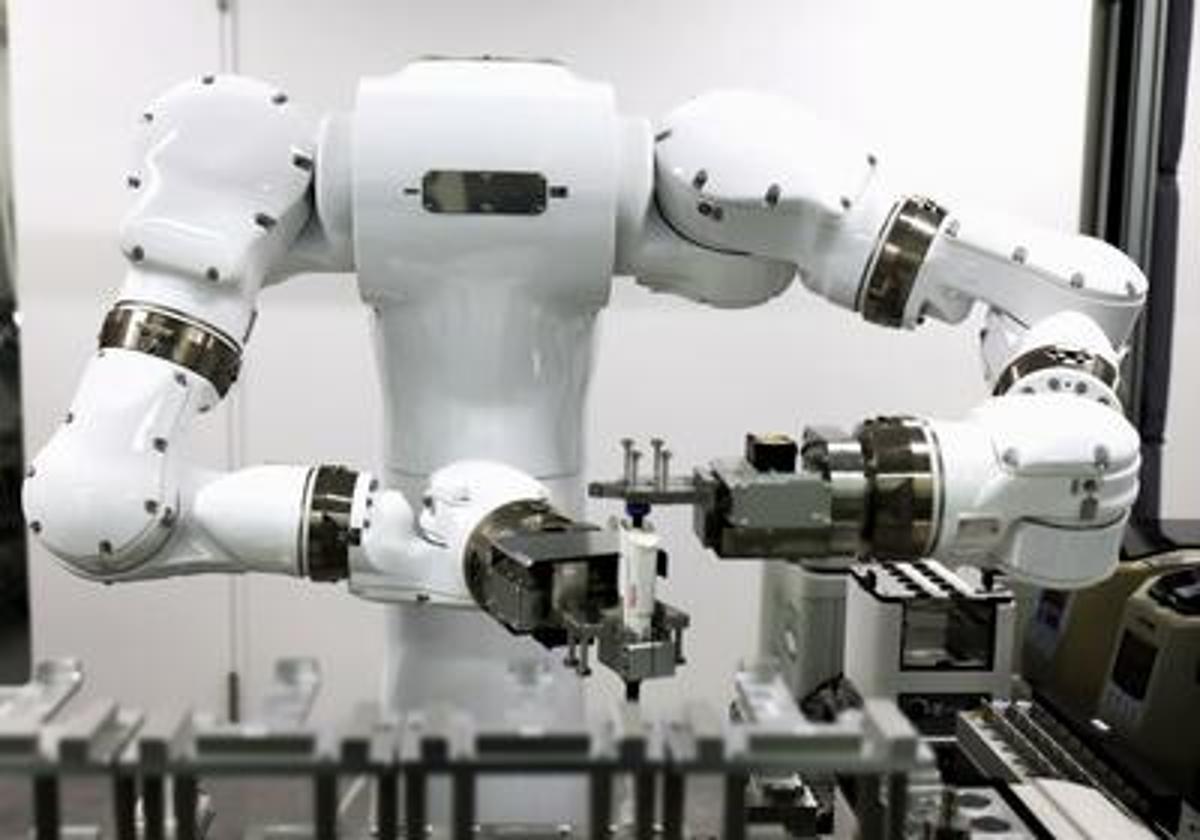
Unmanned Lab Opens with Robots at Work as Researchers Push AI, Automation
Companies Mentioned
Why It Matters
The initiative tackles Japan’s chronic lab‑staff shortage and reduces experimental error, potentially accelerating scientific output and giving the country a competitive edge in AI‑driven research.
Key Takeaways
- •Robotics Innovation Center operates with 10 autonomous robots, no human staff.
- •Maholo LabDroid handles reagent transfer and cell culture tasks.
- •Goal to scale to ~2,000 robots by 2040 for end‑to‑end research.
- •Automation addresses Japan’s lab labor shortages and reduces experimental error.
- •Early deployment at Kobe hospital for iPSC ophthalmology studies.
Pulse Analysis
The Institute of Science Tokyo’s new Robotics Innovation Center marks a watershed moment for laboratory automation in Japan. By deploying ten dual‑arm robots that operate without any human presence, the university is directly confronting a chronic shortage of skilled research staff and the high cost of human error in experimental protocols. The facility blends advanced artificial‑intelligence algorithms with precision robotics to execute routine tasks such as reagent dispensing and equipment handling. This model reflects a broader trend among research institutions worldwide to embed AI‑driven automation at the core of scientific discovery.
At the heart of the center is Maholo LabDroid, a humanoid robot capable of two‑arm manipulation with sub‑millimeter accuracy. Maholo already supports a Kobe‑based ophthalmology hospital, where it conducts induced pluripotent stem‑cell culture and other delicate assays for clinical research. Its ability to open temperature‑controlled chambers, transfer fixed reagent volumes, and maintain sterile conditions demonstrates that robots can reliably replace humans in high‑precision wet‑lab work. The system’s software learns from each experiment, gradually expanding its repertoire from simple pipetting to hypothesis generation.
The center’s roadmap envisions scaling the fleet to roughly 2,000 robots by 2040, effectively automating the entire research pipeline from hypothesis formulation to data validation. If realized, such capacity could accelerate drug discovery, reduce time‑to‑market for biotech innovations, and position Japan as a leader in AI‑enhanced science. However, widespread adoption will hinge on standardizing robot‑compatible labware, ensuring data security, and addressing ethical concerns about reduced human oversight. Investors and policymakers are watching closely, as the success of this model may redefine how laboratories operate globally.
Unmanned lab opens with robots at work as researchers push AI, automation
Comments
Want to join the conversation?
Loading comments...