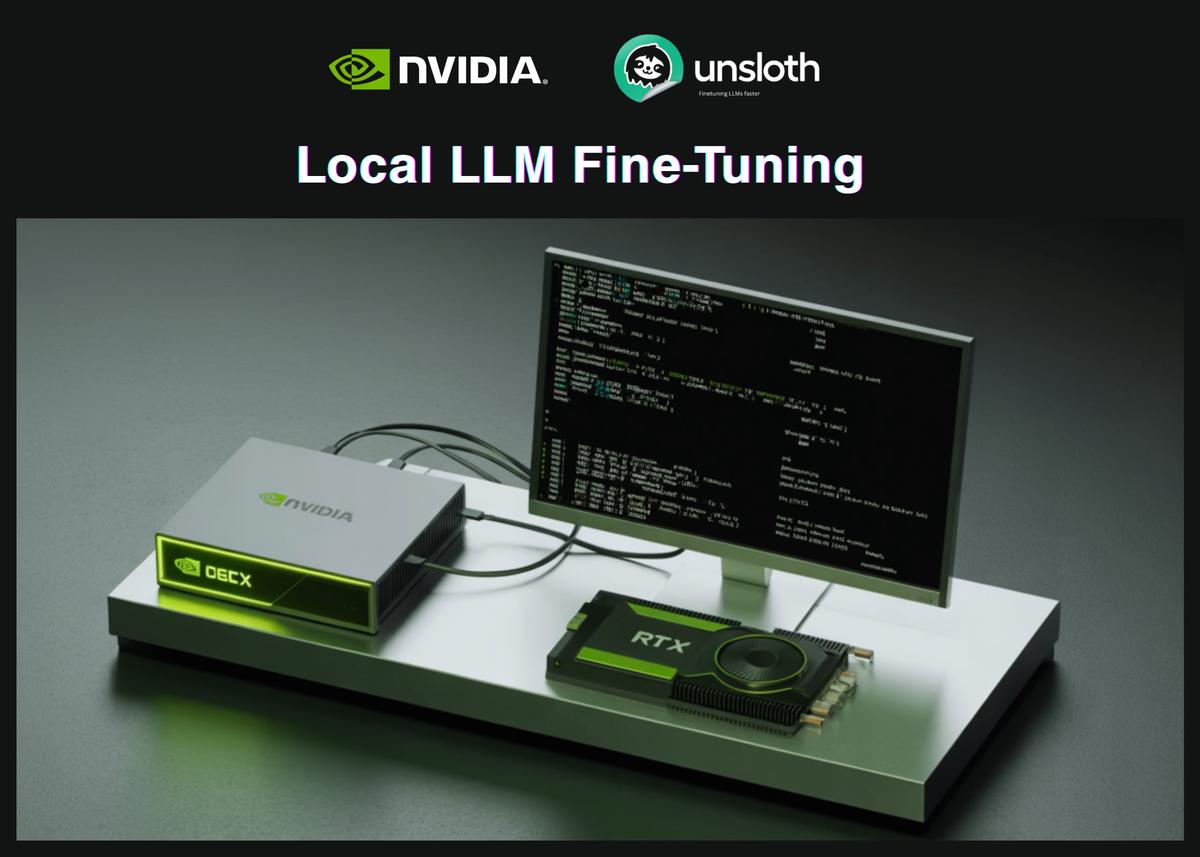
Unsloth AI and NVIDIA Are Revolutionizing Local LLM Fine-Tuning: From RTX Desktops to DGX Spark
•December 19, 2025
0
Companies Mentioned


Why It Matters
Local fine‑tuning reduces latency, cost, and data‑privacy risks while unlocking domain‑specific intelligence that cloud‑only models can’t deliver.
Key Takeaways
- •Unsloth boosts fine‑tuning speed 2.5× on NVIDIA GPUs
- •VRAM requirements mapped for PEFT, full‑tune, RL methods
- •DGX Spark enables 30‑120B model tuning locally
- •Case studies prove productivity gains across coding, finance, healthcare
- •Local models eliminate cloud data‑privacy concerns
Pulse Analysis
The AI landscape is moving from monolithic cloud models toward edge‑centric, agentic systems that run on local hardware. By leveraging NVIDIA’s RTX and DGX Spark GPUs, developers can now fine‑tune small to large language models in‑house, sidestepping the latency and cost of API calls. Unsloth’s custom kernels translate billions of matrix multiplications into highly parallel GPU workloads, delivering a 2.5× speed advantage over vanilla Hugging Face pipelines. This performance uplift makes it feasible to iterate quickly on domain‑specific datasets, whether for coding assistants, legacy‑system translators, or specialized chatbots.
Hardware considerations remain the primary barrier to local LLM adoption. Unsloth provides a clear VRAM matrix: hobbyist‑level PEFT fits on 8‑GB RTX cards, while full‑parameter tuning of 30‑B models demands the 80‑GB memory of a DGX Spark. Reinforcement‑learning workloads sit between, requiring 12‑24 GB for mid‑size models. By matching model size to GPU capacity, organizations can plan incremental upgrades—starting with a consumer‑grade RTX 5090 and scaling to a DGX cluster as needs grow—without over‑investing in unnecessary infrastructure.
The business implications are profound. Companies can keep proprietary data on‑premise, complying with regulations like HIPAA and GDPR while still benefiting from state‑of‑the‑art AI. Fine‑tuned local models deliver faster response times and lower per‑inference costs, translating into higher productivity for developers, analysts, and clinicians. As more enterprises adopt Unsloth‑enabled pipelines, the market will see a surge in niche AI solutions that outperform generic cloud offerings, reshaping competitive dynamics across software, finance, and healthcare sectors.
Unsloth AI and NVIDIA are Revolutionizing Local LLM Fine-Tuning: From RTX Desktops to DGX Spark
0
Comments
Want to join the conversation?
Loading comments...