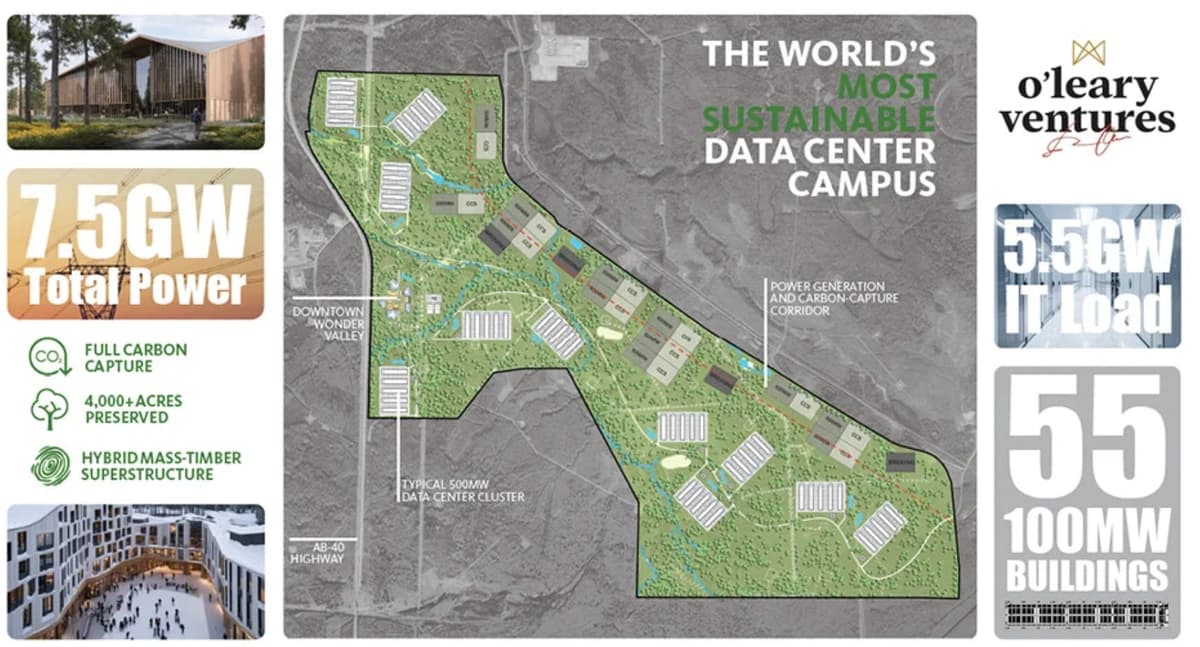
Utah’s Wonder Valley and the Industrialization of AI Infrastructure
Why It Matters
The project illustrates how AI‑driven compute demand is reshaping data‑center economics, turning them into self‑powered industrial hubs that could redefine regional energy, tax, and regulatory landscapes. Its success—or failure—will signal the viability of vertically integrated AI campuses across the United States.
Key Takeaways
- •Wonder Valley aims for up to 9 GW on‑site power generation.
- •Phase 1 plans 3 GW capacity, tied to the Ruby natural‑gas pipeline.
- •MIDA reduced energy‑use tax to 0.5% and rebates 80% of property tax.
- •Projected county revenue $30 M annually, $100 M at full buildout.
- •No hyperscale tenant announced yet, raising demand‑certainty risk.
Pulse Analysis
The Utah Wonder Valley initiative marks a shift from traditional data‑center projects to fully integrated AI infrastructure campuses. By co‑locating massive compute facilities with on‑site power plants, developers aim to sidestep grid constraints and deliver the speed‑to‑power that AI workloads demand. This model mirrors emerging trends in Texas and the Pacific Northwest, where developers bundle power, fiber, and cooling into single‑purpose industrial zones, creating a new class of strategic assets that blur the line between tech and energy sectors.
Natural gas is the linchpin of Wonder Valley’s power strategy, leveraging the 680‑mile Ruby Pipeline to fuel an estimated 3 GW in Phase 1 and up to 9 GW at full scale. While gas turbines can be deployed faster than nuclear or large‑scale renewables, they introduce volatility in fuel pricing and heightened scrutiny over emissions and methane leakage. The project’s closed‑loop cooling design attempts to mitigate Utah’s water‑stress challenges, but gigawatt‑scale heat rejection will still strain local water resources and require sophisticated thermal management. These environmental trade‑offs are increasingly central to hyperscale customers’ sustainability mandates.
Governance and fiscal incentives further differentiate Wonder Valley. MIDA’s tax concessions—cutting energy‑use tax to 0.5% and rebating 80% of property taxes—promise substantial public revenue, yet they also raise questions about long‑term public benefit versus private gain. Community concerns over transparency, land use, and infrastructure costs echo debates seen in other AI‑era projects. As the first U.S. campus to blend AI compute with self‑generated power, Wonder Valley serves as a blueprint; its outcomes will inform how policymakers and developers balance rapid AI expansion with environmental stewardship and local accountability.
Utah’s Wonder Valley and the Industrialization of AI Infrastructure
Comments
Want to join the conversation?
Loading comments...