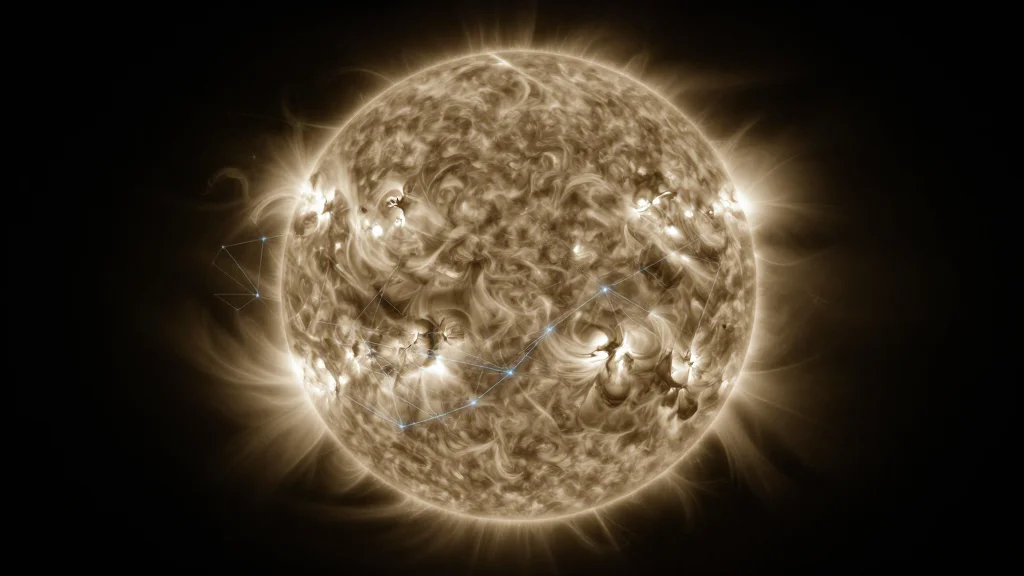
Virtual Sunspots Help AI Find Rare Magnetic Matches in Vast Solar Archives
Why It Matters
It enables rapid identification of rare solar magnetic configurations that drive space‑weather events, saving years of manual analysis and bolstering protection of satellites and ground infrastructure.
Key Takeaways
- •Integrated generative, supervised, and latent‑space models to query solar data
- •Virtual sunspots can be tuned for magnetic flux, polarity, and complexity
- •System locates rare active regions across terabytes of historic observations
- •Framework applicable to instrument translation, artifact correction, and forecasting
Pulse Analysis
The Sun’s magnetic landscape is recorded in petabytes of imagery from missions such as SDO’s Helioseismic and Magnetic Imager. Traditional analysis—manual labeling and visual inspection—cannot keep pace with the data deluge, especially when researchers hunt for the few anomalous active regions that can reshape a solar cycle. Southwest Research Institute (SwRI) has turned this challenge into an opportunity by repurposing generative artificial intelligence, not merely to synthesize fake images but to act as a searchable proxy for the real Sun. By embedding physical quantities into the latent space, the team creates a controllable “virtual sunspot” that can be systematically varied and matched against the archival record.
The workflow stitches together three machine‑learning components. First, a deep generative model learns the distribution of magnetic patches from the SHARPs dataset, producing high‑fidelity synthetic regions. Second, a set of directional vectors in the hidden layer is calibrated to correspond to measurable attributes—magnetic flux, polarity, complexity, and flare propensity—allowing users to slide a knob and instantly reshape the virtual patch. Third, a supervised similarity network takes the edited synthetic image and scans the entire historical archive to retrieve real counterparts that share the same physical signature. This pipeline eliminates the need to sift through millions of gigabytes manually, cutting analysis time from years to minutes.
The implications extend well beyond academic curiosity. Accurate, rapid identification of rare, high‑impact active regions improves space‑weather models that protect satellite operators, power‑grid managers, and aviation crews from geomagnetic storms. Moreover, the same generative‑query framework can be adapted for cross‑instrument calibration, filling data gaps on the Sun’s far side, or even for other astrophysical domains where massive image archives exist. As generative AI matures, SwRI’s approach showcases a practical, physics‑aware use case that bridges the gap between synthetic data creation and actionable scientific insight, setting a new standard for data‑driven heliophysics.
Virtual sunspots help AI find rare magnetic matches in vast solar archives
Comments
Want to join the conversation?
Loading comments...