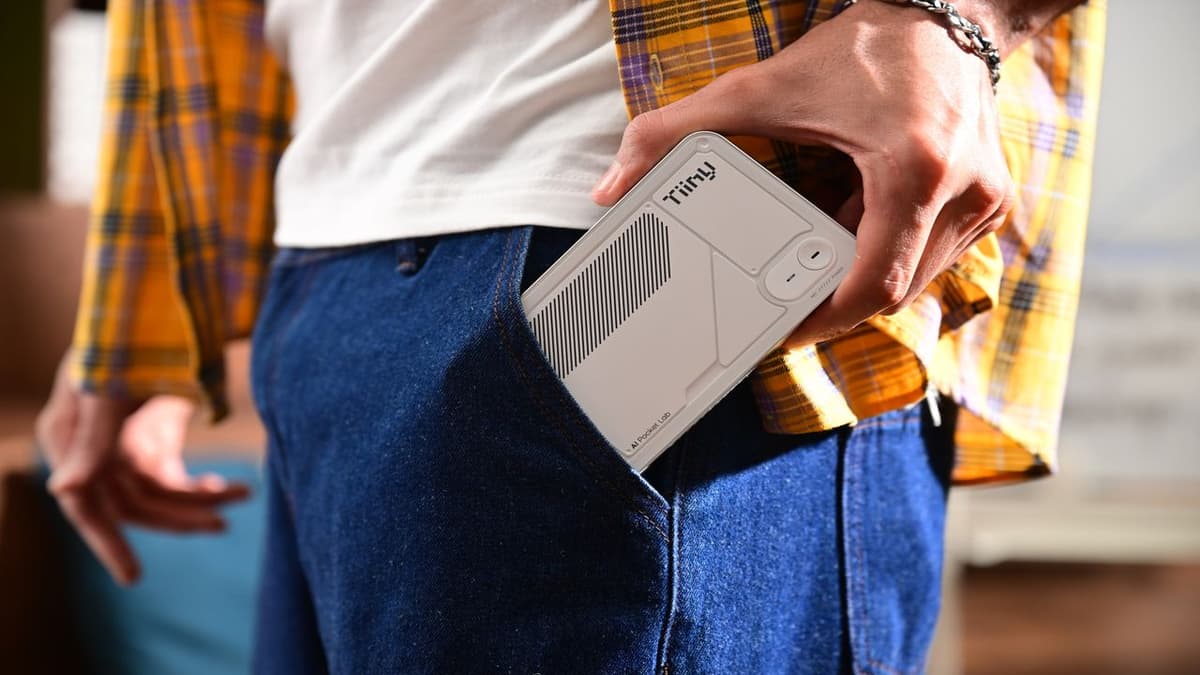
World's Smallest AI Supercomputer Achieves World Record with 120B-Parameter LLM Support On-Device — What I Don't Understand, Though, Is How It Does OTA Hardware Upgrades

Companies Mentioned
Why It Matters
On‑device inference eliminates cloud latency, reduces recurring AI service costs, and safeguards sensitive data, reshaping how enterprises and developers deploy large models.
Key Takeaways
- •Pocket-sized PC runs up to 120B‑parameter models.
- •Operates offline within 65 W power envelope.
- •Custom accelerator delivers ~190 TOPS without discrete GPU.
- •OTA “hardware upgrades” are software‑driven optimizations.
- •Local inference cuts cloud costs and improves data privacy.
Pulse Analysis
Edge AI is moving from concept to commodity as hardware manufacturers strive to bring server‑grade capabilities to the desktop and even handheld form factors. Tiiny’s Pocket Lab exemplifies this trend by integrating a heterogeneous accelerator with a high‑performance ARM CPU, allowing inference workloads that traditionally required multi‑GPU clusters to run on a device that fits in a backpack. The company’s TurboSparse and PowerInfer technologies selectively activate neurons and balance compute across CPU and NPU, achieving impressive throughput while staying within a modest 65‑watt envelope.
The technical architecture hinges on a 12‑core ARMv9.2 processor paired with an 80‑GB LPDDR5X memory pool and a 1‑TB SSD, providing the bandwidth needed for 120‑billion‑parameter models. By eschewing a discrete GPU, Tiiny reduces BOM costs and thermal complexity, relying instead on software‑level optimizations that mimic hardware upgrades via over‑the‑air updates. While the term “OTA hardware upgrades” is marketing shorthand, it reflects a broader industry shift toward firmware‑driven performance scaling, where firmware can unlock new instruction sets or reconfigure accelerator pathways without physical modifications.
The implications for businesses are significant. Local model execution cuts subscription fees for cloud AI APIs, lowers data‑exfiltration risk, and aligns with sustainability goals by minimizing data‑center energy consumption. However, verification of server‑grade performance on such constrained silicon remains a challenge, and developers must adapt models to fit the device’s memory and power limits. As more startups adopt similar edge‑focused designs, we can expect a competitive market that drives down costs, democratizes access to advanced AI, and forces cloud providers to rethink pricing and security models.
World's smallest AI supercomputer achieves world record with 120B-parameter LLM support on-device — what I don't understand, though, is how it does OTA hardware upgrades
Comments
Want to join the conversation?
Loading comments...