Practical AI
Chris on AI, Autonomous Swarming, Home Automation and Rust!
Practical AI
•November 26, 2025•1h 37m
0
Practical AI•Nov 26, 2025
Key Takeaways
- •AI breakthroughs tied to GPU hardware evolution.
- •Open models are narrowing gap with proprietary giants.
- •AI agents, swarming robots enable real‑world automation.
- •Industry focus shifts from model creation to specialized services.
- •Emerging startups like Prometheus challenge big‑tech dominance.
Pulse Analysis
The episode opens with a rapid tour of AI’s historical cycles, emphasizing how the so‑called AI winters were less about ideas and more about missing hardware. Chris traces the pivotal role of GPUs—especially NVIDIA’s rise—and later TPUs, which finally gave neural networks the compute power to scale. This hardware‑first narrative explains why today’s breakthroughs feel inevitable, yet they rest on a decade of silicon innovation that turned theoretical models into production‑ready tools.
Transitioning to the present, the hosts argue that open‑source models are eroding the advantage once held by closed‑door labs. Hundreds of community‑driven models now rival proprietary offerings, turning model training into a commodity. Consequently, major firms are pivoting from pure model providers to specialized AI services, embedding models into agents, autonomous swarms, and home‑automation pipelines. The discussion also highlights Rust’s growing relevance for safe, high‑performance robotics code, underscoring a broader ecosystem where software, hardware, and AI converge.
Looking ahead, the conversation shifts to market dynamics. While giants like Google, Meta, and NVIDIA continue to pour capital into infrastructure, the real innovation may emerge from leaner ventures such as Jeff Bezos’s newly announced Project Prometheus. These startups, backed by massive funding but operating under the radar, illustrate a shifting balance where open ecosystems and niche applications could outpace headline‑grabbing megaprojects. For business leaders, the takeaway is clear: prioritize adaptable AI services, monitor open‑model advances, and stay alert to disruptive startups that blend hardware, robotics, and software into next‑generation solutions.
Episode Description
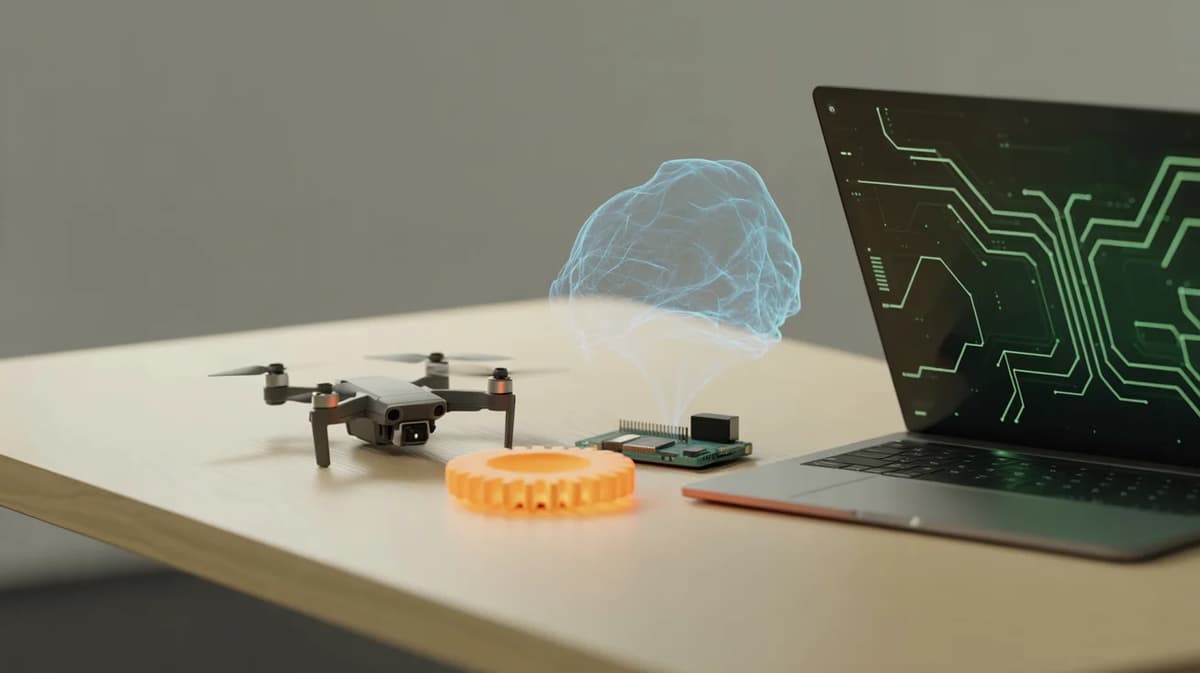
This episode is a special crossover between the Practical AI podcast and The Changelog podcast. Chris was recently invited by longtime friends Jerod Santo and Adam Stacoviak, cohosts of The Changelog, to join them on the show. They discuss AI, drones, robotics, swarming technology, and the rise of high-performance edge computing with Rust. Chris points out that open source software, small AI models, and affordable hardware are making home automation and local AI accessible to everyone. From automating household functions to experimenting with drones and single-board computers, Chris describes how hands-on maker projects are shaping a bright future for physical AI, on small budgets and right from the comfort of your own home.
Featuring:
Jerod Santo – LinkedIn
Adam Stacoviak – LinkedIn
Chris Benson – Website, LinkedIn, Bluesky, GitHub, X
Sponsors:
Miro – Get the right things done faster with Miro's Innovation Workspace. AI Sidekicks, instant insights, and rapid prototyping—transform weeks of work into days. No more scattered docs or endless meetings. Help your teams get great done at Miro.com.
Shopify – The commerce platform trusted by millions. From idea to checkout, Shopify gives you everything you need to launch and scale your business—no matter your level of experience. Build beautiful storefronts, market with built-in AI tools, and tap into the platform powering 10% of all U.S. eCommerce. Start your one-dollar trial at shopify.com/practicalai
Upcoming Events:
Register for upcoming webinars here!
This week we have extended show notes below from Chris!
Swarming & Fully Autonomous Multi-Agent UxV Systems
Chris’s Definition of Swarming (anchor link in show notes)
Chris’s definition of Swarming
“Swarming occurs when numerous independent fully-autonomous multi-agentic platforms exhibit highly-coordinated locomotive and emergent behaviors with agency and self-governance in any domain (air, ground, sea, undersea, space), functioning as a single independent logical distributed decentralized decisioning entity for purposes of C3 (command, control, communications) with human operators on-the-loop, to implement actions that achieve strategic, tactical, or operational effects in the furtherance of a mission.”
© 2025 Chris Benson
Conceptual Foundations
Swarm Robotics – Wikipedia
High-level overview of swarm robotics as decentralized robot collectives.
https://en.wikipedia.org/wiki/Swarm_robotics
Swarm Robotic Platforms – Wikipedia
Survey of hardware platforms used in swarm robotics research.
https://en.wikipedia.org/wiki/Swarm_robotic_platforms
Swarm Intelligence – Wikipedia
Broader algorithms and theory behind collective intelligence (beyond robots).
https://en.wikipedia.org/wiki/Swarm_intelligence
Ant Robotics – Wikipedia
Nature-inspired “ant-like” robotics as a special case of swarm robotics.
https://en.wikipedia.org/wiki/Ant_robotics
Open Research & Multi-Robot Resources (Stepping-Stones Toward True Swarms)
Programming Multiple Robots with ROS 2 (online book)
Free book on multi-robot systems, ROS 2, and the Robot Middleware Framework (RMF).
https://osrf.github.io/ros2multirobotbook
Simulation with ROS 2 & Gazebo (ROS 2 Humble tutorial)
Official tutorial on connecting ROS 2 to Gazebo simulation.
https://docs.ros.org/en/humble/Tutorials/Advanced/Simulators/Gazebo/Gazebo.html
Spawning Multiple Robots in Gazebo with ROS 2
Hands-on tutorial to launch N robots in Gazebo, each with its own namespace.
https://www.theconstruct.ai/spawning-multiple-robots-in-gazebo-with-ros2
ROS 2 Multi-Robot Simulation Best Practices (Discourse thread)
Discussion of patterns for multi-robot systems (domains, namespaces, Nav2, etc.).
https://discourse.openrobotics.org/t/multi-robot-simulation-best-practices/38987
Getting Hands-On: Consumer Robotics, ROS 2 & Gazebo
ROS 2 (Robot Operating System 2)
Official ROS 2 Documentation – Humble (LTS)
Main docs for ROS 2 Humble (recommended distro) with tutorials and APIs.
https://docs.ros.org/en/humble
ROS 2 Installation Guide (Humble)
Step-by-step install on supported platforms.
https://docs.ros.org/en/humble/Installation.html
“From Zero to Robotics Hero: A Beginner’s Guide to ROS 2” (article)
Beginner-friendly overview with ideas for where to go next (MoveIt, Nav2, multi-robot, etc.).
https://riyagoja.medium.com/from-zero-to-robotics-hero-a-beginners-guide-to-ros-2-90ac9c3b87ba
ROS 2 Tutorial for Beginners (2025 guide)
Up-to-date intro that walks you from install to simulating your first robot in 2025.
https://www.timesofexplore.com/2025/10/ros2-tutorial-beginners-build-first-robot-2025.html
Gazebo Simulation
Gazebo Sim – Official Site
Modern Gazebo (Ignition) simulator; models, worlds, and docs.
https://gazebosim.org
Getting Started with Gazebo (Docs)
Official “start here” guide for using Gazebo and Gazebo Fuel assets.
https://gazebosim.org/docs/latest/getstarted
Classic Gazebo Tutorials (still useful for fundamentals)
https://classic.gazebosim.org/tutorials
micro-ROS (ROS 2 on Microcontrollers)
micro-ROS – ROS 2 for Microcontrollers
Official site for running ROS 2 on tiny embedded boards.
https://micro.ros.org
micro-ROS GitHub Organization
Repositories, examples, and tutor...
Show Notes
0
Comments
Want to join the conversation?
Loading comments...