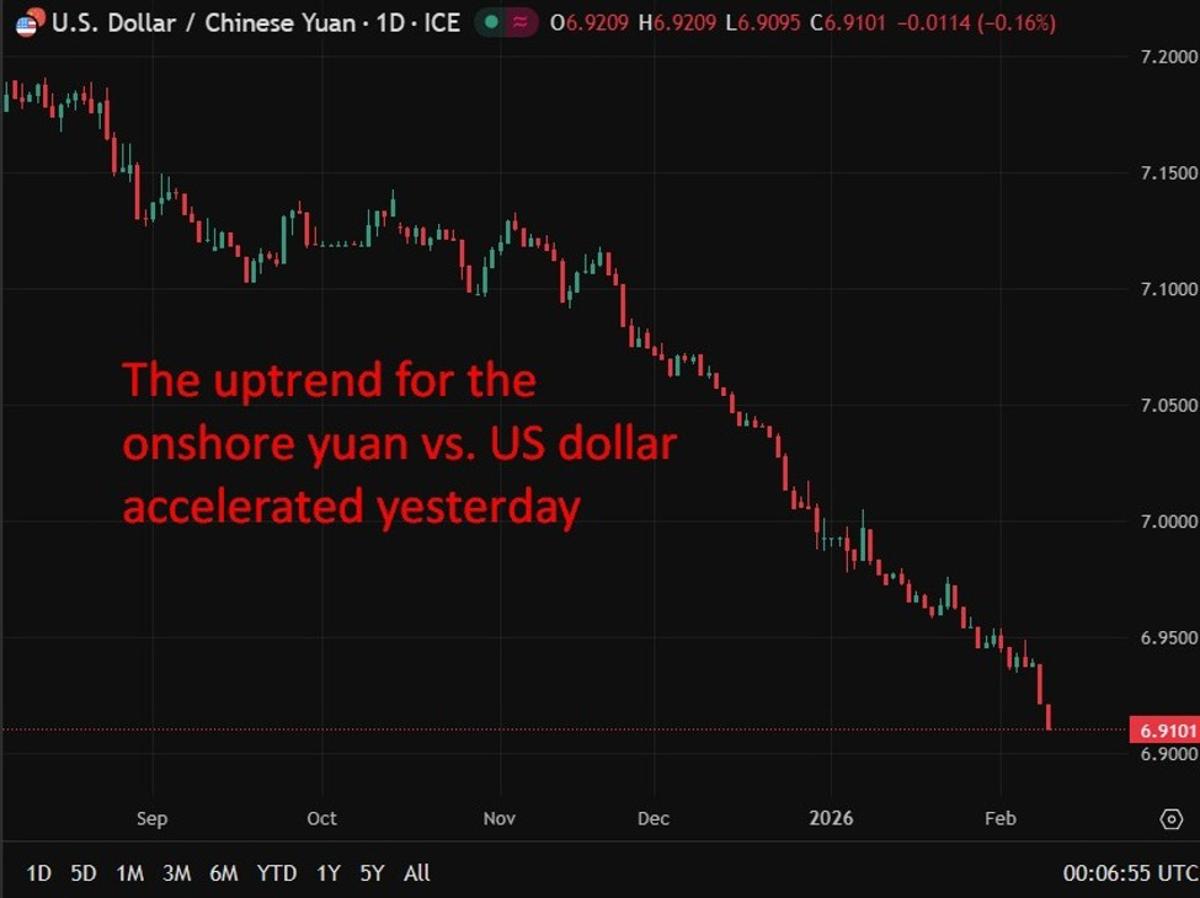
PBOC Is Expected to Set the USD/CNY Reference Rate at 6.9109 – Reuters Estimate
Key Takeaways
- •Fixing set at 6.9109, within 2% band.
- •Midpoint reflects prior close, dollar moves, capital flows.
- •Stronger midpoint signals anti‑depreciation bias.
- •PBOC may intervene if yuan hits band edges.
- •Investors gauge China’s monetary and stability priorities.
Summary
The People’s Bank of China is set to announce the USD/CNY reference rate around 0115 GMT, with Reuters estimating a midpoint of 6.9109. China’s managed‑floating system keeps the yuan within a ±2 % band around this rate, blending market data with policy discretion. The midpoint incorporates the prior close, major currency movements, capital flows, growth momentum, and financial‑stability objectives. Because the fixing can trigger central‑bank intervention, it is viewed as a key policy signal rather than a mere technical reference point.
Pulse Analysis
The People’s Bank of China (PBOC) will announce its daily USD/CNY reference rate around 0115 GMT, with Reuters estimating the midpoint at 6.9109. China’s managed‑floating regime anchors the yuan within a ±2 % band around this central rate, allowing limited market flexibility while preserving policy control. The midpoint is derived from the previous day’s close, movements in major currencies—especially the U.S. dollar—plus domestic factors such as capital flows, growth momentum, and financial‑stability goals. This blend of market data and discretionary judgment makes the fixing a unique hybrid of technical and policy instrument.
A stronger‑than‑expected midpoint, like the projected 6.9109, is read as the PBOC’s effort to curb depreciation pressure, signaling confidence in economic fundamentals or a desire to protect import‑cost stability. Conversely, a softer fixing can indicate tolerance for a weaker yuan, often to support export competitiveness or respond to a strengthening dollar. When the onshore rate approaches the upper or lower band limits, the central bank typically steps in—through state‑bank trading, liquidity adjustments, or outright yuan purchases—to smooth volatility and maintain orderly markets.
For investors, the daily fixing offers a real‑time glimpse into Beijing’s currency priorities, influencing hedge strategies, cross‑border capital allocation, and risk‑premia calculations. In periods of heightened global uncertainty—such as shifts in U.S. rate expectations or trade‑policy turbulence—the yuan’s band flexibility becomes a critical buffer against capital flight and exchange‑rate shocks. Monitoring the PBOC’s midpoint trends helps market participants anticipate potential interventions, assess the balance between competitiveness and financial stability, and position portfolios ahead of any abrupt policy shifts.
PBOC is expected to set the USD/CNY reference rate at 6.9109 – Reuters estimate


Comments
Want to join the conversation?