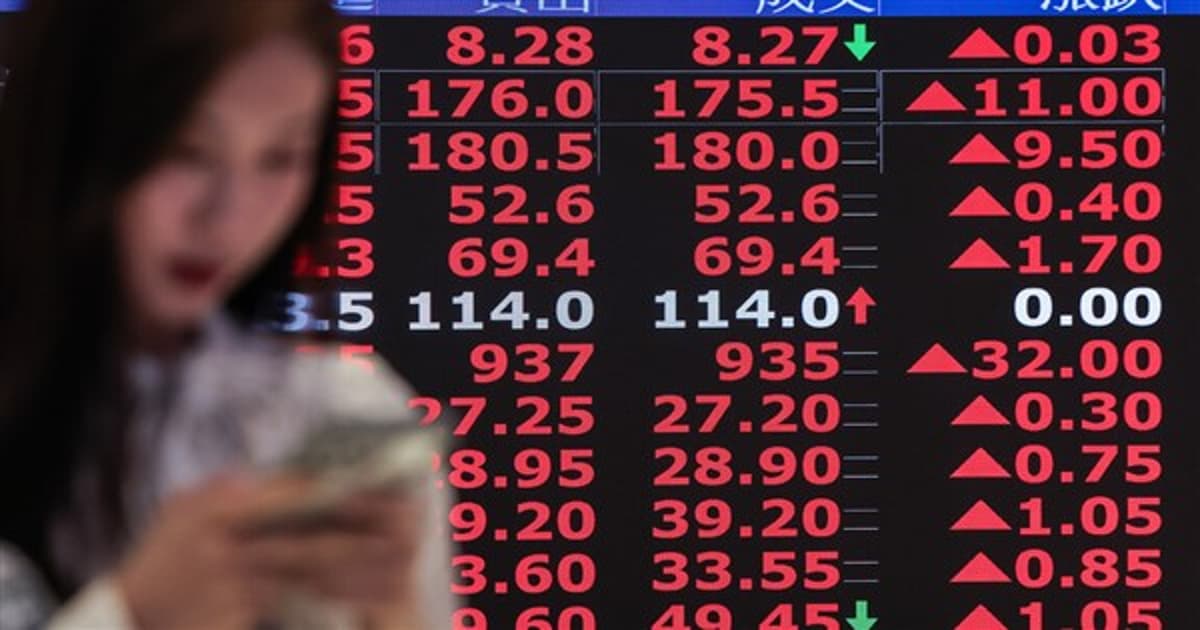
Taiex Sees Gains Limited Amid Renewed Concerns over U.S. Tariff Policies
•February 23, 2026
0

Why It Matters
The session highlights how U.S. trade policy volatility can quickly reshape Taiwan’s tech‑heavy market, influencing both semiconductor giants and smaller chip suppliers. It underscores the sensitivity of global supply chains and capital flows to geopolitical risk, a key signal for investors worldwide.
Key Takeaways
- •Taiex up 0.5% despite tariff worries
- •TSMC fell 0.78% after profit‑taking
- •Memory‑chip stocks surged, led by Winbond +10%
- •Financial stocks rallied, offsetting tech losses
- •Foreign investors net bought NT$8.35 billion
Pulse Analysis
The Taiwan Stock Exchange’s benchmark index, the Taiex, demonstrated its vulnerability to external policy shocks on Feb. 23, when President Donald Trump announced fresh global tariffs after a Supreme Court decision invalidated his earlier reciprocal measures. Such announcements reverberate through Asian markets, prompting investors to reassess exposure to export‑oriented economies. In Taiwan, where high‑tech manufacturing accounts for a sizable share of GDP, tariff anxieties can swiftly dampen optimism, even after a holiday‑induced rally, as traders prioritize capital preservation over speculative gains.
Sector rotation defined the day’s dynamics. TSMC, representing over 40% of the Taiex’s market cap, experienced a 0.78% decline as profit‑taking erased roughly 280 index points, illustrating how a single heavyweight can steer overall performance. Conversely, memory‑chip producers like Winbond and Nanya capitalized on a global supply crunch, delivering double‑digit advances that attracted both domestic and foreign funds. This divergence underscores a broader trend: investors are shifting from large‑cap semiconductor leaders to niche players that can exploit short‑term shortages, thereby balancing risk while still tapping into Taiwan’s tech prowess.
Looking ahead, the market’s trajectory will likely hinge on two factors. First, upcoming U.S. tech events, notably Nvidia’s investor conference, could reignite enthusiasm for semiconductor equities if bullish guidance emerges. Second, continued foreign institutional inflows—evidenced by the NT$8.35 billion net purchase—suggest that despite tariff jitters, global capital remains eager to engage with Taiwan’s resilient export sector. Analysts will monitor how policy developments in Washington intersect with supply‑chain constraints, as these variables will shape the Taiex’s ability to sustain gains and guide strategic allocation for investors targeting Asia’s technology frontier.
Taiex sees gains limited amid renewed concerns over U.S. tariff policies
0
Comments
Want to join the conversation?
Loading comments...