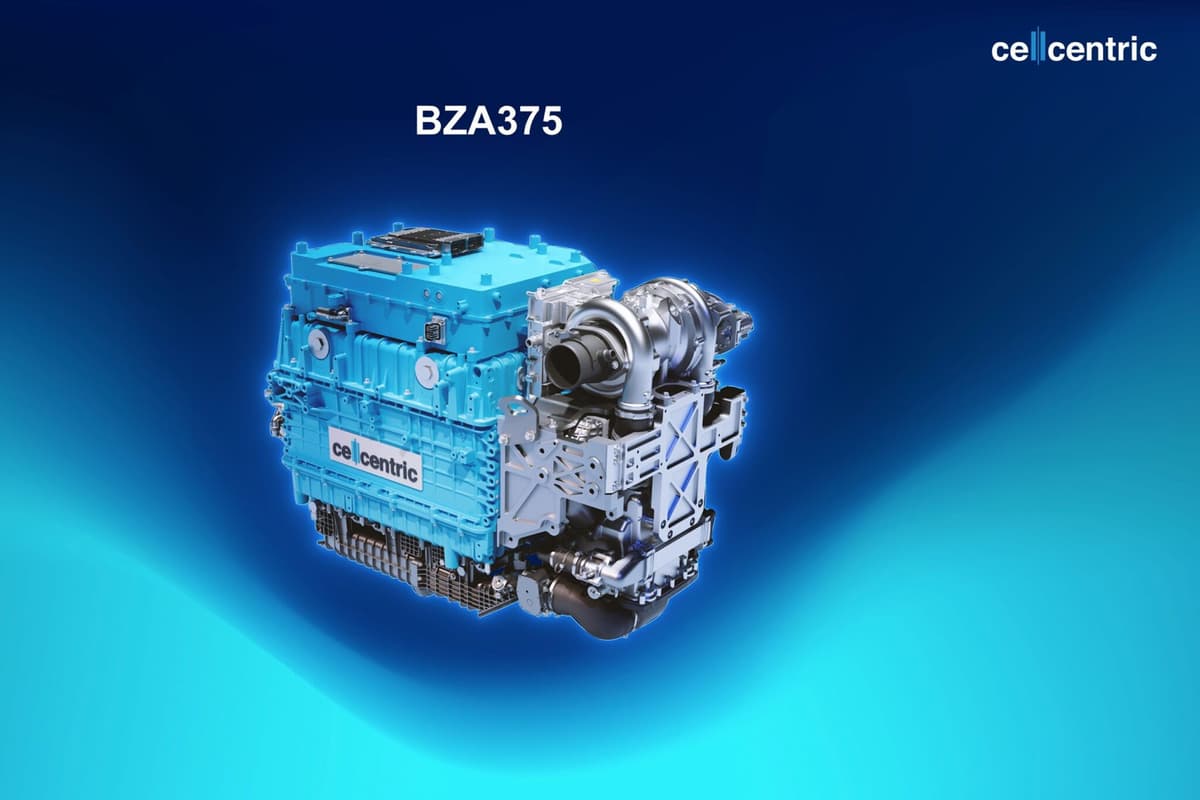
Cellcentric Launches 375 kW Truck Fuel Cell System
Companies Mentioned
Why It Matters
The BZA375’s efficiency gains and compact architecture lower operating costs and simplify retrofits, speeding the shift to zero‑emission heavy‑duty fleets. Its broad applicability promises economies of scale for the emerging hydrogen‑fuel‑cell market.
Key Takeaways
- •BZA375 offers 375 kW power in under 500 kg package.
- •Fuel use drops 20% versus BZA150, cutting hydrogen consumption.
- •Power density up 40%, with 40% fewer components.
- •Designed for 13‑litre diesel bays, enabling OEM retrofit.
Pulse Analysis
cellcentric unveiled its BZA375 fuel‑cell system at Hannover Messe 2026, positioning it as the next‑generation power source for heavy‑duty trucks. Delivering 375 kW (over 500 hp) from a single‑module that weighs less than 500 kg, the unit replaces the twin‑stack architecture of the earlier BZA150. The compact design fits within engine bays originally built for 13‑litre diesel engines, simplifying integration for original equipment manufacturers. With a projected service life of 25,000 hours—roughly ten years of intensive operation—the BZA375 promises both performance and durability for long‑haul applications. The system’s net efficiency also improves thermal management, reducing waste heat by 40% at 300 kW, which eases cooling requirements for vehicle designers.
The performance gains translate into tangible efficiency benefits. cellcentric claims a 20% reduction in hydrogen consumption and a 40% increase in power density compared with the BZA150, meaning a 40‑tonne truck would use under 6 kg of hydrogen per 100 km. Fewer components and 40% less waste heat also lower maintenance costs and improve system reliability. These efficiency metrics improve total cost of ownership, making hydrogen competitive with diesel on a per‑kilometer basis when paired with falling hydrogen production costs. By offering a Tier‑1, independent supplier model, cellcentric invites OEMs such as Daimler Truck to integrate the technology without extensive redesign, accelerating the industry’s shift toward zero‑emission freight.
Series production of the BZA375 is slated for 2030, aligning with Europe’s and North America’s aggressive hydrogen‑fuel‑cell rollout plans. Beyond trucking, the system’s modular architecture is suited for coaches, rail locomotives, mining equipment and stationary power, enabling economies of scale across multiple sectors. Early field trials with Daimler Truck are expected later this year, providing real‑world data that will inform scaling strategies and certification pathways across key markets. As governments tighten emissions standards, the ability to retrofit existing diesel platforms with a high‑power, low‑weight fuel cell could become a decisive factor for fleet operators seeking compliance and cost‑effective decarbonisation.
cellcentric launches 375 kW truck fuel cell system
Comments
Want to join the conversation?
Loading comments...