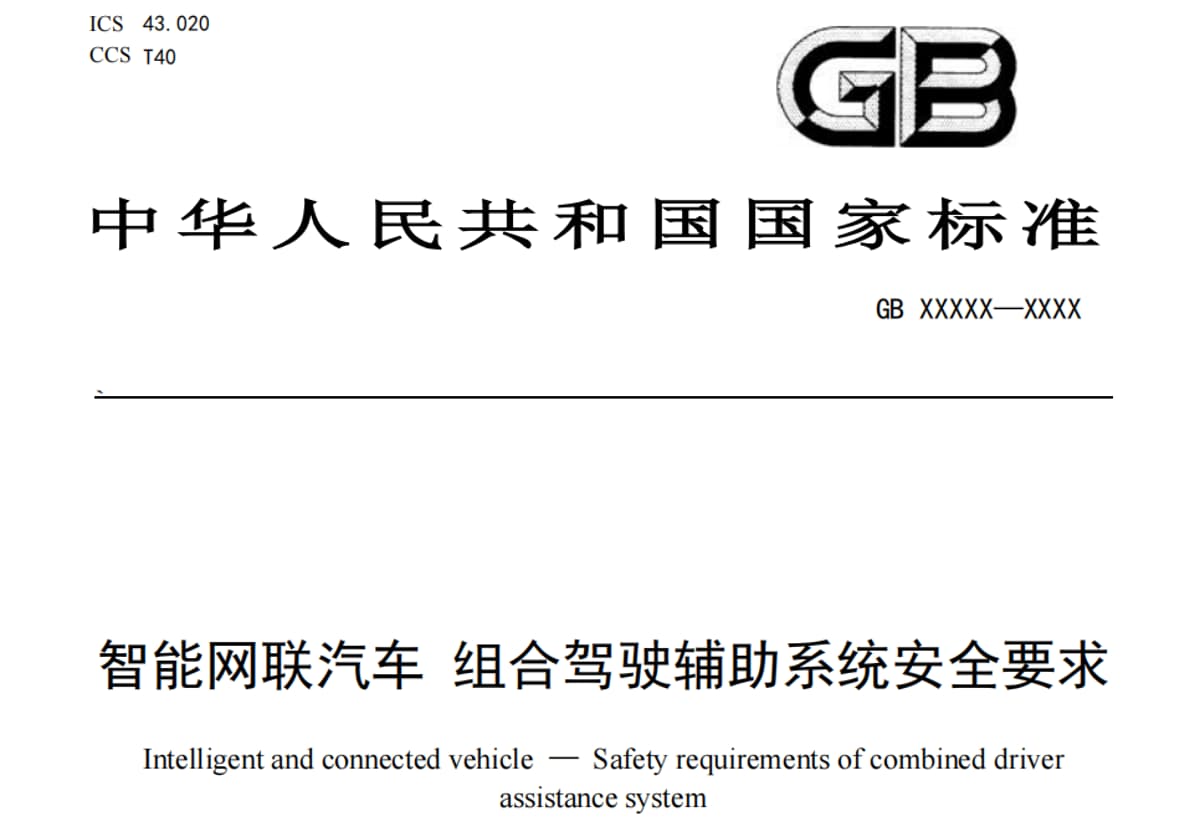
Draft for Approval of Mandatory National Standard for "Safety Requirements for Combined Driving Assistance Systems of Intelligent Connected Vehicles" Completed
Why It Matters
The standard creates a unified safety framework for advanced driver‑assistance technologies in China, forcing OEMs to upgrade design, testing and compliance processes, which will accelerate market readiness for higher‑level autonomy.
Key Takeaways
- •China finalizes mandatory safety standard for combined driving assistance systems
- •Standard defines three system tiers and driver‑state monitoring requirements
- •Hybrid testing (proving‑ground, road, simulation) mandated for type approval
- •New models must comply within 13 months; existing models have 25 months
- •Data‑recording specifications added to support post‑incident analysis
Pulse Analysis
China’s automotive regulator is moving decisively toward a regulated ecosystem for advanced driver‑assistance systems (ADAS). By codifying safety requirements for combined driving assistance systems, the MIIT aligns domestic policy with global trends that prioritize functional safety, driver monitoring, and transparent data handling. The three‑tier classification mirrors the industry’s progression from lane‑keeping aids to full‑pilot capabilities, offering a clear roadmap for manufacturers seeking to scale autonomy while satisfying stringent safety expectations.
The draft standard goes beyond high‑level mandates, prescribing granular technical specifications. Continuous detection of hands‑off and eyes‑off conditions becomes a core compliance element, with graded alerts that compel driver re‑engagement before a takeover warning. Testing regimes now require a hybrid mix of proving‑ground, real‑road, and validated simulation, ensuring that virtual results meet credibility thresholds. An appendix detailing data‑recording formats and storage further supports post‑incident investigations, a move that could streamline insurance and liability processes. The phased rollout—13 months for new type‑approval models and 25 months for existing ones—gives manufacturers a defined window to retrofit or redesign vehicles.
For OEMs and tier‑1 suppliers, the standard represents both a compliance hurdle and a market opportunity. Early adopters that integrate the mandated driver‑state monitoring and robust testing pipelines can differentiate their offerings in a crowded Chinese market, potentially gaining export advantages as other jurisdictions look to China’s regulatory model. Supply chains will need to adjust, with increased demand for sensor suites, high‑precision simulation tools, and secure data‑logging hardware. Ultimately, the rule is poised to accelerate the deployment of higher‑level ADAS, shaping the competitive landscape of intelligent connected vehicles in the world’s largest auto market.
Draft for Approval of Mandatory National Standard for "Safety Requirements for Combined Driving Assistance Systems of Intelligent Connected Vehicles" Completed
Comments
Want to join the conversation?
Loading comments...