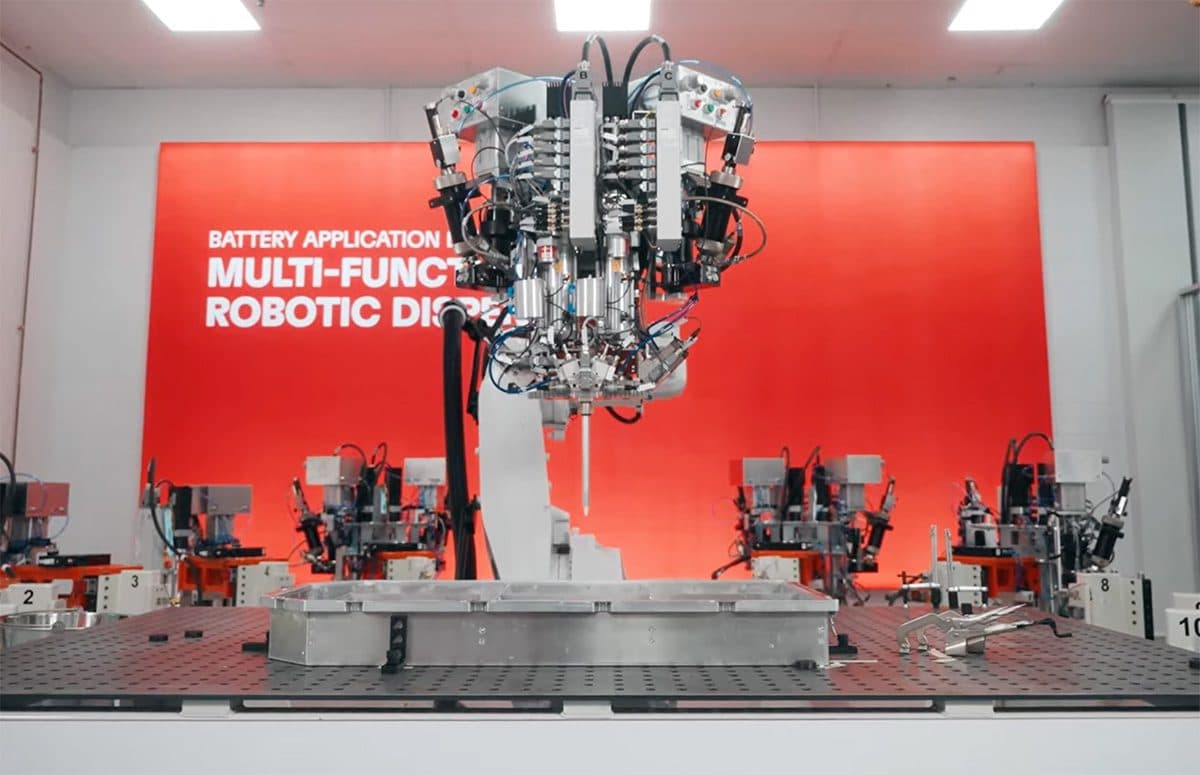
Inside Henkel’s Battery Application Center, Where Adhesive Formulations Meet Production-Line Robots
Companies Mentioned
Why It Matters
By bridging lab and line, Henkel accelerates adhesive qualification, reducing time‑to‑market for EV battery manufacturers and addressing tightening repairability and recycling regulations.
Key Takeaways
- •Production‑grade robot dispenses one‑ and two‑component adhesives
- •Real‑time data on bead geometry and temperature captured
- •De‑bonding adhesives enable repair and recycling of battery packs
- •Digital twin modeling shortens development cycles and ensures scale‑up consistency
Pulse Analysis
The surge in electric‑vehicle production has turned battery pack assembly into a high‑stakes engineering challenge, where adhesive performance directly impacts safety, durability, and manufacturing efficiency. Henkel’s Battery Application Center answers this need by replicating full‑scale production conditions inside a laboratory setting. Equipped with a six‑axis ABB robot, multi‑material dispense heads, and temperature‑controlled pump stations, the center lets battery makers evaluate polyurethane, epoxy, silicone and thermal adhesives on actual cell housings, capturing precise metrics on bead geometry, flow rates, and cure temperatures.
Beyond standard dispensing, the center is pioneering "de‑bond on demand" technologies that allow adhesives to release under controlled electrical or thermal triggers. This capability addresses emerging regulatory pressures in Europe and North America that demand repairability and end‑of‑life recyclability for EV batteries. By collaborating with OEMs to develop reversible bonds, Henkel helps manufacturers design packs that can be serviced in‑plant, repaired in the field, or efficiently disassembled for material recovery, mitigating the risk of single‑use battery assemblies.
The strategic value of the facility lies in its feedback loop to Henkel’s R&D pipeline. Real‑world data collected at the center informs digital twin simulations, shortening physical iteration cycles and ensuring that formulations qualified in the lab perform identically on high‑volume production lines. This co‑engineering model accelerates time‑to‑market, reduces development costs, and strengthens Henkel’s position as a critical supplier in the rapidly evolving e‑mobility ecosystem.
Inside Henkel’s Battery Application Center, where adhesive formulations meet production-line robots
Comments
Want to join the conversation?
Loading comments...