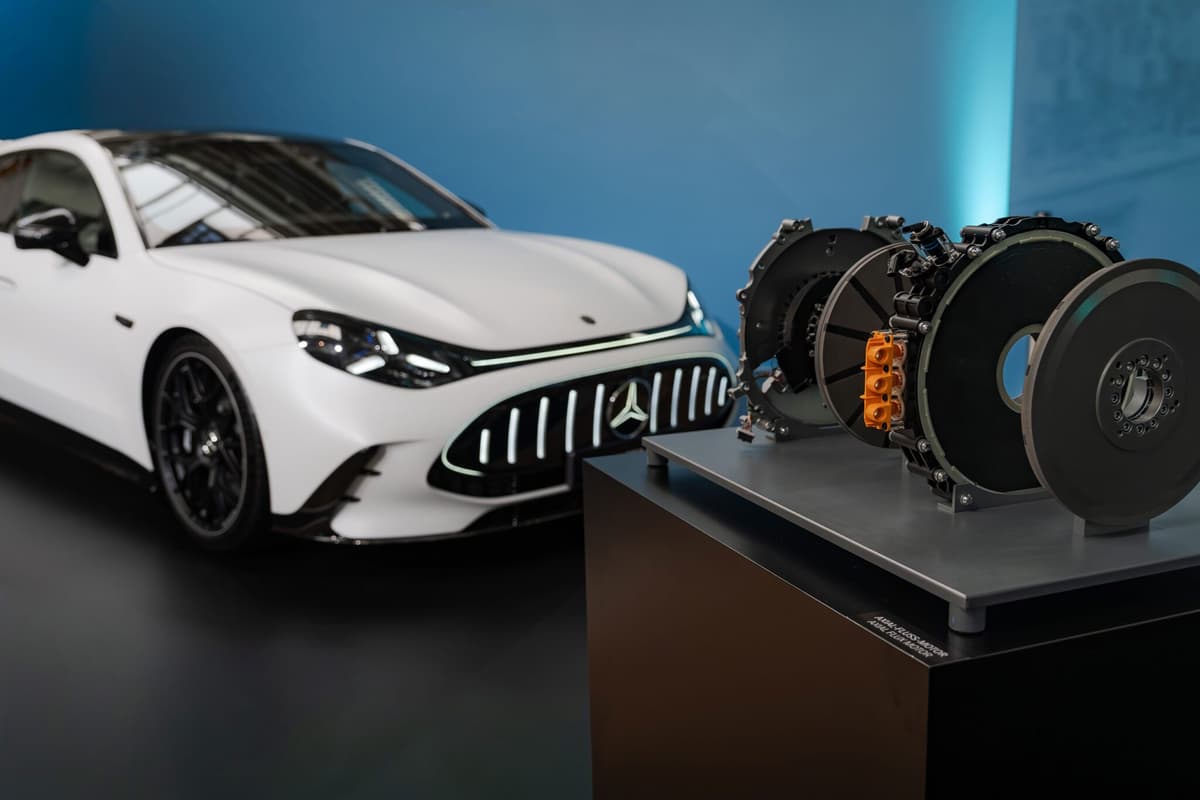
Mercedes-Benz Starts Axial Flux Motor Production in Berlin
Companies Mentioned
Why It Matters
Mass‑producing axial‑flux motors gives Mercedes a performance edge and signals a shift toward denser, more efficient EV powertrains across the industry.
Key Takeaways
- •30,000 sqm facility launches axial flux motor production
- •35 of 98 process steps are brand‑new worldwide
- •Over 30 patents filed for the new motor technology
- •Motor enables 0‑100 km/h in 2.1 seconds, 300 km/h top speed
- •AI‑driven quality control ensures 0.1 mm assembly tolerance
Pulse Analysis
Axial flux motors have long been a niche concept, promising higher power density than the traditional radial designs that dominate most electric vehicles. The technology, pioneered by British specialist YASA, arranges the stator between two rotors, allowing magnetic flux to travel parallel to the shaft and delivering a disc‑shaped package that is both lighter and more compact. While prototypes have demonstrated impressive performance, scaling the design to mass production has remained elusive—until Mercedes‑Benz’s recent rollout, which turns a decades‑old laboratory idea into a factory‑ready powertrain.
The Berlin‑Marienfelde plant, Mercedes‑Benz’s oldest factory, now hosts a 30,000‑square‑metre “axial flux programme” spread across three halls and seven production lines. Of the 98 steps required to build the High Performance Electric Drive Unit, 35 are brand‑new globally, and more than 30 patent applications have been filed to protect the process. Production relies on laser‑welded copper coils, AI‑assisted optical inspection of polymer welds, and a final assembly that tolerates magnetic forces up to 9 kN while keeping stator alignment within 0.1 mm. The Digital Factory Campus links these operations to Mercedes’ worldwide network, accelerating data‑driven improvements.
The first vehicle to receive the new motor, the Mercedes‑AMG GT 4‑Door Coupe, accelerates from 0‑100 km/h in 2.1 seconds and tops out at 300 km/h, figures that rival many supercars while delivering zero‑emission performance. By mastering axial flux at scale, Mercedes positions itself ahead of rivals such as Tesla and BMW, who are still exploring alternative motor architectures. The move also signals to suppliers that high‑density electric drivetrains are becoming mainstream, likely spurring further investment in compact motor research and reshaping the EV powertrain landscape over the next decade.
Mercedes-Benz starts axial flux motor production in Berlin
Comments
Want to join the conversation?
Loading comments...