Understanding Sichuan's Automotive Industry Cluster at a Glance | Gasgoo Global Automotive Industry Big Data
Companies Mentioned
Why It Matters
The multi‑pole cluster boosts Sichuan’s resilience and positions it as a key growth engine in China’s shift toward electrified and connected vehicles, attracting investment and talent across the supply chain.
Key Takeaways
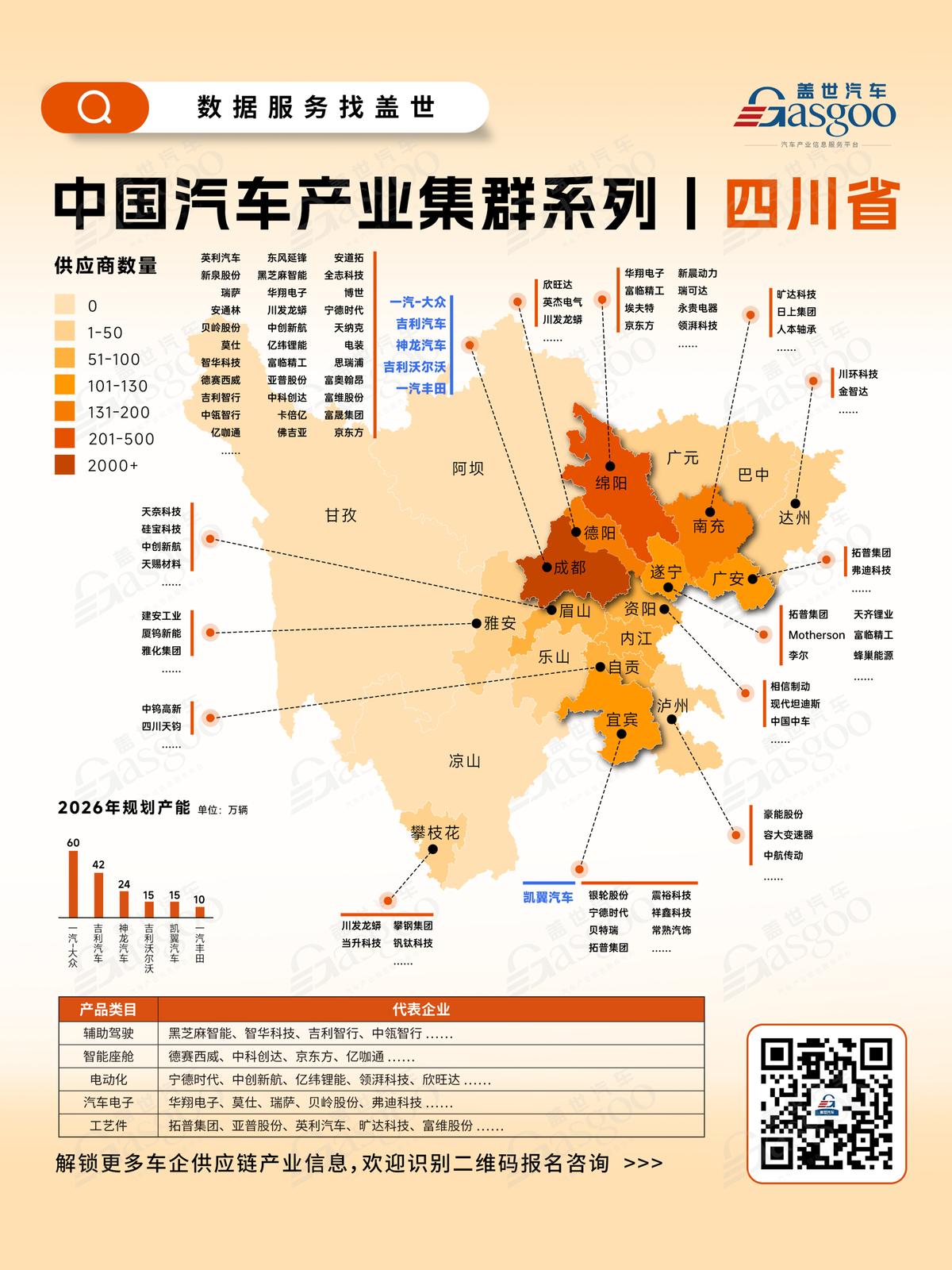
- •Chengdu hosts 2,000+ auto suppliers, covering production and tech
- •Mianyang specializes in automotive intelligence, sensors, and IoT integration
- •Deyang provides core component manufacturing and battery power systems
- •Planned 2026 output exceeds 1.66 million units, led by FAW‑Volkswagen
Pulse Analysis
Sichuan’s automotive ecosystem illustrates how regional specialization can drive national competitiveness. Chengdu, the provincial capital, anchors the cluster with a dense network of over 2,000 suppliers spanning vehicle assembly, intelligent connectivity, and automotive electronics. The presence of global‑scale OEMs—FAW‑Volkswagen, Geely, Dongfeng Peugeot‑Citroën and FAW‑Toyota—creates a virtuous loop that attracts high‑tech firms like Black Sesame and Desay SV, turning the city into a dual‑core hub where manufacturing and innovation coexist.
South of Chengdu, Mianyang leverages its legacy in electronic information to carve out a niche in automotive intelligence. Companies such as Huaxiang Electronics and BOE focus on sensor technology, communications, and software‑hardware integration, laying the groundwork for autonomous driving and Internet‑of‑Vehicles applications. Meanwhile, Deyang sustains the supply chain’s backbone with robust component manufacturing and battery‑related power systems, exemplified by firms like Yingjie Electric and Sunwoda. This division of labor ensures that each city contributes distinct value, reinforcing the overall resilience of Sichuan’s auto sector.
Looking ahead, the province’s target of over 1.66 million vehicles by 2026 signals a strategic push toward new‑energy and smart‑vehicle production. The concentration of OEM capacity—600,000 units from FAW‑Volkswagen alone—combined with a thriving supplier base, positions Sichuan to capture a larger share of China’s electrified‑vehicle market. However, achieving deeper supply‑chain integration and more efficient resource allocation will be critical to sustain growth, mitigate risks, and elevate the region’s standing on the global automotive stage.
Understanding Sichuan's Automotive Industry Cluster at a Glance | Gasgoo Global Automotive Industry Big Data
Comments
Want to join the conversation?
Loading comments...