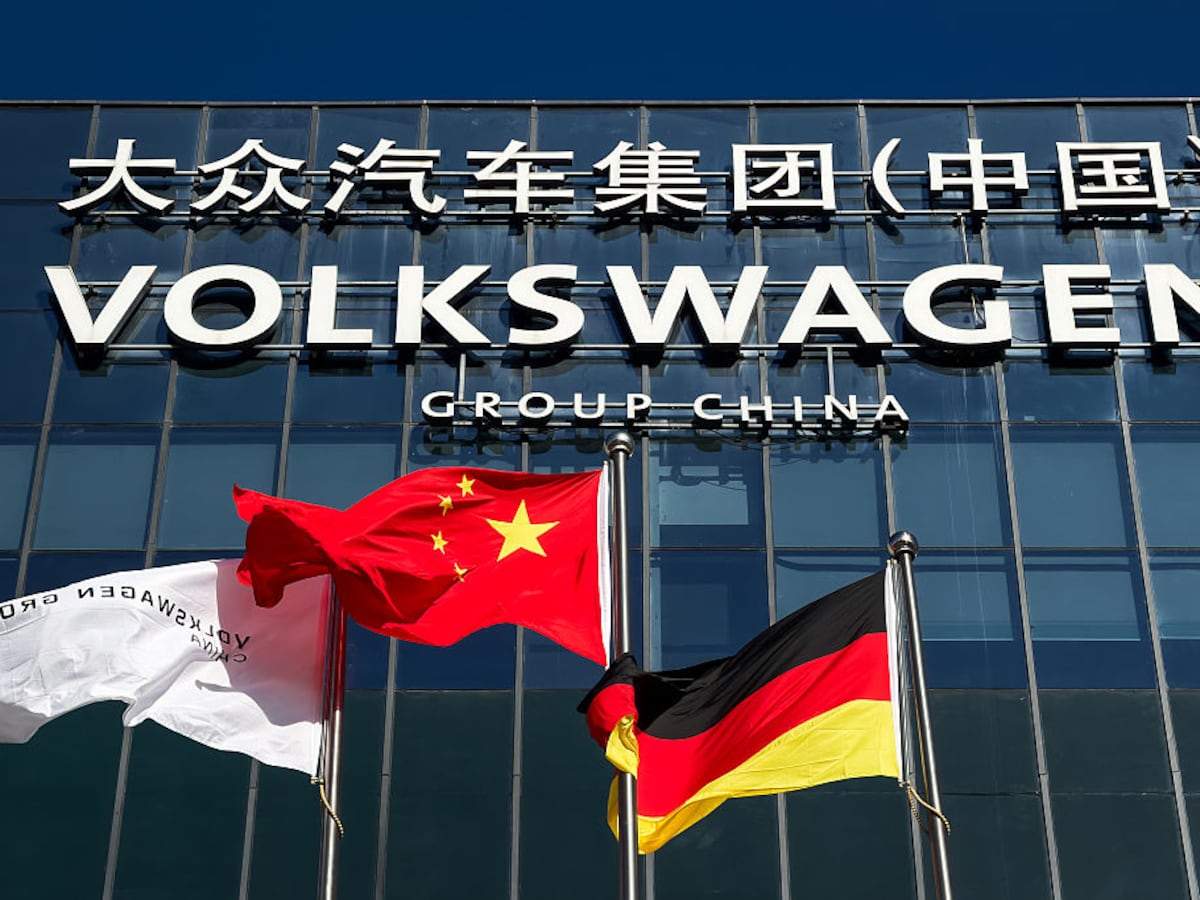
Volkswagen Slashes China Targets as Competition Erodes Growth Outlook
Companies Mentioned
Why It Matters
The downgrade signals intensified competition and slowing growth in the world’s largest auto market, forcing legacy manufacturers to accelerate EV strategies and streamline operations. It reshapes the competitive landscape for both foreign and domestic Chinese carmakers.
Key Takeaways
- •Volkswagen cuts 2030 China sales target to 3.2 million units.
- •Operating margin goal lowered to 4‑6% from previous double‑digit range.
- •Production capacity reduced by 1.5 million units since 2023.
- •Workforce shrank to 70,000 employees, down from 90,000.
- •New EV models launched to regain market share in China.
Pulse Analysis
Volkswagen’s revised China outlook underscores a broader shift in the global automotive sector, where slowing demand and fierce competition are prompting legacy OEMs to recalibrate expectations. China, accounting for roughly a third of worldwide vehicle sales, has seen growth decelerate as consumers gravitate toward electric mobility and domestic brands sharpen their value propositions. By slashing its 2030 sales target to 3.2 million units, VW acknowledges that the market’s structural dynamics no longer support the aggressive volume growth it once pursued.
The strategic retreat includes a 1.5 million‑unit cut in production capacity and a 22% reduction in staff, reflecting a disciplined effort to align cost structures with realistic revenue forecasts. Lowering the operating‑margin target to 4‑6% signals a move away from the high‑margin premium segment that previously buoyed profitability. Simultaneously, VW is accelerating its China‑specific electric‑vehicle program, unveiling four new EV models across VW, Jetta, and Audi lines to capture the rapidly expanding EV buyer base. This dual focus on cost efficiency and localized EV innovation aims to preserve market relevance while navigating tighter profit constraints.
Industry observers see VW’s pivot as a bellwether for other foreign manufacturers operating in China. The emphasis on locally tailored EVs and streamlined operations may prompt rivals to reassess their own capacity and investment plans, potentially spurring further consolidation or joint‑venture restructuring. As Chinese consumers increasingly prioritize technology, range, and price, the ability of legacy brands to adapt will determine their long‑term viability in the world’s most important automotive market.
Volkswagen slashes China targets as competition erodes growth outlook
Comments
Want to join the conversation?
Loading comments...