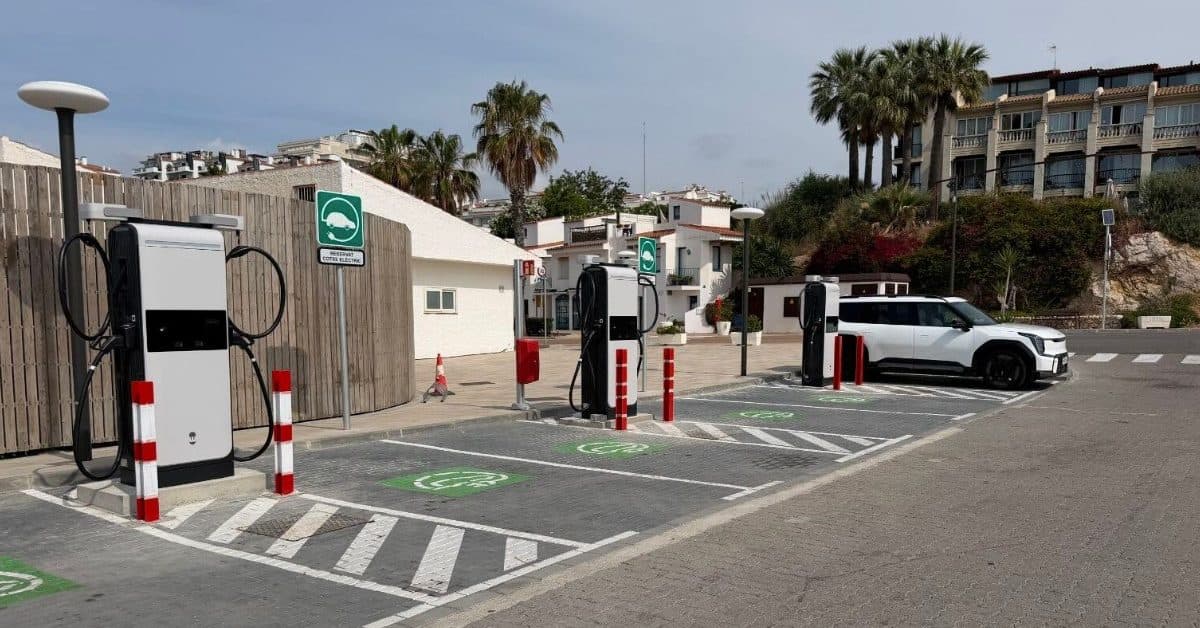
Wallbox Deploys Its First Supernova PowerRing DC Fast Chargers
Companies Mentioned
Why It Matters
The technology shows operators can expand fast‑charging networks without costly grid upgrades, a critical advantage as EV adoption accelerates.
Key Takeaways
- •First public Supernova PowerRing deployment at Spain’s Port de Sitges.
- •Shared 240 kW capacity across three chargers; scalable to 720 kW.
- •System allocates 80‑240 kW per vehicle, up to 400 kW if capable.
- •Enables operators to maximize limited grid connections and space.
- •Marks start of Wallbox’s broader European fast‑charging rollout.
Pulse Analysis
The rapid growth of electric‑vehicle (EV) fleets has outpaced the ability of many urban grids to supply high‑power charging stations. Traditional DC fast chargers draw a fixed amount of electricity, often requiring costly upgrades to meet peak demand. Wallbox’s Supernova PowerRing challenges that model with a shared‑capacity architecture that dynamically allocates power among multiple units. By treating the charger cluster as a single, flexible resource, operators can extract more performance from existing grid connections, reducing capital expenditure while still delivering ultra‑fast charging rates.
The inaugural public installation at Port de Sitges in Spain showcases the system in a real‑world setting. Three Supernova units collectively provide up to 240 kW, which the software can redistribute so a single vehicle may receive 80 kW, 240 kW, or even 400 kW when the hardware is expanded to its 720 kW ceiling. This elasticity means a busy marina can serve multiple EVs without overloading the local transformer, and high‑end models can still enjoy top‑tier charging speeds. The modular design also simplifies maintenance, as individual modules can be serviced without shutting down the entire site.
Wallbox’s rollout signals a broader shift in Europe toward smarter, grid‑friendly charging infrastructure. As municipalities grapple with limited underground space and stringent permitting processes, the PowerRing’s ability to squeeze more power out of a modest connection makes it attractive to both public operators and private developers. The technology could accelerate the deployment of fast‑charging networks along highways, ports, and dense city centers, helping meet the EU’s target of 30 million EVs by 2030. Investors and OEMs will be watching closely to see if Wallbox can scale the model beyond pilot sites.
Wallbox deploys its first Supernova PowerRing DC fast chargers
Comments
Want to join the conversation?
Loading comments...