SlipLift expands warehouse robotics beyond high‑frequency, short‑haul lanes, delivering measurable labor savings and throughput gains for heavier, multi‑site supply chains.
Dock operations have long struggled with variability—different trailer types, freight weights, and limited connectivity often force manual, time‑consuming unloads. SlipLift tackles these pain points by offering a plug‑and‑play robotic system that requires no Wi‑Fi or complex IT hookups, delivering consistent five‑minute turnarounds regardless of cargo type. This simplicity lowers the barrier for midsize distributors and manufacturers to adopt autonomous loading, a capability previously reserved for high‑frequency, short‑haul routes.
The technical edge of SlipLift lies in its payload‑agnostic design. By separating the robot from the SlipCarrier tray, the platform can handle loads up to 20,000 lb, covering heavy automotive assemblies, dense paper products, and bulk food items. This decoupling also means a single robot can service multiple docks, dramatically improving robot‑per‑door ratios and reducing capital expense. Integrated as a Robotics‑as‑a‑Service (RaaS) offering, SlipLift provides predictable OPEX, allowing customers to scale automation without expanding their robot fleet.
For the broader logistics ecosystem, SlipLift’s capabilities signal a shift toward more flexible, site‑agnostic automation. Companies like John Deere and GE Appliances are already piloting the technology, reporting higher dock throughput and safer work environments. As regional distribution centers and last‑mile hubs adopt SlipLift, the economics of pre‑staging freight improve, enabling more deliveries per driver shift and easing dock congestion. The upcoming MODEX showcase will likely accelerate market adoption, positioning Slip Robotics as a key player in the next wave of warehouse and transportation automation.

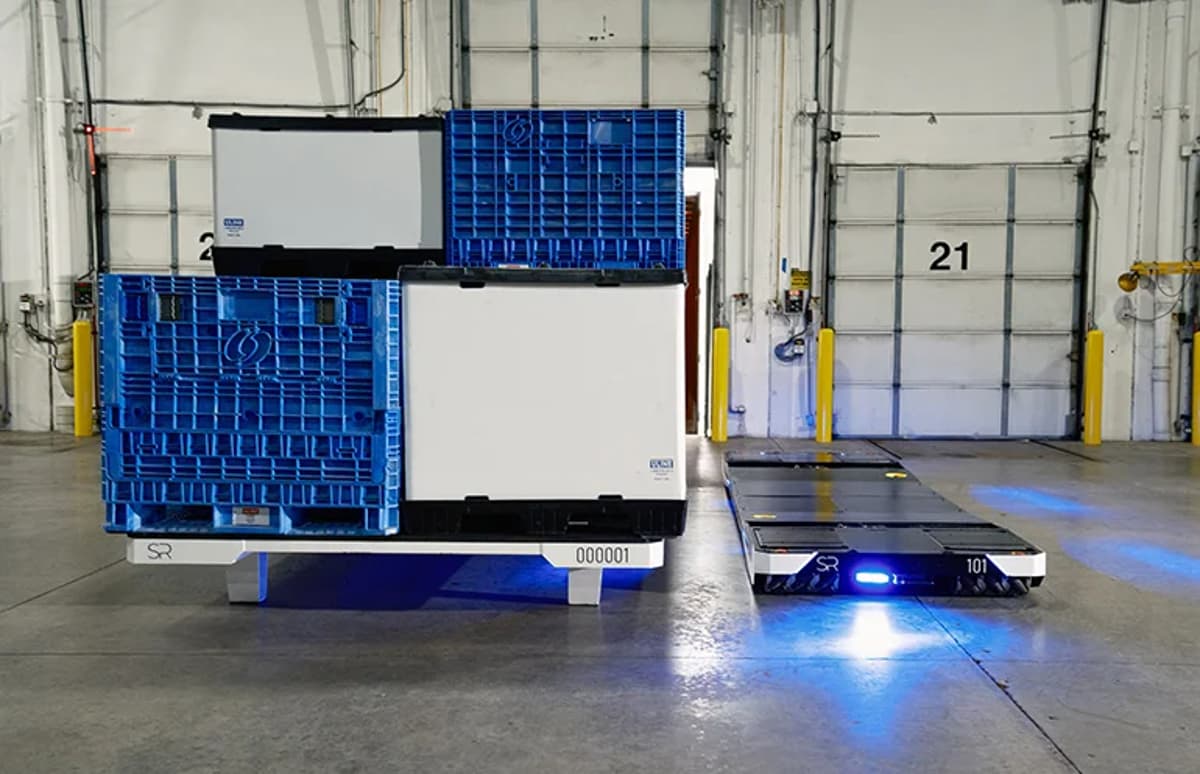
SlipLift + SlipCarrier Tray autonomously load and unload any truck in five minutes. Source: Slip Robotics
LAS VEGAS — Instead of unloading boxes, cases, or pallets from a trailer, the Slip system from Slip Robotics slides out an entire load at once. At Manifest this week, the company unveiled SlipLift, a new platform that decouples the mobile robot from the platform for greater agility and utilization rates.
Slip Robotics said it designed SlipLift to extend autonomous trailer loading and unloading beyond short-haul, high-frequency routes to heavier freight, regional distribution, and last-mile delivery applications.
“We’ve always focused on removing uncertainty at the dock,” said Chris Smith, CEO of Slip Robotics. “SlipLift extends that philosophy. Customers get fast, repeatable load and unload times across more routes, without adding robots or complexity.”
Slip Robotics claimed that its robotic platforms can automatically load or unload any truck in five minutes — at any dock, with any type of freight, in any trailer, and with no Wi-Fi or IT integration required. The Norcross, Ga.-based company said it can help organizations reduce variability at the dock while improving throughput, safety, and operational predictability across supply chains.
Companies across North America using SlipBots in 24/7 production operations include John Deere, GE Appliances, Nissan, and Valeo.
By decoupling the robot from the payload, Slip Robotics said that SlipLift delivers SlipBot-level speed, safety, and labor savings. Fewer robots can cover more docks, resulting in faster and more predictable dock operations, said the company.
Slip Robotics introduced SlipBot to solve short-haul, high-frequency, closed-loop loading. SlipLift builds directly on that foundation, extending Slip’s robots-as-a-service (RaaS) model to routes and applications where payload weight, route length, or dock variability previously limited automation.
“SlipLift lets customers scale automation without scaling complexity,” said Smith. “We’re delivering faster and more predictable dock operations, keeping people out of trailers, and making deployment as simple as rolling the system onto the dock.”
Save the date for the 2026 Robotics Summit
As Slip worked with customers across manufacturing, distribution, and logistics, it saw a clear pattern emerge.
“We kept hearing the same thing from customers,” said Smith. “They wanted the same fast, predictable dock turns we deliver today, but for heavier freight and more routes. SlipLift came directly out of those conversations—it’s about meeting customers where their operations actually are.”
Heavy short-haul, high-velocity operations such as food and beverage, packaging and paper products, and dense automotive assemblies can benefit from SlipLift’s support for payloads up to 20,000 lb. (9,071.8 kg), said Slip Robotics.
Regional and medium-haul distribution networks, including consumer packaged goods, cold chain hubs, and furniture distribution, can now use fewer robots to service more doors, the company noted. Decoupling robots from individual shipments allows automation to scale across multi-site networks without requiring a robot at every door.
Last-mile delivery operations can benefit from SlipLift’s ability to pre-stage freight ahead of daily routes Slip added. Morning load-outs can be completed in minutes, enabling more deliveries per day while reducing driver dwell time and congestion at the dock.
“Pre-staging changes the economics of last-mile loading,” said Lauren Marneni, head of product at Slip Robotics. “When freight is ready on a SlipCarrier, loading becomes a quick, repeatable process instead of a daily scramble.”
SlipLift operates through a simple, repeatable workflow. A SlipLift picks up a loaded SlipCarrier from the dock, autonomously places it inside a trailer or box truck, and exits before repeating the process until the load is complete. Operators remain outside the trailer using a handheld controller, while the robot handles navigation, alignment, and placement.
“Our goal was to make autonomy feel natural for operators,” Marneni added. “The operator stays in control, but the robot does the hard, dangerous work inside the trailer. That’s how you improve safety without slowing things down.”
SlipCarriers are a key enabler of this flexibility, said Slip Robotics. Instead of modifying robots to handle new freight types, SlipCarriers can be customized to support different payloads, simplifying configuration and expansion, it explained. When empty, SlipCarriers stack, saving dock space and enabling efficient transport.
After showing SlipLift at Manifest, Slip Robotics said it will bring the robot to MODEX 2026. Initial deployments are underway, and the company plans to make SlipLift broadly availabile this year.
The post SlipLift automates trailer unloading for more sites, says Slip Robotics appeared first on Automated Warehouse.
Comments
Want to join the conversation?
Loading comments...