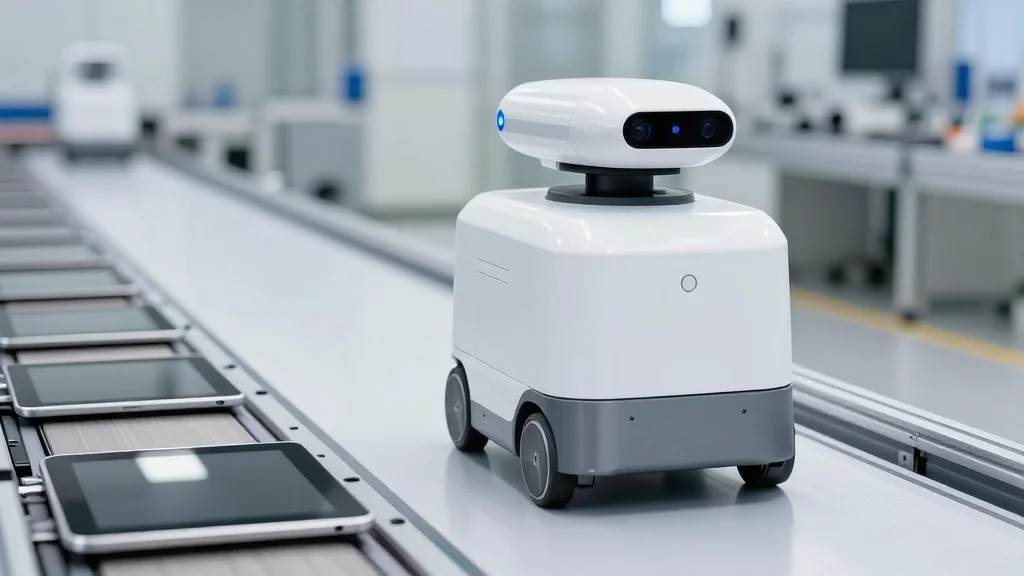
Agibot G2 Completes 8‑Hour Error‑Free Run, Paving Way for 100‑Unit Rollout

Companies Mentioned
Why It Matters
The G2’s error‑free eight‑hour run demonstrates that embodied AI can meet the reliability standards required for mass production, a hurdle that has limited wider adoption of autonomous robots. By proving that a single robot can handle thousands of tasks without human oversight, Agibot challenges the prevailing belief that human‑supervised automation is necessary for high‑mix manufacturing. The planned 100‑unit expansion signals a shift toward large‑scale, flexible automation that could reduce labor costs, improve product quality, and accelerate time‑to‑market across multiple industries. If the G2’s performance scales as promised, manufacturers in automotive and semiconductor sectors—traditionally reliant on highly specialized equipment—may adopt similar embodied AI solutions, reshaping supply chains and competitive dynamics. The success also validates the Genie Sim 3.0 digital twin platform, suggesting that rapid, low‑risk deployment could become a standard practice, further lowering barriers to entry for advanced robotics.
Key Takeaways
- •Agibot G2 completed 8‑hour, 2,283‑task run with zero errors at Longcheer's tablet factory
- •Production rate reached 310 tablets per hour, with each operation taking 18‑20 seconds
- •Digital twin platform reduced debugging from months to 36 hours; total deployment time was four months
- •Company plans to install 100 G2 units by Q3 2026, expanding into automotive and semiconductor lines
- •Equipment reuse rate reported at 95%, and line changeovers require under four hours
Pulse Analysis
Agibot’s breakthrough with the G2 robot illustrates a turning point in the economics of factory automation. Historically, manufacturers have hesitated to replace legacy robotic arms because of high upfront costs, long integration cycles, and the need for custom tooling. The G2’s ability to adapt to multiple product models in under four hours, combined with a 95% reuse rate, dramatically improves the total cost of ownership. This could accelerate the shift from fixed‑function automation to flexible, AI‑driven platforms, especially in sectors where product cycles are shortening.
The rapid deployment timeline—four months from project kickoff to live operation—was made possible by the Genie Sim 3.0 digital twin. By simulating the entire production line virtually, Agibot eliminated the trial‑and‑error phase that traditionally consumes months of engineering resources. This approach not only shortens time‑to‑value but also reduces risk for manufacturers wary of costly downtime. As more firms adopt digital twins, the barrier to entry for sophisticated robotics will lower, potentially democratizing access to high‑precision automation.
Looking ahead, the real test will be whether the G2 can maintain its zero‑error record at scale across diverse manufacturing environments. The planned expansion to 100 units will expose the system to varied product mixes, higher throughput demands, and different operational constraints. Success would cement Agibot’s position as a leader in embodied AI and could trigger a wave of investment in similar technologies. Conversely, any degradation in performance could reinforce skepticism about the reliability of autonomous robots in complex, real‑world settings. Stakeholders should watch the upcoming deployments closely, as they will likely set the benchmark for the next generation of factory automation.
Agibot G2 Completes 8‑Hour Error‑Free Run, Paving Way for 100‑Unit Rollout
Comments
Want to join the conversation?
Loading comments...