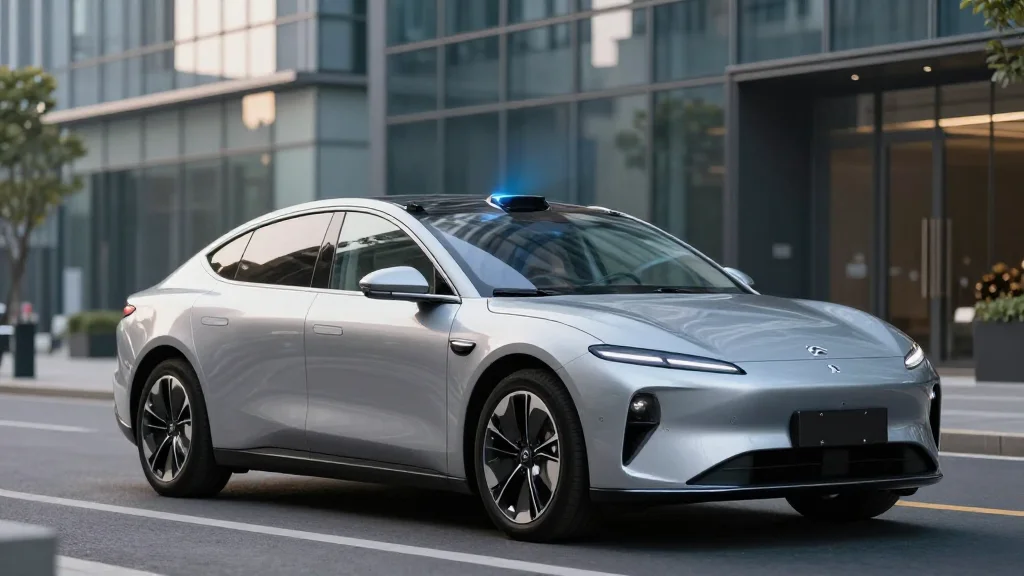
AI Drives the New Horsepower at Beijing Auto Show, Boosting Autonomy Race

Why It Matters
The Beijing Auto Show’s AI‑centric focus signals a watershed moment for autonomous vehicle development. By treating intelligence as the primary source of horsepower, manufacturers are redefining performance metrics away from raw engine output toward computational capability, safety and user experience. This shift could accelerate regulatory acceptance of higher‑level autonomy, as demonstrable safety gains become a marketable asset. Moreover, the deepening hardware‑software partnerships, exemplified by Onsemi’s 900 V collaboration with Nio, address a long‑standing bottleneck: the need for power‑dense, thermally efficient platforms to support the massive compute loads of modern perception stacks. As Chinese OEMs scale these solutions, they may set de‑facto standards that influence global supply chains, potentially reshaping the competitive landscape for autonomous technology worldwide.
Key Takeaways
- •1,451 vehicles displayed, including 181 premieres and 71 concept cars
- •Momenta’s R7 model uses reinforcement‑learning to train on rare "long‑tail" scenarios
- •Onsemi’s EliteSiC M3e technology will power Nio’s new 900 V architecture
- •Chery‑Bosch joint 48‑volt program targets mass production in China
- •Physical AI framed as the new horsepower, shifting performance focus from engine output to AI capability
Pulse Analysis
The Beijing International Auto Show has crystallized a strategic inflection point for the autonomy sector. Historically, Chinese automakers have leveraged scale and cost advantage to dominate volume markets. This year, the narrative pivot to "physical AI" reflects a deliberate move up the value chain, where differentiation hinges on proprietary perception and decision‑making algorithms rather than manufacturing efficiency alone. Companies like Momenta are betting that reinforcement‑learning models trained on simulated edge cases can deliver safety margins that regulators will eventually codify into higher autonomy grades.
Hardware integration is the other side of the equation. The Onsemi‑Nio partnership illustrates how silicon‑carbide power devices are becoming as critical as GPUs for autonomous stacks. By enabling 900 V architectures, manufacturers can support higher‑power sensor arrays, lidar, and edge‑compute platforms without compromising range or thermal budgets. This convergence of AI software and high‑density power electronics could compress the timeline for Level‑4 deployments, especially in densely populated Chinese cities where infrastructure constraints demand rapid charging and robust safety margins.
Finally, the "integrated exhibition" model signals a broader industry restructuring. When suppliers and OEMs co‑locate, they can iterate hardware and software in lockstep, reducing development cycles and fostering ecosystem lock‑in. For investors and policymakers, the takeaway is clear: the next wave of automotive growth will be measured in teraflops and silicon‑carbide wafers, not just horsepower. Companies that can orchestrate seamless collaboration across the supply chain will capture the lion's share of the emerging autonomous market, both domestically and abroad.
AI Drives the New Horsepower at Beijing Auto Show, Boosting Autonomy Race
Comments
Want to join the conversation?
Loading comments...