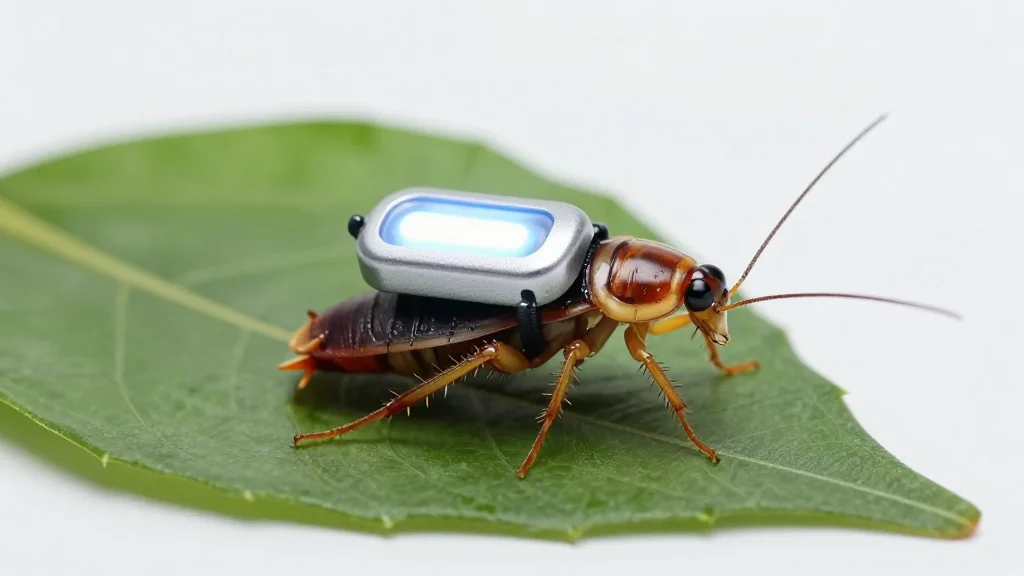
AI Listens to Insect Body Signals to Guide Cyborg Cockroaches
Why It Matters
By listening to physiological cues, the ISC enables more humane, efficient control of living robots, expanding their viability for search‑and‑rescue, environmental monitoring, and other high‑risk tasks.
Key Takeaways
- •ISC integrates heartbeat, neural signals, and motion for AI-driven control
- •Random Forest model achieved 93% accuracy classifying five environmental states
- •Closed-loop stimulation guided cockroaches through mazes with reduced intervention
- •Approach shifts from commanding insects to listening to their physiological state
- •Framework could extend to other organisms for bio‑hybrid sensing applications
Pulse Analysis
Bio‑hybrid robotics has long wrestled with the ethical and technical challenges of commandeering living organisms. Traditional approaches treat insects as simple locomotion platforms, relying on external cues such as light or temperature to steer them. This method often ignores the animal’s own physiological responses, leading to erratic behavior and limited reliability in complex environments. The new Insect Synergy Circuit (ISC) reframes the problem: instead of imposing commands, it listens to the insect’s internal signals—heartbeat, low‑frequency neural activity, and movement—creating a richer feedback loop that mirrors natural decision‑making processes.
The Osaka team’s implementation involves a lightweight backpack fitted to Madagascar hissing cockroaches. Sensors continuously record cardiac and neural data while inertial units track motion. Machine‑learning models, particularly a Random Forest classifier, were trained on data from five distinct conditions—baseline, UV light, chemical exposure, heat, and food presence—reaching 93% classification accuracy. In real‑time maze trials, the AI selectively delivered UV or vibration stimuli only when the inferred state was attractive or neutral, allowing the insect’s own avoidance responses to dominate otherwise. This closed‑loop control reduced unnecessary interventions and enabled several cockroaches to complete the maze, a feat unattainable with prior behavior‑only systems.
The implications extend beyond academic curiosity. A control paradigm that respects an organism’s internal state could make bio‑hybrid agents viable for disaster response, where navigating rubble or toxic atmospheres demands both agility and adaptability. Moreover, the ISC framework is adaptable to other species—potentially fish, worms, or even plant‑based sensors—opening pathways for ultra‑small, self‑sustaining monitoring networks. As the field progresses, balancing performance gains with animal welfare and regulatory oversight will be crucial, but the ISC demonstrates that cooperative, state‑aware bio‑robotics is within reach.
AI listens to insect body signals to guide cyborg cockroaches
Comments
Want to join the conversation?
Loading comments...