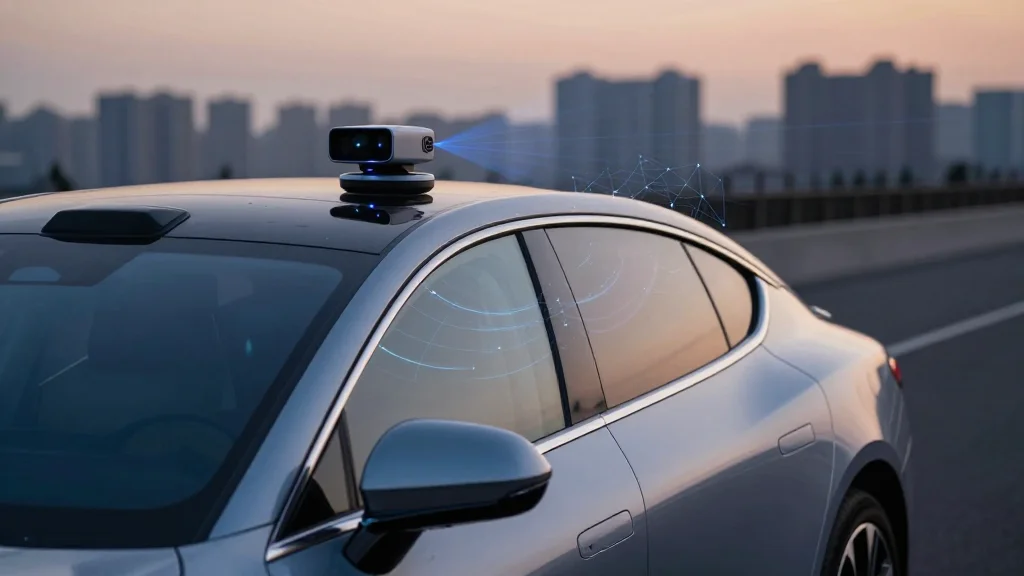
Applied AI in Autonomous Vehicles Market Projected to Hit $202.55 B by 2035

Why It Matters
The projected expansion to $202.55 billion underscores the strategic importance of AI as the core enabler of next‑generation transportation. A market of this magnitude will attract sustained venture funding, reshape supply chains for chips and sensors, and pressure regulators to craft new safety standards. For automakers, the forecast signals a competitive imperative to integrate advanced AI stacks now, rather than risk obsolescence as robotaxi services and Level 4 capabilities become mainstream. Beyond economics, the scale of AI adoption in vehicles raises broader societal questions about data privacy, cybersecurity, and the future of urban mobility. If the forecast holds, autonomous vehicles could dramatically reduce traffic fatalities, reshape public transit, and alter the geography of commuting, making the trajectory of applied AI a pivotal factor in shaping cities over the next decade.
Key Takeaways
- •Market valued at $13.20 B in 2025, projected to reach $202.55 B by 2035
- •Compound annual growth rate of 31.40% from 2026‑2035
- •Waymo and Baidu cited as leading firms scaling autonomous fleets
- •Level 4 autonomy gaining traction; Level 5 still faces regulatory hurdles
- •Robotaxi services identified as a primary growth driver
Pulse Analysis
The forecast’s 31% CAGR is aggressive, but not implausible given the convergence of AI hardware acceleration and software maturity. Historically, autonomous‑vehicle initiatives have suffered from over‑optimistic timelines; however, the recent surge in edge‑AI processors and the scaling of data‑centric training pipelines have narrowed the gap between prototype and production. Companies that can deliver low‑latency, high‑reliability AI inference at the vehicle edge will capture a disproportionate share of the upcoming market.
From a competitive standpoint, the report highlights a bifurcation: tech giants with deep AI expertise (e.g., Waymo, Baidu) are racing ahead of legacy automakers that must retrofit AI capabilities onto existing platforms. Partnerships between OEMs and chipmakers—such as Nvidia’s Drive platform or Intel’s Mobileye—are likely to accelerate this transition, but they also introduce dependency risks. Investors should therefore assess not only a firm’s AI stack but also its ecosystem alliances and ability to navigate evolving safety regulations.
Regulatory uncertainty remains the most significant headwind. While the forecast assumes a smooth path to commercial Level 4 deployment, jurisdictions differ sharply on testing permissions, liability frameworks, and data‑privacy rules. Companies that proactively engage regulators and embed compliance into their AI pipelines will mitigate delays and position themselves as industry standards. In sum, the $202.55 billion projection is a bellwether for capital allocation, talent recruitment, and policy advocacy across the autonomous‑vehicle ecosystem.
Applied AI in Autonomous Vehicles Market Projected to Hit $202.55 B by 2035
Comments
Want to join the conversation?
Loading comments...