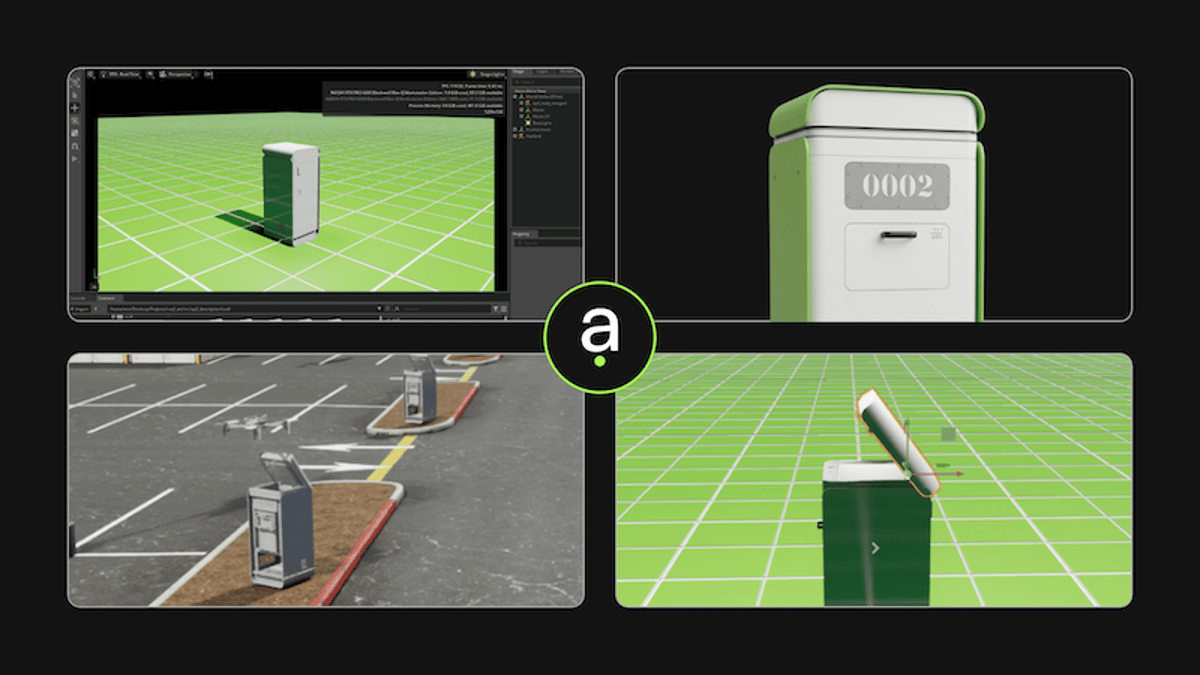
Arrive AI Using Nvidia Isaac Sim and Blackwell GPUs to Develop Autonomous Drone Delivery Network
Companies Mentioned
Why It Matters
By marrying high‑fidelity simulation with powerful GPUs, Arrive AI can shrink development cycles and improve safety, giving it a competitive edge in the rapidly expanding autonomous delivery market.
Key Takeaways
- •Arrive AI adopts Nvidia Isaac Sim for realistic AI training
- •Blackwell GPUs provide high VRAM and ray‑tracing for large models
- •Simulation cuts manual data collection, speeding drone delivery development
- •Continuous learning pipeline accelerates real‑world performance improvements
- •Strategy targets logistics, healthcare, and enterprise automation markets
Pulse Analysis
Nvidia Isaac Sim is reshaping how autonomous robotics firms generate training data. By recreating gravity, friction, collisions and photorealistic lighting in a virtual world, the platform produces exact ground‑truth labels that would otherwise require labor‑intensive field collection. This simulation‑first approach not only slashes costs but also enables rapid iteration on perception algorithms, a critical advantage for drone delivery where environmental variability is high. Companies that adopt such tools can move from prototype to production in months rather than years.
The computational backbone of Arrive AI’s new pipeline rests on Nvidia’s Blackwell architecture. These GPUs combine massive VRAM capacities with dedicated ray‑tracing cores, allowing developers to train models that span billions to trillions of parameters while rendering realistic scenes in real time. Energy‑efficient performance means continuous workloads can run 24/7 without prohibitive power bills, supporting parallel simulation runs that feed a steady stream of fresh data into the learning loop. This hardware advantage translates directly into higher‑resolution perception, more robust navigation, and the ability to scale fleets quickly.
Beyond the technology, the integration of simulation, AI, and high‑performance computing signals a strategic shift in logistics and beyond. A continuous learning pipeline lets Arrive AI’s drones adapt to novel obstacles—like unexpected weather or new urban layouts—without waiting for physical test flights. The resulting speed and safety gains are poised to accelerate adoption in sectors such as healthcare delivery and enterprise supply chains, where reliability is paramount. As competitors scramble to match this capability, the market is likely to see a wave of simulation‑driven autonomous solutions, redefining how goods move in the coming decade.
Arrive AI using Nvidia Isaac Sim and Blackwell GPUs to develop autonomous drone delivery network
Comments
Want to join the conversation?
Loading comments...