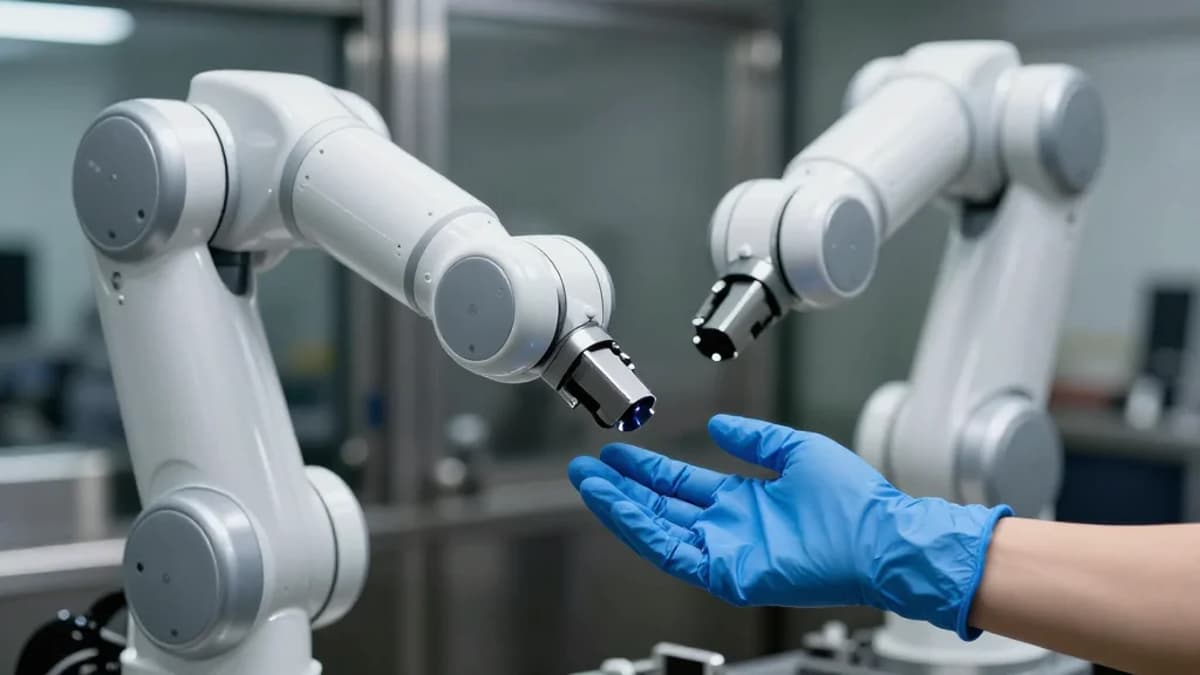
Brain-Like Chips and LIDAR Sensors May Enable Safer Human-Robot Teamwork
•March 2, 2026
0
Why It Matters
The breakthrough reduces safety barriers and operational costs, accelerating adoption of collaborative robots across manufacturing and beyond.
Key Takeaways
- •LIDAR + neuromorphic chips enable millisecond response
- •Integrated AI processing reduces data bandwidth and power
- •MEMS mirrors use AlScN for efficient 3D imaging
- •Platform supports custom safety applications for factories
- •Technology may power drones and agricultural sensor systems
Pulse Analysis
Collaborative robots, or cobots, have moved from isolated cells to shared factory floors, but safety remains a bottleneck. Traditional vision systems rely on cameras and external processors, introducing latency that can jeopardize human workers when robots operate at high speed or handle heavy loads. LIDAR technology offers precise, real‑time 3‑D mapping, yet the sheer volume of point‑cloud data strains conventional CPUs. By embedding AI and neuromorphic chips directly into the sensor, manufacturers can achieve sub‑millisecond perception, a critical step toward truly risk‑free human‑robot teamwork.
NeurOSmart combines a MEMS‑based LIDAR scanner with AlScN‑coated mirrors that deliver high‑resolution depth images while consuming minimal power. The sensor’s front‑end runs AI algorithms that filter and prioritize regions of interest before the data reaches the neuromorphic accelerator, a wafer‑scale matrix of “thinking cells” that mimic neuronal spikes. This architecture collapses the traditional compute‑pipeline into a single chip stack, cutting data transfer overhead and reducing energy use by orders of magnitude compared with GPU‑centric solutions. The result is a response time measured in a few milliseconds, enough to halt a heavy‑duty arm before contact.
The platform’s modular design lets OEMs tailor safety functions to specific production lines, and its low‑power footprint opens doors for mobile robots, agricultural drones, and remote monitoring stations. As manufacturers chase higher throughput and tighter labor shortages, the ability to deploy cobots without extensive fencing or safety cages can translate into significant cost savings. Industry analysts predict that neuromorphic processors will capture a growing share of the AI‑edge market, and Fraunhofer’s early lead positions Europe to compete with US and Asian chip makers. NeurOSmart therefore signals a shift toward energy‑efficient, real‑time intelligence on the factory floor.
Brain-like chips and LIDAR sensors may enable safer human-robot teamwork
0
Comments
Want to join the conversation?
Loading comments...