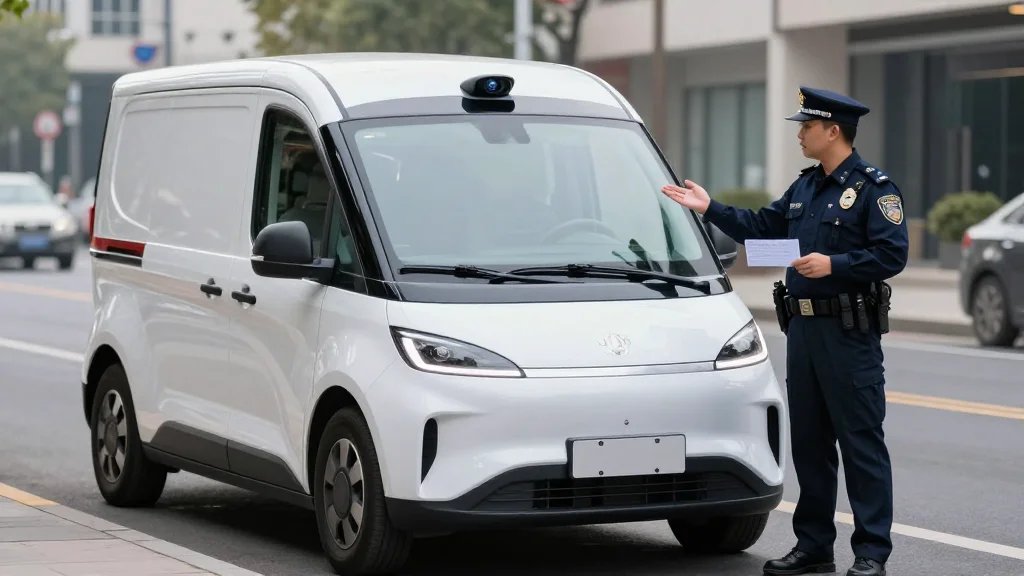
California Empowers Police to Ticket Driverless Cars Starting July 1

Companies Mentioned
Why It Matters
The ability to ticket autonomous vehicles removes a longstanding loophole that left municipalities unable to enforce traffic laws on driverless fleets, directly affecting public safety and accountability. By holding owners liable, California forces manufacturers to prioritize compliance and rapid remediation, which could accelerate the maturation of autonomous‑driving software. The expanded permissions for heavy autonomous trucks and midibuses also signal the state’s intent to become a testing ground for larger‑scale commercial AV use, potentially reshaping freight and public‑transport logistics on the West Coast. Beyond California, the rule sets a de‑facto national standard. Other states watching the rollout may adopt similar enforcement mechanisms, creating a more uniform regulatory environment that could lower legal uncertainty for manufacturers and investors. The policy’s emphasis on emergency‑response capabilities and geofencing also introduces new technical requirements that could drive innovation in vehicle‑to‑infrastructure communication, a critical component for broader AV integration.
Key Takeaways
- •Effective July 1, California police can issue a notice of non‑compliance to autonomous vehicles that break traffic laws.
- •Vehicle owners will be held financially responsible for any tickets issued to driverless cars.
- •New mileage thresholds: 50,000 miles with a safety driver and 50,000 driverless miles for passenger‑car permits; 500,000 miles each for commercial permits.
- •State now permits autonomous trucks of ~4.5 tonnes GVW and midibuses up to 6.35 tonnes.
- •Failure to remediate violations can lead to suspension or revocation of a manufacturer’s operating permit.
Pulse Analysis
California’s decision to empower law‑enforcement with ticketing authority marks a pragmatic shift from the industry‑first approach that previously left AV operators in a regulatory vacuum. By attaching monetary liability to the vehicle owner, the state forces manufacturers to treat software glitches and edge‑case failures as business risks, likely accelerating the deployment of more robust safety‑validation pipelines. This mirrors the evolution seen in traditional automotive safety recalls, where financial exposure drives quicker fixes.
The mileage requirements, especially the ten‑fold increase for commercial vehicles, reflect a cautious stance toward scaling driverless freight. While Texas has already opened its highways to heavy AV trucks, California’s entry could create a bi‑coastal corridor for autonomous logistics, prompting shippers to re‑evaluate routing strategies. The emergency‑response clause—30‑second response time and two‑minute geofence clearance—introduces a real‑time performance metric that could become a benchmark for future AV standards worldwide.
From an investment perspective, the rule reduces political risk for venture capital and corporate backers of AV firms operating in California. The clarity around enforcement means that revenue projections for robotaxi fleets can now factor in potential fines and compliance costs, improving financial modeling accuracy. However, the added compliance burden may favor larger players with deep engineering resources, potentially widening the gap between incumbents like Waymo and smaller startups. In the longer term, if California’s model proves effective, other high‑traffic states may adopt similar frameworks, nudging the entire U.S. market toward a more unified, safety‑centric regulatory regime.
California Empowers Police to Ticket Driverless Cars Starting July 1
Comments
Want to join the conversation?
Loading comments...