EXPO NEWS: Beamr Explains What ML-Safe Compression Requires Across the AV Pipeline
Companies Mentioned
Why It Matters
Ensuring compression does not erode model fidelity is critical for scaling petabyte‑level data while meeting development timelines in autonomous‑vehicle programs. A proven, industry‑wide validation framework will accelerate adoption of efficient storage practices without compromising safety‑critical AI performance.
Key Takeaways
- •Beamr's CABR cuts video size up to 50% while preserving ML accuracy
- •No shared industry framework exists for validating ML‑safe video compression
- •Validation shows less than 2% mAP drop across object detection models
- •Compression integrates via standard codecs, requiring no new hardware
- •Framework supports real‑world and synthetic data, enabling petabyte‑scale pipelines
Pulse Analysis
The autonomous‑vehicle sector now faces a data tsunami: fleets generate petabytes of raw footage, and synthetic datasets from foundation models add even more volume. Traditional storage and bandwidth constraints are becoming bottlenecks, yet most teams lack a rigorous way to verify that compression preserves the nuanced features AI models rely on, such as object boundaries and scene geometry. This gap has forced many developers to either accept unverified risk or revert to larger, less efficient formats, slowing innovation cycles.
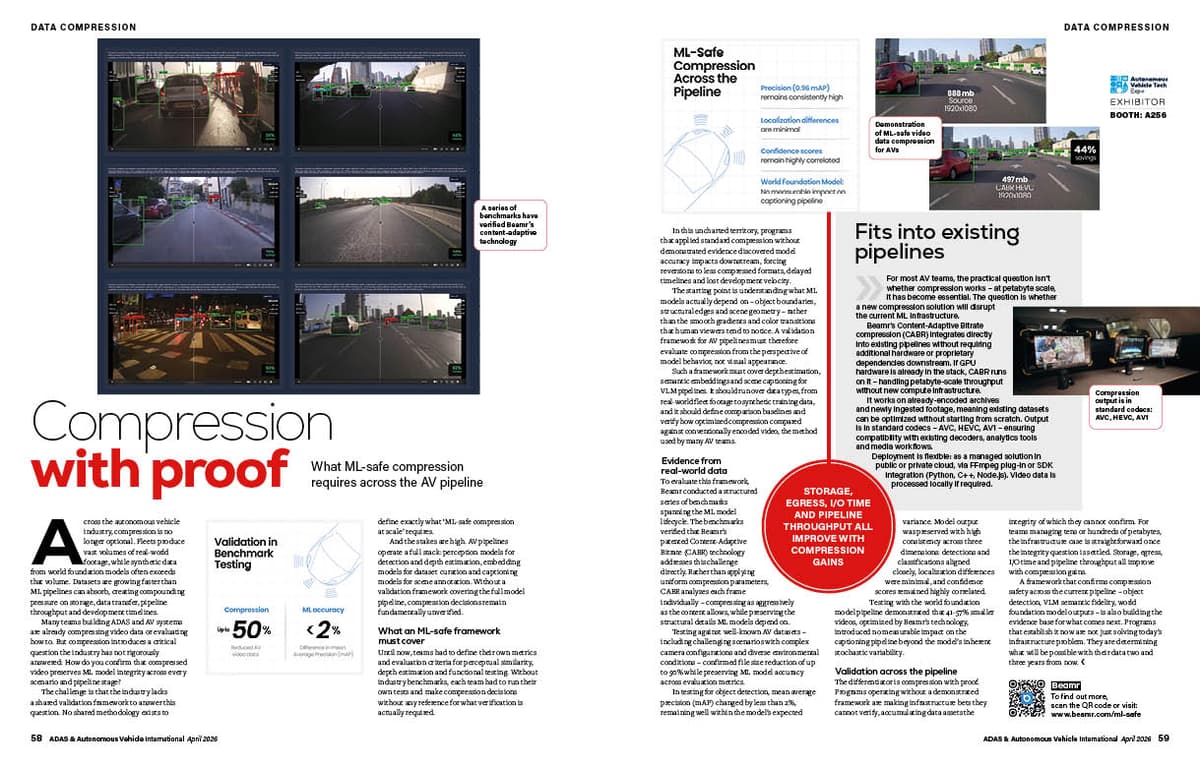
Beamr’s Content‑Adaptive Bitrate (CABR) technology tackles the problem by analyzing each frame and applying variable compression levels that respect the structural cues essential for machine learning. In benchmark tests on industry‑standard AV datasets, CABR achieved up to 50% file‑size reduction while keeping mean average precision within a 2% margin and maintaining high correlation in confidence scores for detection and captioning tasks. The approach works with standard codecs—AVC, HEVC, AV1—so it plugs directly into existing pipelines via FFmpeg, SDKs, or cloud‑managed services, eliminating the need for new hardware investments.
The broader implication is a shift from ad‑hoc compression practices to a data‑centric, validated workflow that can be standardized across the industry. By providing a reproducible framework, Beamr enables OEMs and Tier‑1 suppliers to confidently compress massive datasets, freeing storage, reducing egress costs, and accelerating model training. As autonomous systems become more data‑hungry, such ML‑safe compression standards will likely become a prerequisite for regulatory compliance and competitive advantage, shaping the next wave of AV development.
EXPO NEWS: Beamr explains what ML-safe compression requires across the AV pipeline
Comments
Want to join the conversation?
Loading comments...