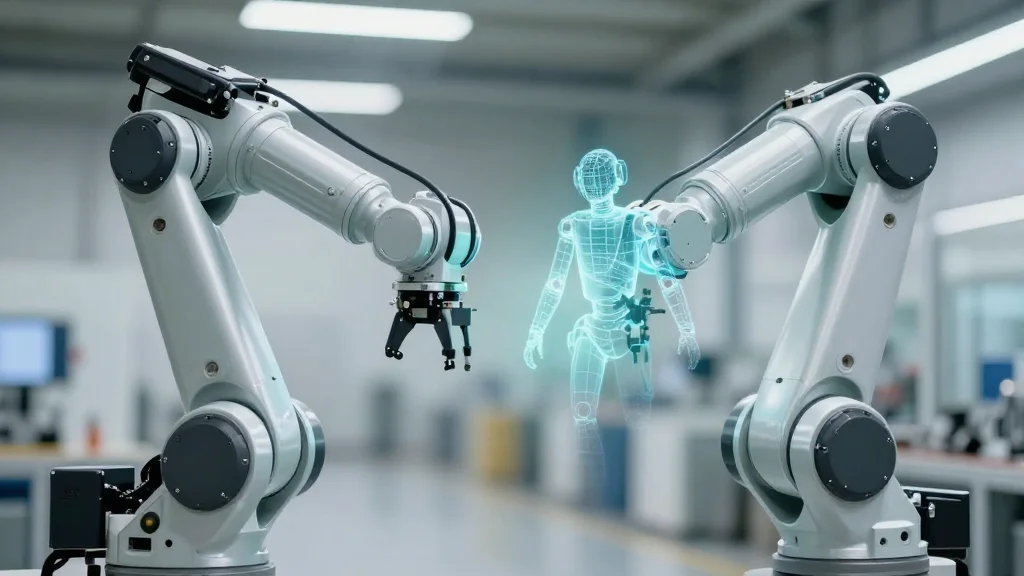
Fanuc Deepens Nvidia Tie‑Up to Boost AI Robot Simulation and Digital Twins

Companies Mentioned
Why It Matters
The Fanuc‑Nvidia integration could reshape how manufacturers prototype and commission robotic cells. By delivering near‑identical digital twins, factories can cut commissioning time by weeks, reduce material waste, and accelerate the adoption of AI‑based robot learning. This shift also pressures competitors to offer comparable simulation fidelity, potentially sparking a wave of software‑centric innovation across the industrial automation sector. For the broader autonomy ecosystem, the partnership illustrates a growing convergence of traditional robotics firms with AI‑hardware leaders. As more manufacturers seek to embed learning algorithms directly into production lines, the demand for high‑performance, physics‑accurate simulation environments will rise, creating new revenue streams for both robot OEMs and GPU providers.
Key Takeaways
- •Fanuc and Nvidia announced tighter integration of RoboGuide with Isaac Sim, enabling real‑time digital twins
- •Two integration modes: Isaac‑front with RoboGuide back‑end, and RoboGuide‑front with Nvidia PhysX physics engine
- •Supports reinforcement learning, imitation learning, and flexible‑part handling simulations
- •Aims to reduce robot commissioning time and eliminate costly physical trial‑and‑error
- •No financial terms disclosed; rollout slated for software updates and field trials later in 2026
Pulse Analysis
Fanuc’s move to embed Nvidia’s Isaac Sim directly into its RoboGuide workflow signals a strategic pivot from hardware‑centric differentiation to software‑driven value creation. Historically, Fanuc has relied on its reputation for rugged, high‑precision industrial robots; however, the pace of AI adoption in manufacturing is forcing OEMs to offer end‑to‑end development tools that bridge the gap between algorithmic research and shop‑floor execution. By leveraging Nvidia’s GPU‑accelerated physics and learning frameworks, Fanuc can now provide customers with a sandbox that mirrors real‑world dynamics at a fraction of the cost.
The dual‑mode architecture is particularly clever. It lets integrators choose the simulation focus that aligns with their project timeline—either rapid prototyping with real‑time control fidelity or deep physics‑based validation for complex bin‑picking scenarios. This flexibility could make Fanuc’s platform the de‑facto standard for AI‑enabled robot commissioning, pressuring rivals like ABB and KUKA to accelerate similar partnerships or develop in‑house equivalents. Moreover, the partnership taps into Nvidia’s growing ecosystem of AI developers, potentially expanding the pool of third‑party solutions that can plug into Fanuc’s robots.
Looking ahead, the real test will be adoption rates among midsize manufacturers, who have traditionally been priced out of high‑end simulation tools. If Fanuc can bundle the enhanced software with competitive licensing, it may unlock a new segment of the market that is eager to experiment with AI‑driven automation but lacks the resources for extensive physical trials. Success here would not only boost Fanuc’s software revenue but also reinforce Nvidia’s position as the go‑to GPU provider for industrial AI workloads, creating a virtuous cycle of hardware‑software co‑development in the autonomy space.
Fanuc Deepens Nvidia Tie‑Up to Boost AI Robot Simulation and Digital Twins
Comments
Want to join the conversation?
Loading comments...