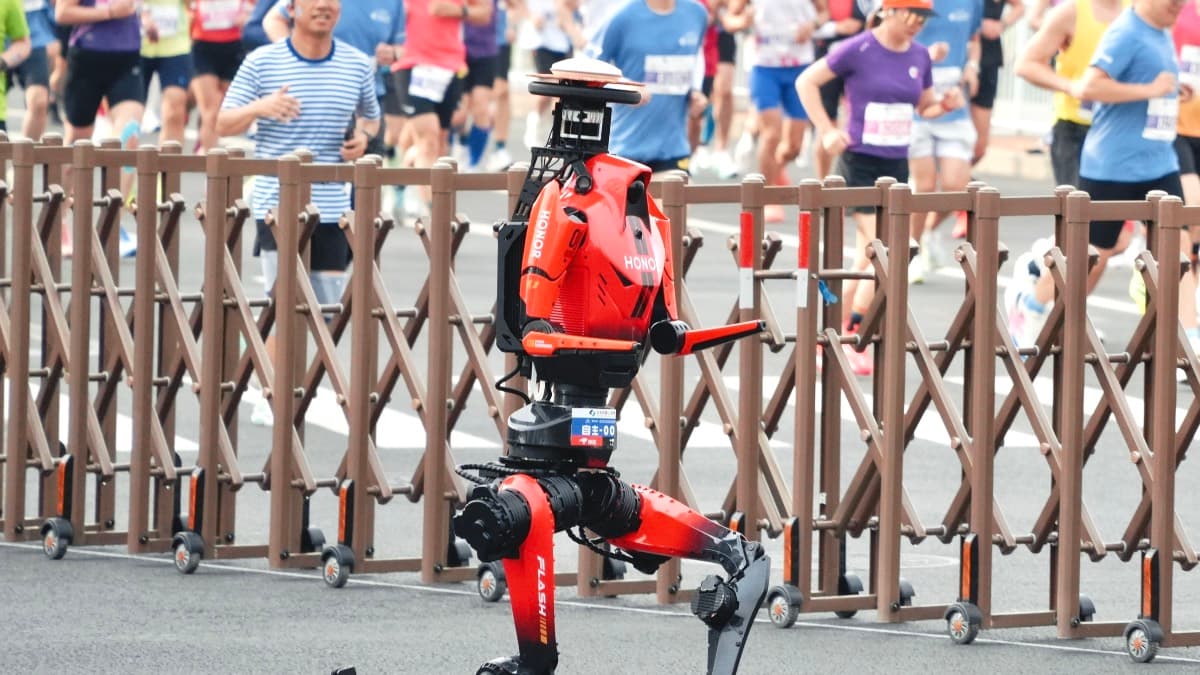
Human Half-Marathon World Record Zapped by Humanoid Robot at the 2026 Beijing E-Town Half Marathon
Why It Matters
Lightning’s sub‑hour half‑marathon time proves autonomous robotics can outpace elite humans on pavement, signaling a shift in competitive sports, technology transfer, and future commercial applications of high‑speed e‑running systems.
Key Takeaways
- •Lightning finished half marathon in 50:26, shattering human record
- •Honor built robot in just one year, using consumer electronics tech
- •300 robots and 12,000 runners competed on parallel courses
- •Autonomous LiDAR navigation replaced remote control, boosting speed 100 minutes
- •Robots dominate pavement races; trail events still favor humans
Pulse Analysis
The 2026 Beijing E‑Town Half Marathon marked a watershed moment for robotics when the humanoid unit dubbed Lightning crossed the 13.1‑mile course in 50 minutes and 26 seconds. That time not only eclipsed the current human half‑marathon world record of 57:20 set by Uganda’s Jacob Kiplimo, but it also outpaced the previous robot best by more than 100 minutes. The event drew over 12,000 runners and roughly 300 robots, all racing on side‑by‑side tracks, turning a traditional endurance test into a live showcase of machine speed.
Lightning’s advantage stems from Honor’s rapid integration of consumer‑electronics components into a dedicated humanoid platform. The robot relies on a LiDAR‑based perception suite—borrowed from autonomous‑vehicle technology—to map the pavement in real time, eliminating the need for a human operator that constrained the 2025 field. Built in just a year, the machine’s lightweight frame, stripped of a head, eyes, and hands, maximizes power‑to‑weight efficiency, allowing a 3:50‑minute‑per‑mile pace. The leap illustrates how cross‑industry technology transfer can compress development cycles dramatically.
The implications extend beyond novelty. As autonomous runners achieve sub‑hour half‑marathon times, manufacturers may explore commercial e‑running gear, exoskeletons, or even robot‑assisted training tools for elite athletes. Yet the performance gap remains limited to smooth, paved surfaces; rugged trail races such as the UTMB still favor human physiology. Stakeholders in sports governing bodies, insurance, and urban planning will need to address safety standards, fairness rules, and potential crowd‑control challenges as robot participation becomes a regular feature of mass‑participation events.
Human Half-Marathon World Record Zapped by Humanoid Robot at the 2026 Beijing E-Town Half Marathon
Comments
Want to join the conversation?
Loading comments...