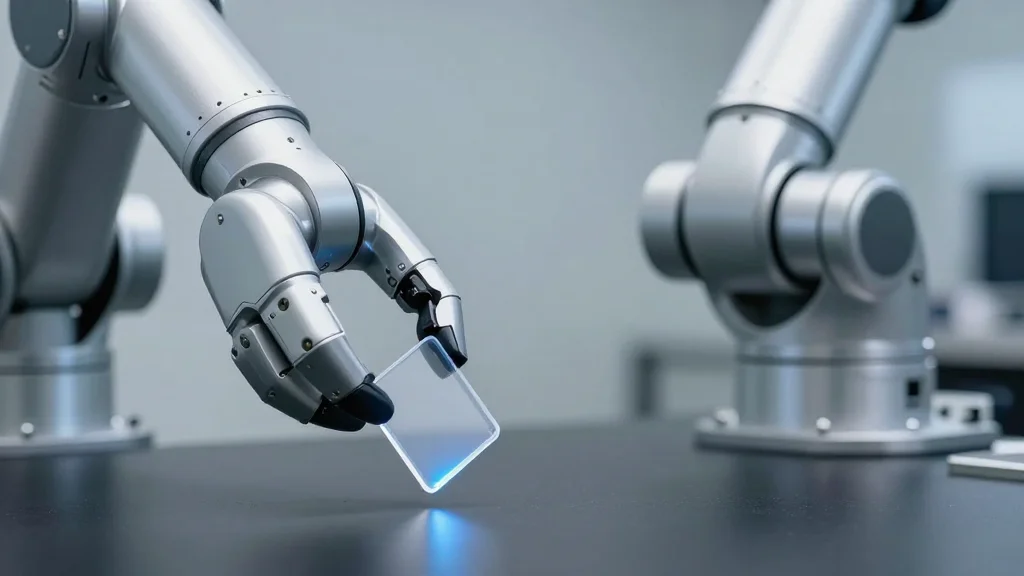
Industrial Robot Market Rebounds as AI Drives New Factory Demand
Companies Mentioned
Why It Matters
AI‑enabled automation is reshaping high‑mix, high‑value manufacturing, accelerating capital spending and lowering integration barriers, which will boost productivity and reshape supply chains across Asia and beyond.
Key Takeaways
- •2025 robot shipments up 5.1%, revenue up 0.8%.
- •AI boosts demand in semiconductor and data‑center manufacturing.
- •Articulated, SCARA, and mobile cobots dominate wafer‑handling segment.
- •Fanuc demoed AI‑driven cable‑sorting and precision screw‑tightening.
- •Low‑code AI software eases robot integration, reducing complexity.
Pulse Analysis
The resurgence of industrial robots in 2025 reflects a broader shift toward AI‑driven manufacturing. While overall revenue growth was modest, the 5.1% rise in shipments signals renewed confidence among OEMs that automation can keep pace with surging demand for AI chips and advanced electronics. Analysts at Interact Analysis highlight that the market’s momentum is anchored not just in hardware volume but in the emergence of software platforms that simplify robot programming, making automation accessible to firms without deep robotics expertise.
Semiconductor production is emerging as the fastest‑growing niche for robot adoption. Regions such as Taiwan, mainland China and South Korea are investing heavily in articulated, SCARA and mobile collaborative robots to handle delicate wafer‑handling tasks. The sector’s projected 7.8% compound annual growth rate through 2030 underscores how critical precision automation has become for meeting the escalating output of AI‑centric chips. Companies like Fanuc and Universal Robots are tailoring solutions to these high‑precision environments, reinforcing their market leadership.
Beyond hardware, AI‑powered software is eroding the traditional barriers to robot integration. Low‑code and no‑code interfaces now allow operators to command robots with natural language, while advanced machine‑vision reduces the need for extensive sensor suites. This democratization of robot programming is lowering the cost of entry and accelerating deployment cycles, a trend that could broaden automation beyond large manufacturers to midsize firms seeking to stay competitive in a rapidly digitising supply chain.
Industrial robot market rebounds as AI drives new factory demand
Comments
Want to join the conversation?
Loading comments...