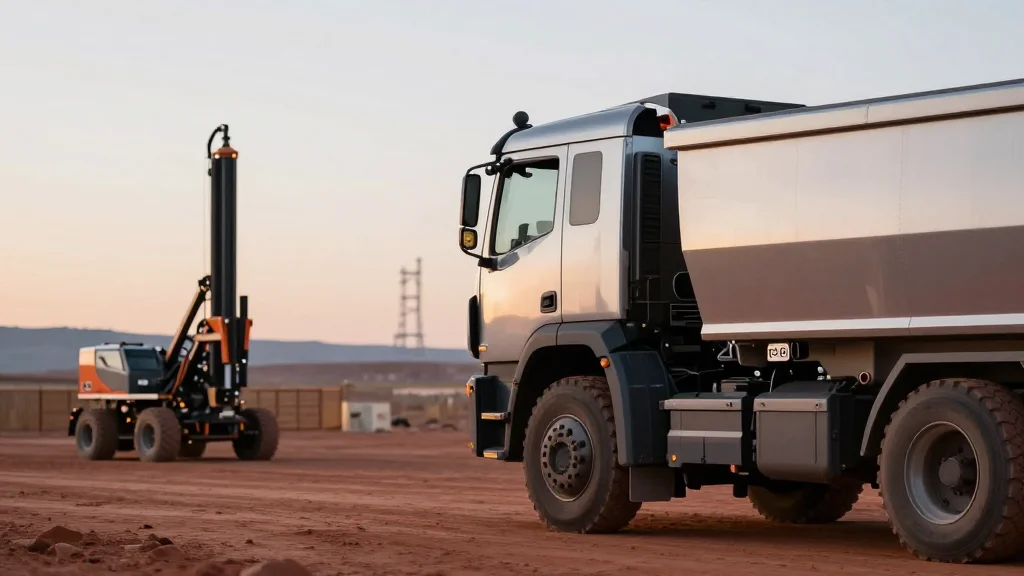
Mariana Minerals Restarts Utah Mine as World’s First Fully Autonomous Mine and Refinery

Companies Mentioned

Why It Matters
The launch of a fully autonomous mine and refinery demonstrates that AI can move beyond isolated tasks to orchestrate an entire minerals value chain. By reducing reliance on human operators, Mariana aims to lower labor costs, improve safety and accelerate project timelines—factors that could reshape investment decisions in the capital‑intensive mining sector. Moreover, the U.S. copper deficit has become a strategic concern for manufacturers and the defense industry; a domestic source that can scale quickly and sustainably could lessen dependence on imports and bolster supply‑chain resilience. If Mariana’s integrated platform proves economically viable, it could trigger a wave of software‑first mining ventures that prioritize data and automation over traditional equipment‑centric models. This shift may also pressure regulators and labor groups to reconsider safety standards and workforce training for a future where human oversight is largely remote.
Key Takeaways
- •Mariana Minerals restarted Copper One on April 27, 2026, creating the world’s first fully autonomous mine and refinery.
- •The site integrates Pronto’s Autonomous Haulage System, Sandvik’s AutoMine drilling and Boston Dynamics’ Spot robots under a single AI stack.
- •Target output is 50,000 metric tons of high‑purity copper cathode per year by 2030.
- •CapitalProjectOS aims to cut project schedule overruns by up to 40% and reduce capital costs, though exact figures were not disclosed.
- •U.S. copper deficit could tighten by 30% by 2030; Copper One could supply roughly 5% of projected domestic demand.
Pulse Analysis
Mariana’s approach flips the traditional mining playbook on its head. Rather than retrofitting legacy equipment with incremental automation, the company built a software‑first architecture that treats data as the primary asset. This mirrors trends in other heavy‑industry sectors where digital twins and predictive analytics have begun to dominate. By unifying haulage, drilling and refining under one operating system, Mariana reduces the latency between sensor input and process adjustment, a competitive edge that could translate into higher recovery rates and lower energy intensity.
Historically, autonomous haulage has been the low‑hanging fruit for miners, but extending autonomy to drilling and refining has been hampered by the complexity of process control and the need for real‑time decision making. Mariana’s PlantOS, which automatically tweaks reagent dosing based on continuous sensor feeds, suggests that machine‑learning models have matured enough to handle the nuanced chemistry of copper electrowinning. If the system can maintain product purity while cutting reagent waste, the cost savings could be substantial, especially given the volatile price of copper.
The broader market impact will hinge on scalability. Copper One’s 10,000‑acre footprint is modest compared with mega‑projects in Chile or Australia, but the technology stack is designed to be portable. Should Mariana demonstrate consistent uptime and cost advantages, larger operators may license or acquire the platform, accelerating industry‑wide adoption. Investors will be watching Mariana’s Q3 2026 performance data closely; a strong showing could unlock further capital for replication at other sites, while a stumble might reinforce skepticism about full‑stack autonomy in mining.
Mariana Minerals Restarts Utah Mine as World’s First Fully Autonomous Mine and Refinery
Comments
Want to join the conversation?
Loading comments...