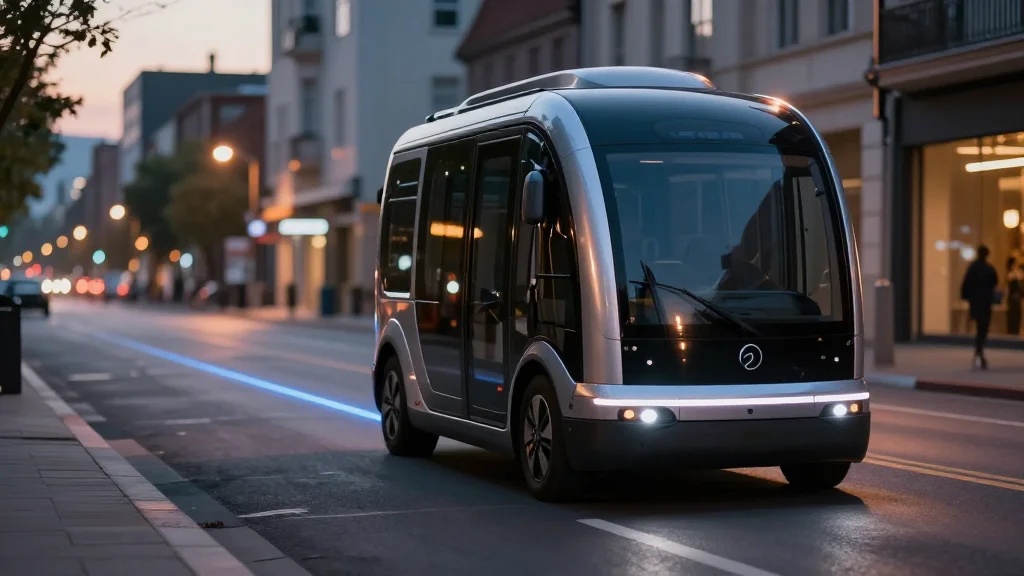
May Mobility Launches Fifth‑gen AV Architecture that Reasons Through the Physical World

Companies Mentioned
Why It Matters
The introduction of a reasoning‑centric AV stack could shift industry benchmarks for safety and scalability. By reducing reliance on massive data sets, May Mobility’s architecture may lower barriers for smaller operators and speed up geographic expansion, potentially reshaping competitive dynamics among legacy automakers and tech‑focused startups. Moreover, the transparent multi‑policy framework aligns with emerging regulatory expectations for explainable AI in transportation, positioning the firm favorably in upcoming policy discussions. For investors and city planners, the technology signals a move toward more adaptable driverless services that can handle unpredictable urban environments without prohibitive infrastructure upgrades. If the system delivers on its performance claims, it could accelerate the timeline for widespread, cost‑effective autonomous mobility solutions.
Key Takeaways
- •May Mobility launches fifth‑generation AV system blending deep learning with a predictive world model
- •System runs hundreds of 200 ms simulations up to 10 seconds ahead, selecting safest policy in real time
- •Company reports over 525,000 commercial rides and 1.1 million autonomous miles across three U.S. states
- •CEO Dr. Edwin Olson emphasizes human‑like reasoning as a path to scalable safety
- •Field trials slated for two new cities in 2026, aiming for one million autonomous miles by mid‑2027
Pulse Analysis
May Mobility’s new architecture arrives at a moment when the autonomous vehicle sector is grappling with diminishing returns from pure data‑driven models. Early AV pilots demonstrated that sheer mileage does not guarantee robustness; edge‑case handling remains the Achilles' heel. By embedding a physics‑based world model that can generate rapid, multi‑policy simulations, May Mobility sidesteps the need for billions of miles of training data, a cost factor that has limited many competitors.
Historically, the industry has oscillated between modular stacks—where perception, planning, and control are isolated—and end‑to‑end neural networks that promise simplicity but sacrifice interpretability. The hybrid approach May Mobility champions could become a middle ground, offering the adaptability of learning‑based perception while retaining the auditability of rule‑based reasoning. This could appease regulators who demand explainable decision pathways, especially as municipalities begin to codify safety standards for driverless fleets.
Looking forward, the real test will be how the architecture performs in dense, unstructured environments beyond the company’s current three‑state footprint. If field trials in new metros confirm smoother rides and lower compute overhead, the model may set a new efficiency benchmark, prompting rivals to adopt similar reasoning layers. Investors should watch for partnership announcements that could accelerate rollout, as well as any regulatory feedback that might validate the system’s safety case. The next 12‑month window will likely determine whether May Mobility’s reasoning engine becomes a differentiator or another incremental upgrade in a crowded market.
May Mobility launches fifth‑gen AV architecture that reasons through the physical world
Comments
Want to join the conversation?
Loading comments...