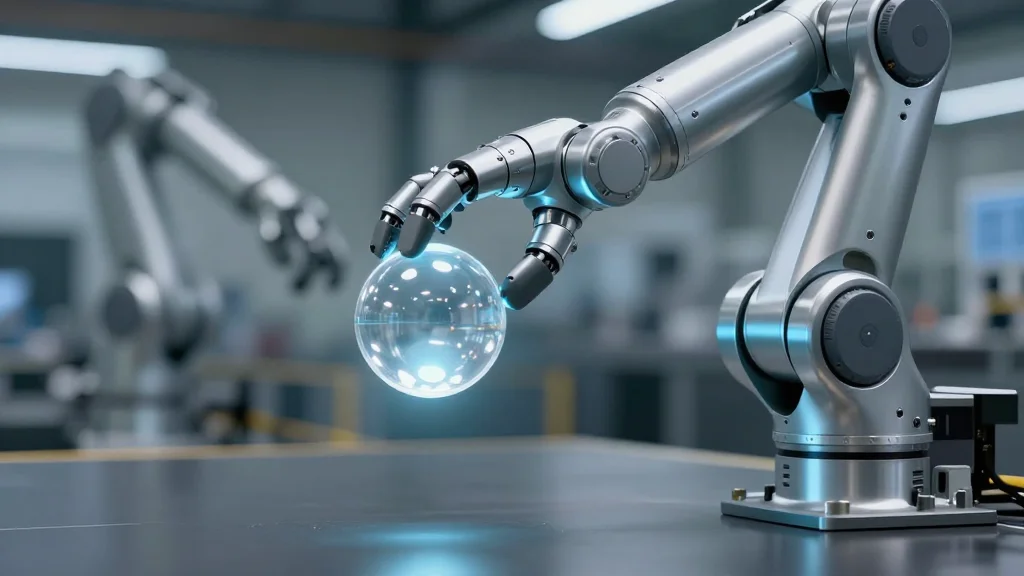
Mind Robotics Secures $400 Million to Deploy AI‑Powered Factory Robots

Companies Mentioned

Why It Matters
The infusion of $400 million into Mind Robotics highlights a pivotal shift toward data‑driven, adaptable automation in manufacturing. By leveraging real‑world production data from Rivian’s high‑volume plant, the startup aims to solve the long‑standing limitation of industrial robots—rigidity in the face of variability—potentially reshaping labor economics on the factory floor. If successful, AI‑powered manipulators could lower the cost of entry for flexible automation, enabling smaller manufacturers to compete with larger players that have traditionally relied on extensive human labor for complex assembly tasks. Moreover, the round signals that venture capital is betting heavily on the convergence of AI and robotics as a growth engine for the broader industrial sector. As OEMs confront rising labor costs and the need for rapid product cycles, platforms that can learn and adapt in situ may become the new standard, pressuring legacy robot manufacturers to accelerate their AI roadmaps or risk obsolescence.
Key Takeaways
- •Mind Robotics raised $400 million in a round led by Kleiner Perkins.
- •Total funding now exceeds $1 billion, following a $500 million Series A in March.
- •Rivian CEO RJ Scaringe founded Mind Robotics in 2025 and remains an operating partner.
- •Investors include Meritech Capital, Redpoint Ventures, SV Angel, Accel, Andreessen Horowitz and Bain Capital Ventures.
- •Capital will fund expansion of AI‑driven robots for complex tasks like wiring harnesses and soft‑trim fitting.
Pulse Analysis
Mind Robotics’ latest financing round is more than a cash infusion; it is a bet on the data advantage that comes from embedding AI robots directly in a high‑volume EV factory. Historically, industrial automation has been dominated by deterministic, repeat‑able motions, leaving a gap for tasks that require visual perception and adaptive decision‑making. By turning Rivian’s production line into a living laboratory, Mind Robotics can generate terabytes of manipulation data that rivals cannot easily replicate without similar partnerships. This data moat could translate into faster model iteration cycles, higher robot uptime, and ultimately lower total cost of ownership for manufacturers.
The competitive landscape is heating up. Traditional OEMs such as FANUC, KUKA and ABB are rolling out AI‑enhanced servos and vision systems, but they often retrofit legacy hardware rather than designing a unified AI‑hardware‑software stack from the ground up. Mind Robotics’ approach—building the platform holistically—could give it a first‑mover edge in sectors where product mix changes daily, such as consumer electronics and specialty automotive components. However, scaling beyond Rivian will require securing similar data pipelines with other manufacturers, a challenge that may test the startup’s ability to negotiate access while protecting proprietary production information.
From an investment perspective, the round reflects a broader trend of capital flowing into AI‑centric robotics, a sub‑segment that has seen a 45% increase in venture funding year‑over‑year according to PitchBook. The presence of deep‑pocketed VCs and strategic investors suggests confidence that autonomous manufacturing will be a key lever for cost reduction and supply‑chain resilience. If Mind Robotics can demonstrate measurable productivity gains—say, a 20% reduction in labor hours for complex assemblies—its valuation could surge, prompting a wave of M&A activity as larger automation firms scramble to acquire data‑rich AI platforms. The next 12‑18 months will be a litmus test for whether data‑first robot startups can convert pilot successes into scalable commercial deployments.
Mind Robotics Secures $400 Million to Deploy AI‑Powered Factory Robots
Comments
Want to join the conversation?
Loading comments...