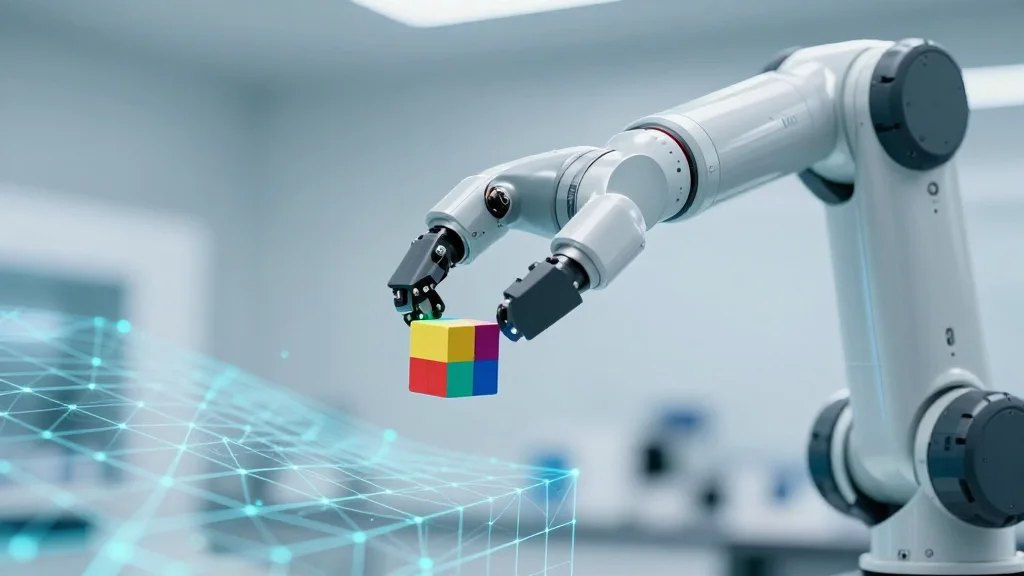
New Framework Helps Robots Turn Complex Language Into Precise 3D Actions
Why It Matters
RAM gives robots true spatial intelligence, accelerating deployment of adaptable service and industrial automation that can follow natural language instructions without costly retraining.
Key Takeaways
- •RAM merges vision-language models with object‑centric 3D maps.
- •Enables zero‑shot execution of complex spatial language commands.
- •Improves robot adaptability via subgoal decomposition and replanning.
- •Generalizes to unseen objects in CO3D dataset without retraining.
- •Paves way for household and industrial robots to follow natural instructions.
Pulse Analysis
The gap between human language and robotic action has long limited the utility of service robots. While vision‑language models excel at interpreting simple cues, they lack the spatial reasoning needed for nuanced tasks such as precise object placement or orientation. Retrieval‑Augmented Manipulation (RAM) addresses this shortfall by feeding a VLM an explicit, object‑centric 3D representation of the scene, effectively grounding abstract commands in concrete geometry. This hybrid approach transforms high‑level instructions into a series of physically plausible subgoals, enabling robots to act with a level of spatial awareness previously reserved for heavily trained, task‑specific systems.
Technically, RAM operates in three stages: visual perception, semantic grounding, and action planning. Cameras capture a 2D view, which the system converts into a 3D map that identifies object locations, shapes, and orientations. The VLM then receives this spatial context as augmented input, allowing it to parse complex language into a hierarchy of sub‑tasks. In zero‑shot experiments, a robot equipped with RAM completed multi‑step manipulations—such as stacking irregular items or navigating around obstacles—while dynamically replanning when unexpected collisions occurred. Benchmarks on the Common Objects in 3D (CO3D) dataset demonstrated robust performance across novel object categories and varying occlusion levels, underscoring the framework’s generalization capability.
The commercial implications are significant. By eliminating the need for extensive task‑specific data collection, RAM lowers the barrier to deploying robots in homes, warehouses, and hospitals where environments are unpredictable and user commands are diverse. Companies can now envision fleets of robots that understand natural language directives and adjust in real time, accelerating the shift toward truly autonomous service automation. As the framework matures and integrates with larger robot platforms, it could become a cornerstone technology for the next generation of adaptable, AI‑driven manipulators.
New framework helps robots turn complex language into precise 3D actions
Comments
Want to join the conversation?
Loading comments...